Skip to content
Commercial roof maintenance prevents leaks by catching the small problems that cause them before those problems grow into damage that soaks insulation, ruins inventory, and forces emergency repairs. A crack in a seam, a blocked drain, a flashing joint pulling away from an HVAC curb — none of those things looks serious from the ground. But left alone through one Georgia summer with its afternoon thunderstorms and sustained heat, any of them can become an active leak inside your building. According to the National Roofing Contractors Association (NRCA), up to 40 percent of all building-related problems can be traced back to water infiltration through the roof system. This article covers exactly how a commercial maintenance program works, what it catches, what it costs, and why the numbers strongly favor prevention over reaction for every business in the Watkinsville, GA area and around Hiawassee, GA.
How Does Commercial Roof Maintenance Prevent Leaks?
Commercial roof maintenance prevents leaks by finding and fixing the vulnerabilities in a roofing system before water has a path to enter the building. The key word is before. By the time a leak is visible as a stain on a ceiling tile or a drip onto a work surface, the water has already traveled through the membrane, saturated the insulation, and potentially damaged the roof deck. The leak you see is never the beginning of the problem. It is the end stage of a process that started weeks or months earlier with something small that was never caught.
A structured maintenance program intercepts that process at every step. Inspections find seam separations before they open fully. Drain cleanings prevent water from ponding long enough to degrade the membrane. Sealant replacement around penetrations keeps pipe boots and HVAC curbs watertight. Flashing re-anchoring prevents the perimeter detail failures that, according to industry data from RoofConnect, account for 36 percent of all building envelope litigation. All of those tasks are inexpensive and fast when done on a schedule. All of them become major repair events when deferred until they fail.
Research from a 15-year study by Firestone Building Products and ProLogis found that proactively maintained commercial roofing systems averaged a lifespan of 21 years, compared to just 13 years for roofs managed reactively. That is eight additional years of service from the same roof. For businesses in Watkinsville and surrounding Oconee County, where a commercial roof replacement can run $10 to $20 per square foot and often totals hundreds of thousands of dollars for a mid-size building, those eight years represent significant capital preserved.
What Are the Most Common Causes of Commercial Roof Leaks?
The most common causes of commercial roof leaks are failed flashing, clogged or damaged drains, membrane punctures or seam failures, deteriorated sealants around penetrations, and ponding water. Each of these failure modes is detectable long before it produces a leak, which is exactly what makes regular maintenance so effective.
Flashing Failures
Flashing connects the roofing membrane to vertical surfaces like parapet walls, HVAC curbs, skylights, and pipe penetrations. It is the transition point where the flat membrane meets anything that sticks up through it or borders it. Flashing is the most leak-prone part of any commercial roofing system because it experiences constant movement from thermal expansion and contraction, wind, and settling. Over time, the metal or membrane flashing pulls away from the substrate, creating a gap where water enters directly. Maintenance catches loose or separated flashing before that gap opens wide enough to allow water in.
Drainage Blockages
Standing water is the single greatest enemy of a low-slope commercial roof. Water that cannot drain sits on the membrane and exerts constant pressure. It softens membrane materials, accelerates seam deterioration, promotes algae and biological growth, and adds structural weight. Even a one-inch layer of water over 1,000 square feet weighs more than five tons. Gutters, internal drains, and scuppers clogged with debris from Georgia’s seasonal leaf fall and storm events are a leading cause of ponding water problems on commercial roofs in the Watkinsville area. Quarterly drain cleaning is one of the simplest and most cost-effective maintenance tasks available.
Penetration Sealant Degradation
Every pipe, conduit, vent, exhaust fan, and HVAC unit that passes through or sits on a commercial roof is a potential leak point. The sealants and boots that waterproof these penetrations are made from materials that degrade with UV exposure and temperature cycling. In Georgia’s heat, caulking and pipe boot materials can become brittle and crack within three to five years. Maintenance includes inspecting every penetration and replacing any sealant that has begun to check, crack, or separate from the surrounding membrane.
Membrane Punctures
Low-slope commercial membranes like TPO, EPDM, and modified bitumen are tough but not indestructible. Foot traffic from HVAC service technicians, falling tree debris, hail, and thermal stress all create punctures and micro-tears that can go unnoticed for months before a leak develops. Inspections with close-up walking of the membrane surface catch these punctures when they are still tiny and can be patched in minutes rather than repaired as a large-scale breach.
How Often Should a Commercial Roof Be Inspected?
A commercial roof should be inspected a minimum of twice per year, according to the NRCA. The standard recommendation is once in the spring after winter stress and once in the fall before the wet season. In addition, an inspection should be conducted after any significant storm event, particularly hail, high winds, or severe thunderstorms that are common across Georgia during spring and summer.
For older commercial roofs approaching 10 to 15 years of age, quarterly inspections are a prudent step up from the biannual minimum. As a roof ages, the rate of deterioration accelerates, and the window between a detectable problem and an active failure shortens. According to data cited by industry sources based on NRCA guidelines, approximately 60 percent of roof failures stem from inadequate maintenance. In addition, about 85 percent of premature roof failures can be traced directly to inadequate maintenance and inspections. Both figures point to the same conclusion: inspection frequency is one of the most controllable factors in how long a commercial roof performs.
For commercial properties in Hiawassee, GA and the surrounding Towns County area, where rainfall totals are higher than most of Georgia due to mountain terrain, the case for biannual-plus-storm inspections is even stronger. Higher precipitation puts more cumulative stress on drainage systems, seams, and membrane surfaces every year. Businesses near Hiawassee that operate in the mountain climate should treat storm inspections as routine rather than optional.
Commercial property owners in the Watkinsville area who want documented evidence of their roof’s condition for insurance and warranty purposes can use Drone Zone AI roofing inspections to generate photographic records of the full roof surface, including areas that are difficult to access by foot.
What Does a Commercial Roof Maintenance Program Include?
A commercial roof maintenance program includes scheduled biannual inspections, drain and gutter cleaning, sealant inspection and replacement, flashing re-anchoring and sealing, membrane surface inspection for punctures and seam conditions, and written documentation with photos of all findings and repairs made.
The inspection component evaluates every part of the roofing system: membrane surface condition, seam integrity, flashing at all perimeters and penetrations, drain flow, gutter condition, and the condition of any roof accessories like walkway pads, equipment curbs, and expansion joints. Modern commercial roof inspection programs also use tools like thermal imaging, which detects moisture trapped beneath the surface by identifying temperature differences in the membrane. Wet insulation retains heat differently than dry insulation, and a thermal scan can identify moisture zones that would be invisible to a standard visual inspection.
Drone inspection is another powerful tool that gives contractors a detailed aerial view of the entire roof surface without extensive foot traffic on the membrane. High-resolution drone images catch problems in hard-to-reach areas near parapet walls, at valley intersections, and around clustered rooftop equipment that would be easy to miss on a standard walking inspection.
The documentation component is often the most overlooked but is critically important. Most commercial roof warranties explicitly require documented maintenance records to remain valid. A property owner who needs to make a warranty claim for premature membrane failure but cannot produce maintenance records may find that claim denied. Maintenance logs also support insurance claims after storm events by demonstrating that the roof was in documented good repair prior to the storm.
How Much Does Commercial Roof Maintenance Cost vs. Reactive Repairs?
Commercial roof maintenance costs significantly less than reactive repairs, and the data makes this comparison very clear. According to research from a 15-year study by Firestone Building Products and ProLogis, proactive maintenance averaged 14 cents per square foot annually, compared to 25 cents per square foot for reactive maintenance. That is an 11-cent-per-square-foot annual savings. On a 50,000-square-foot commercial roof, that difference equals $5,500 per year, every year, for the life of the roof.
The comparison becomes even more stark when emergency repairs are factored in. Emergency commercial roof repair labor can run $200 to $300 per hour, plus premium material costs and potential after-hours or weekend charges. Reactive repairs also cost three to five times more than planned maintenance work because by the time a leak is visible, the damage typically extends beyond the breach itself into the insulation, deck, and potentially interior finishes. A small sealant failure that costs $150 to address in a maintenance visit can become a $15,000 to $30,000 repair event if it develops into an active leak before being caught.
Industry data shows that proactive maintenance programs reduce overall roof-related expenses by 30 to 50 percent compared to purely reactive approaches. One real-world example from a school district reported by RoofConnect found that proactive maintenance reduced leak volume by more than 75 percent over a nine-year period and allowed the district to preserve existing roofing systems rather than replacing them prematurely.
For commercial building owners in Watkinsville, GA, these numbers have direct relevance. The average cost of replacing a commercial roof runs $10 to $20 per square foot, which translates quickly to $100,000 or more for a mid-size commercial building. A maintenance program that extends the roof’s useful life by even five to eight years represents a large amount of deferred capital expenditure. Businesses in the Watkinsville area interested in commercial roofing services and maintenance can start with an assessment through commercial roofing in Watkinsville.
Proactive vs. Reactive Commercial Roof Maintenance: A Cost Comparison
| Factor | Proactive Maintenance | Reactive Maintenance |
|---|---|---|
| Annual cost per sq. ft. | $0.14 | $0.25 |
| Average roof lifespan | 21 years | 13 years |
| Emergency repair frequency | Low | High |
| Water damage to interior | Rare | Common |
| Warranty compliance | Maintained | Often voided |
| Insurance claim support | Strong (documented records) | Weak (no records) |
| Overall lifecycle cost reduction | 30 to 50% lower | Baseline |
Sources: Firestone Building Products / ProLogis 15-year study; National Roofing Contractors Association (NRCA); RoofConnect Leak Free Maintenance Program data; industry commercial roofing cost aggregates.
What Are the Warning Signs of a Commercial Roof Leak?
The warning signs of a commercial roof leak are interior ceiling stains or discoloration, a sudden unexplained increase in energy bills, visible moisture or mold near ceiling fixtures or HVAC vents, sagging or soft spots in ceiling tiles, pooling water on the roof surface after rain, and a musty or damp smell in the building even when nothing appears wet.
Interior stains are the most common sign that a property owner notices, but they are a late-stage indicator. The yellow or brown rings that appear on ceiling tiles show up long after moisture has already saturated the insulation above. By that point, the insulation has lost a significant portion of its R-value, forcing the HVAC system to work harder to maintain building temperature. This is why energy bill spikes are often one of the first measurable signs of a developing leak, even before visible water staining appears.
Mold growth near roof penetrations, HVAC ductwork, or ceiling joints is another serious warning sign. Mold requires moisture and an organic food source, both of which a wet commercial roof deck provides in abundance. If mold is visible inside the building, the moisture source has been present long enough for spore colonies to establish. Remediation at that stage involves not just the roofing repair but professional mold treatment of interior materials, which adds significantly to total costs.
On the roof surface itself, warning signs include bubbling or blistering in the membrane, separated or lifted seam tape, cracked or pulling caulk around penetrations, rust staining below metal flashing, and any areas where debris has accumulated and prevented drainage. All of those conditions are easily identified and corrected during a routine inspection. None of them are dramatic on their own. Together, they describe a roof that is developing multiple vulnerabilities simultaneously and needs professional attention.
What Happens to a Commercial Roof If It Is Not Maintained?
A commercial roof that is not maintained will fail significantly earlier than its design lifespan, accumulate water damage that spreads far beyond the roof itself, void any existing manufacturer warranty, and create escalating emergency repair costs that exceed what the full maintenance program would have cost many times over.
The progression is predictable. Debris clogs drains. Water ponds. Ponding water degrades the membrane. Degraded membrane allows moisture into the insulation. Wet insulation loses its thermal performance. Energy costs rise. Eventually, the membrane fails at a seam or penetration point. Water enters the building. By that stage, what began as a $200 drain cleaning has become a $20,000 to $50,000 repair including membrane replacement, insulation replacement, and interior damage remediation.
According to data from the NRCA, neglecting maintenance can effectively cut a commercial roof’s lifespan in half. A 20-year TPO or EPDM system that receives no professional maintenance may fail in 10 to 13 years. On a large commercial building, replacing the roof eight to ten years early represents a cost that dwarfs any maintenance savings the building owner thought they were capturing by deferring inspections.
There is also a liability dimension. Commercial properties with water damage are subject to slip-and-fall liability from interior wet surfaces. Equipment and inventory that is damaged by leaks generates claims and disputes. In Georgia, commercial property owners have a duty to maintain safe premises, and a documented pattern of deferred roof maintenance can complicate that position in any legal dispute arising from property damage or injury. Edge metal failure alone, which regular maintenance directly addresses, accounts for 36 percent of building envelope litigation according to industry data.
Can Commercial Roof Maintenance Extend Roof Life?
Yes, commercial roof maintenance can extend roof life by 30 to 50 percent or more. The data on this is consistent across multiple sources. The NRCA states that properly maintained commercial roofs often significantly outlast neglected systems, even those that are newer. The Firestone and ProLogis study measured an eight-year lifespan extension for maintained roofs versus reactive ones. Industry research consistently finds that regular upkeep can push commercial roofing systems beyond 30 years when the design lifespan is 20 years.
The mechanism is straightforward. Maintenance preserves the integrity of each component in the system: membrane, insulation, flashing, drainage, and sealants. When all of those components perform as designed, the system degrades slowly and evenly rather than failing at its weakest point and allowing damage to cascade through the assembly. A small sealant repair done at year three costs a fraction of replacing wet insulation at year eight because the sealant was never replaced. Each maintenance visit essentially resets the clock on the components that are addressed.
For Watkinsville businesses and commercial properties across Oconee County, this lifespan extension has direct financial value. Deferring a $150,000 commercial roof replacement by eight years, even without any interest or inflation considerations, is $150,000 available for other capital uses. With maintenance costs running a fraction of that amount, the return on investment for a structured program is one of the clearest in commercial facility management.
Property owners who want to evaluate the current condition of their commercial roof and understand how much useful life remains can start with a professional inspection. Commercial roof repair services in Watkinsville include condition assessments that help owners make informed decisions about whether repair, maintenance, or replacement is the right path for their specific system and age.
What Is Included in a Commercial Roof Inspection Checklist?
A commercial roof inspection checklist includes the membrane surface, all seams and overlaps, perimeter flashing and edge metal, all roof penetrations and their sealants, drainage components including internal drains, gutters, scuppers and downspouts, expansion joints, any rooftop equipment curbs, walkway pads, and the interior ceiling and attic space for signs of moisture or staining.
The membrane surface inspection looks for blisters, punctures, torn or lifted areas, UV oxidation, and any debris accumulation that is holding moisture against the surface. The seam inspection is particularly important because seams are the most common failure point in single-ply commercial membranes like TPO and EPDM. A seam that is lifting at the edge or showing signs of delamination is a few rainstorms away from becoming an active leak.
Flashing inspection covers every linear foot of perimeter where the membrane meets a parapet wall, gravel stop, or fascia, as well as every point where the membrane meets a vertical surface rising from the roof deck. Counterflashing condition, sealant condition at all termination bars, and the integrity of through-wall flashing are all part of this review. Penetration inspection covers every pipe, conduit, drain, HVAC unit, and any other item that passes through or sits on the membrane surface. Each is checked for seal integrity, corrosion, and physical damage.
Drain inspection includes running water into interior drains to confirm flow rate and checking for debris blockages at the drain bowl, the drain strainer, and downstream in the drain body itself. Slow-draining or non-flowing drains are corrected on the spot during a maintenance visit. The interior inspection looks at ceiling surfaces nearest to roof penetrations, along exterior walls, and at the highest points of interior spaces for any staining, soft spots, or discoloration that would indicate moisture infiltration has already occurred somewhere in the assembly.
How Does Commercial Roof Maintenance Protect Warranty Coverage?
Commercial roof maintenance protects warranty coverage because most manufacturer warranties for commercial roofing systems explicitly require documented maintenance as a condition of the warranty remaining valid. If a building owner needs to make a warranty claim for premature membrane failure and cannot produce maintenance records, the manufacturer may deny the claim on the grounds that the warranty conditions were not met.
Warranty terms for commercial roofing systems typically specify that the roof must be professionally inspected at least once per year, that all roof penetrations and accessories must be maintained in a watertight condition, that drains must be kept clear, and that any damage observed must be repaired promptly. Some warranties require that maintenance be performed by a contractor certified by the manufacturer, not just any general contractor.
This is not a technicality that manufacturers rarely invoke. It is a standard coverage condition that comes up regularly in warranty claim disputes, particularly on roofs that have aged past the 10-year mark. A building owner who has invested in a premium commercial roofing system with a 20-year NDL (no dollar limit) warranty and then fails to maintain it may find that the warranty that made the investment attractive is no longer available when it is needed most.
Ridgeline Roofing and Exteriors holds GAF certifications that allow commercial property owners to access extended warranty coverage tied to certified installation and maintenance programs. For commercial clients in Watkinsville and the surrounding Oconee County area, working with a GAF-certified contractor ensures that the maintenance documentation produced is consistent with the warranty requirements attached to those commercial roofing systems. More information about commercial roofing and available products is available through commercial roofing services.
Does Commercial Roof Maintenance Affect Energy Costs?
Yes, commercial roof maintenance directly affects energy costs. A properly maintained commercial roof with intact insulation and clean reflective coatings performs significantly better from an energy standpoint than one with compromised insulation or degraded surface reflectivity.
Wet insulation is the main energy efficiency threat. When moisture infiltrates the insulation layer of a commercial roof, whether from an active leak or from vapor condensation that was never caught, the insulation loses its thermal resistance. Wet insulation can lose 40 to 70 percent of its R-value depending on how saturated it becomes. That means the building’s HVAC system has to work significantly harder to maintain interior temperature, and energy bills rise as a result. In Georgia’s hot summers, where commercial HVAC systems are already under heavy load, insulation that is performing at half capacity creates a measurable increase in cooling costs.
According to the U.S. Environmental Protection Agency’s data on cool roofs, maintaining the reflective quality of a white or light-colored commercial membrane through regular cleaning and coating inspections can help reduce air conditioning energy use by up to 15 percent on single-story buildings compared to buildings with dark, degraded membrane surfaces. Maintenance that keeps reflective coatings intact and insulation dry is a direct energy cost management strategy, not just a structural protection measure.
Clean, properly maintained commercial roofing also reduces the strain on HVAC equipment, which extends the service life of that equipment and reduces the frequency of mechanical repairs. The connection between roof condition and HVAC performance is often underestimated by facility managers who treat roofing and mechanical systems as entirely separate budget items. In practice, they are closely linked through the thermal performance of the building envelope.
What Is the Cheapest Time of Year to Schedule Commercial Roof Maintenance?
The cheapest time of year to schedule commercial roof maintenance is late fall or early winter, typically October through December in Georgia. Contractor demand is lower during this period than in the spring and summer storm season, which means better scheduling availability and more contractor attention on each project.
Fall maintenance also positions a commercial roof well for the winter season by ensuring that drains are clear before leaf fall peaks, that any sealants damaged by summer UV exposure are replaced before cold weather stresses them further, and that any membrane issues identified during summer inspections are addressed before the wet season intensifies. For businesses in Watkinsville, GA, where autumn brings a combination of heavy leaf fall from surrounding trees and increasing rainfall, fall maintenance timing has clear practical advantages.
Spring maintenance is equally important and should not be skipped simply because fall maintenance was done. Spring visits assess any damage caused by winter weather, recheck drainage after the heaviest leaf accumulation season, and prepare the roof for the upcoming summer storm cycle. Both visits together represent the NRCA-recommended biannual inspection standard and cost a fraction of what a single emergency repair event would typically run.
Businesses considering their first commercial roof maintenance program can contact Ridgeline Roofing and Exteriors to discuss a maintenance plan schedule and what an initial condition assessment would involve for their specific building and roofing system type.
What Should a Business Owner Do After a Storm Damages a Commercial Roof?
After a storm damages a commercial roof, a business owner should first ensure the building is safe to occupy, document all visible damage with photos immediately, contact a licensed commercial roofing contractor for a post-storm inspection, and notify their insurance carrier promptly. The sequence and the timing of these steps matters for both the insurance claim and the repair outcome.
Photographic documentation should happen as soon as it is safely possible. Photos of interior staining, pooled water, damaged equipment, or visible membrane damage are supporting evidence for an insurance claim. If debris caused the damage, document where it came from. If hail was involved, note the time of the storm and check with neighbors or nearby businesses to establish that a storm event did occur. Storm event documentation strengthens claims and reduces disputes with adjusters.
Do not attempt temporary repairs before the insurance adjuster has visited unless water is actively entering the building and causing ongoing damage. If tarping is necessary to protect interior assets, document the condition of the roof before tarping and keep records of the tarping materials and labor. Make the claim call the same day if possible. Georgia insurance policies have reporting requirements, and delaying the claim can complicate the process and give adjusters grounds to question the timeline of the damage.
Having a licensed contractor present during the adjuster inspection is one of the most important steps a commercial property owner can take. A roofing professional can document specific damage patterns, identify storm-related damage versus pre-existing wear, and provide a detailed written estimate that supports the claim. Business owners in the Watkinsville area can schedule post-storm inspections quickly through Watkinsville commercial roof repair services.
Frequently Asked Questions
How often should a commercial roof be inspected in Watkinsville, GA?
A commercial roof in Watkinsville, GA should be inspected at least twice per year, according to the NRCA: once in the spring after winter and once in the fall before the wet season. In addition, an inspection should be conducted after any significant storm, including the severe thunderstorm and hail events that move through Oconee County each spring and summer. For commercial roofs older than 10 to 15 years, quarterly inspections are a smart investment. Georgia’s heat, humidity, and storm frequency accelerate the degradation of commercial membranes, sealants, and flashing, and more frequent inspections close the window between a detectable problem and an active failure.
What is the average lifespan of a commercial roof in Georgia?
The average lifespan of a commercial roof in Georgia is 20 to 30 years with proper maintenance, depending on the system type and climate exposure. TPO and EPDM single-ply membranes typically last 15 to 25 years. Modified bitumen systems average 20 to 25 years. Metal commercial roofing can last 40 years or more. Georgia’s hot and humid climate, with its combination of sustained UV exposure and regular severe weather, places commercial roofing systems under more stress than in milder regions. Without a maintenance program, those lifespans can be cut to 10 to 13 years, which means a replacement cycle that is nearly twice as frequent as it needs to be.
Does commercial roof maintenance affect my insurance premiums or claims near Hiawassee, GA?
Yes, commercial roof maintenance directly affects insurance outcomes near Hiawassee, GA and across Georgia. Insurance carriers are paying closer attention to deferred maintenance on commercial properties and in some cases using documented maintenance history as a factor in coverage decisions and claims. A property owner with a documented maintenance log, professional inspection reports, and records of all repairs made is in a much stronger position after a storm than one with no maintenance history. After a hail event or major storm near Hiawassee, documented evidence that the roof was in professional care prior to the event makes the claim process smoother and reduces the risk of a carrier attributing storm damage to pre-existing deterioration from lack of maintenance.
What commercial roofing systems are best for Georgia’s climate?
The best commercial roofing systems for Georgia’s climate are TPO single-ply membranes, standing seam metal roofing, and modified bitumen systems. TPO is the most popular choice for new low-slope commercial construction in Georgia because of its white reflective surface, strong heat-weld seam technology, and resistance to UV degradation. It also performs well in the heat and humidity common across Oconee County and the north Georgia mountains. Metal roofing is the best choice for long-term durability and energy performance, particularly on commercial buildings near Hiawassee where rainfall is higher. Modified bitumen is a proven and durable option for retrofit applications on existing built-up systems. All three systems benefit significantly from regular maintenance, and TPO in particular requires seam inspection to catch any areas where heat-welded joints are delaminating before they allow water infiltration.
How much does commercial roofing maintenance cost per year in Watkinsville?
Commercial roof maintenance costs vary based on the size and condition of the roof and the specific tasks included in the maintenance visit. Industry data from the Firestone and ProLogis study placed annual proactive maintenance costs at an average of 14 cents per square foot, compared to 25 cents per square foot for reactive maintenance. For a 20,000-square-foot commercial building in Watkinsville, that translates to roughly $2,800 per year for proactive maintenance versus $5,000 per year for reactive, plus the cost of emergency repairs and interior damage remediation when problems are not caught early. The actual cost depends on the specific roof system, its age and current condition, and the scope of maintenance tasks required. The best starting point is a professional inspection that provides a documented baseline of the roof’s condition and a maintenance plan tailored to that specific building and system.
Can commercial roof coatings help prevent leaks near Watkinsville, GA?
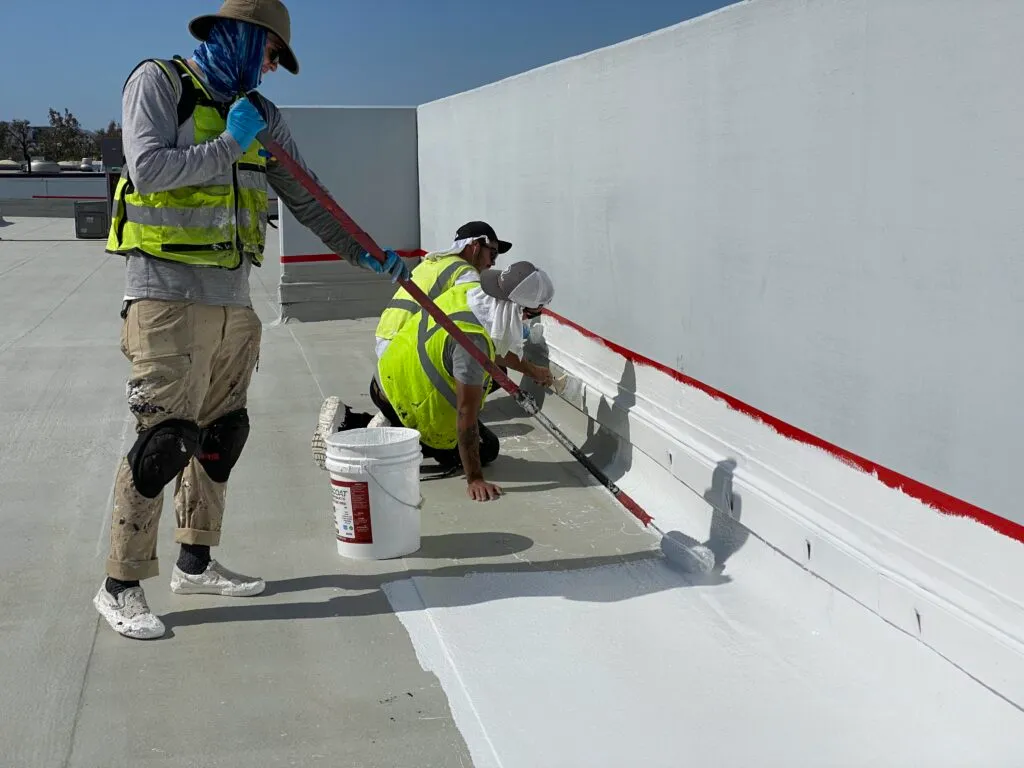
Yes, commercial roof coatings can help prevent leaks near Watkinsville, GA by providing an additional waterproof barrier over an aging or mildly deteriorated membrane surface. Roof coatings are applied over existing TPO, EPDM, modified bitumen, and metal roofing systems to extend service life, improve reflectivity, and seal minor surface defects before they become active leak points. A coating application on a commercial roof that is structurally sound but showing surface weathering can extend service life by five to ten years at a fraction of the cost of a full membrane replacement. In Georgia’s climate, the reflective benefits of a white coating also reduce cooling loads meaningfully. Coating is not appropriate for roofs with significant wet insulation or structural issues, which is why an inspection and moisture scan should precede any coating project to confirm the underlying system is sound enough to support it. Commercial roofing services in Watkinsville can evaluate whether a coating or restoration approach makes sense for your building.
Final Thoughts
Commercial roof maintenance is not an optional line item in a facility budget. It is the single most cost-effective action a commercial property owner can take to protect one of their most valuable assets. The data from industry research, NRCA guidelines, and real-world maintenance programs all point to the same outcome: maintained roofs last longer, cost less over their lifetime, stay in warranty compliance, and support insurance claims more effectively than neglected ones. For every dollar spent on proactive maintenance, the return in deferred repairs, extended lifespan, and preserved building value is measurable and consistent.
For commercial property owners in Watkinsville, GA, Hiawassee, GA, and across northeast Georgia, the stakes are real. Georgia’s heat, humidity, and seasonal storm activity create a demanding environment for commercial roofing systems. Buildings that receive professional attention twice a year, with additional visits after storm events, are the ones that hit and exceed their design lifespan. Buildings that are managed reactively are the ones that need emergency repairs during business hours, experience interior water damage to inventory and equipment, and face replacement costs years earlier than planned.
Is your commercial roof on a maintenance program? Ridgeline Roofing and Exteriors serves commercial property owners in Watkinsville, Hiawassee, and throughout northeast Georgia with professional inspection, maintenance, repair, and replacement services. The team holds GAF certifications and provides documented inspection reports that meet warranty and insurance requirements. Call 770-706-ROOF or schedule online to get a baseline inspection and a maintenance plan tailored to your building. Do not wait for a leak to tell you what your roof has been trying to show you for months. Visit Ridgeline’s Watkinsville commercial roofing services and get ahead of the next storm season today.