Spotting missing or damaged roof shingles starts with a ground-level inspection using binoculars to look for gaps, bare patches, lifted or curling edges, shingles in the yard, granules in the gutters, and any section of the roof that looks darker or different in color from the rest. You do not need to climb onto the roof to identify most shingle damage. What you are looking for from the ground, and inside the attic, tells you whether you have a problem that needs prompt attention or something that can be monitored. For homeowners in Watkinsville and Hiawassee, where Georgia’s spring and summer storm seasons regularly produce hail and wind speeds that damage shingles, knowing what to look for and how to respond is the difference between a $350 repair and a $15,000 emergency replacement. This guide answers every question Georgia homeowners ask about damaged and missing shingles so you can act with confidence.
How to Identify Damaged Shingles
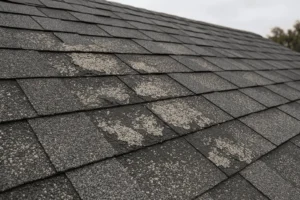
You identify damaged shingles by looking for six specific visual conditions, each of which indicates a different type of damage or failure. Curling or cupping shingles have edges that turn upward or centers that bowl downward, indicating age-related moisture loss or inadequate ventilation. Cracked shingles have visible splits running across the surface, caused by thermal cycling, hail impact, or brittleness from UV degradation. Blistering shingles show raised circular spots where granules are missing in a concentrated area, caused by excessive heat, poor ventilation, or manufacturing defects. Bruised shingles appear darker and slightly concave in small circular areas, indicating hail impact that has fractured the fiberglass mat beneath the granule surface. Granule loss shows up as smooth, shiny spots on the shingle surface where the protective mineral coating has worn away, and you will find the evidence of this in your gutters as grit that looks like coarse sand.
According to JD Hostetter, the safest way for most homeowners to conduct a roof inspection is from the ground with binoculars, or by hiring a licensed roofing contractor. Walking on a damaged roof causes additional shingle cracking and creates fall risk, and according to Weather Shield Roofers, homeowners cause more damage walking on already-compromised shingles. The inspection sequence that works for most homeowners is to walk the full perimeter of the house at ground level with binoculars, check the gutters and downspouts for granule accumulation, check the attic for water stains or daylight coming through the deck, and check the yard and driveway for shingle pieces or tab sections that came off during a storm. Any two or more of these signs appearing simultaneously indicates a roof that needs professional assessment in the Watkinsville and Hiawassee areas.
What Is the 25% Rule in Roofing?
The 25% rule in roofing is a building code standard that requires a full permitted roof replacement when more than 25% of the roof surface is repaired or replaced within a 12-month period. This rule applies across most Georgia jurisdictions, including Oconee County and Towns County, and prevents property owners from making large piecemeal repairs that bypass the permitting and code-compliance requirements of a full replacement. When storm damage affects more than a quarter of your shingle area, the correct path under most Georgia building codes is a full permitted replacement rather than a series of repairs that each individually fall below the threshold.
For homeowners dealing with damage after a Georgia thunderstorm or hail event, the 25% rule shapes the conversation with both your roofing contractor and your insurance adjuster. If a hail storm damages 30% of your shingles uniformly, you have a permitted full replacement situation, not a patch repair. Understanding this rule before authorizing repair work prevents the scenario where a well-intentioned contractor patches 30% of your roof without pulling a permit, leaving you with code violations, insurance complications, and a roof that was partially replaced without documentation. A licensed local roofing contractor will assess the damage extent accurately and advise you on whether you are below the threshold or in full replacement territory.
What Do Missing Shingles Look Like?
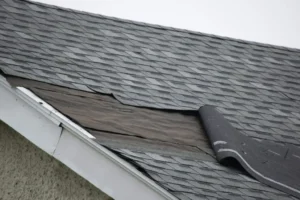
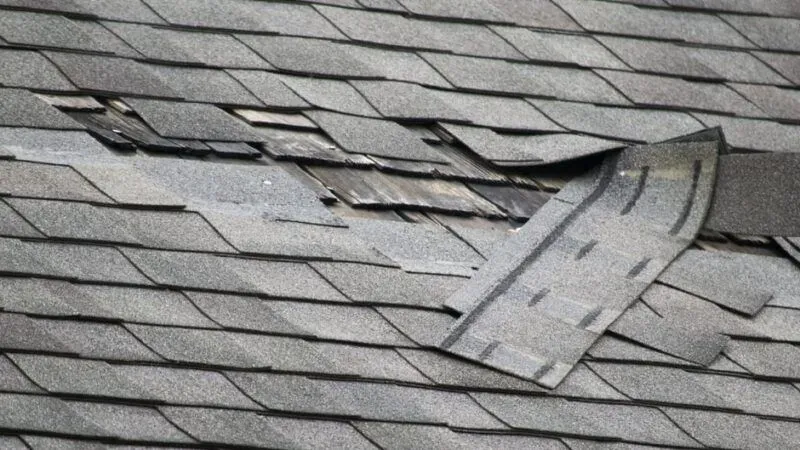
Missing shingles look like rectangular gaps or bare patches in the otherwise uniform shingle pattern of your roof, where the darker underlayment or older secondary layer is visible through the gap. According to Smith Rock Roofing, on the roof you will see noticeable gaps or patches of a different color where the exposed underlayment or older shingles underneath are visible. From the ground, a missing shingle area appears as a section that does not match the color or texture pattern of the surrounding roof. The gap may be obvious on a simple gable roof, or subtle on a heavily shaded roof where the exposed underlayment is similarly dark.
From the yard and driveway, missing shingles often announce themselves before you even look up at the roof. Shingle pieces, tabs, or whole shingles lying in the yard, on the driveway, in landscaping beds, or against the foundation of the house are the first post-storm sign that something came off the roof. According to GAF, after a significant weather event like heavy winds or hail, check for exterior damage as soon as it is safe. For homeowners in Watkinsville and Hiawassee where afternoon thunderstorms with gusty winds occur regularly through spring and summer, walking the yard after every significant storm and checking gutters for granule accumulation is a simple habit that catches shingle problems in the early stage rather than when water has already entered the home.
Can Missing, Cracked, or Displaced Roof Shingles Indicate Damage?
Yes, missing, cracked, or displaced roof shingles indicate damage and should be treated as a call for prompt professional inspection. Missing shingles expose the roof underlayment and deck directly to rain, UV rays, and wind, which accelerates deterioration in those exposed areas at a rate significantly faster than on protected sections of the roof. Cracked shingles allow water to penetrate at the crack location and potentially travel laterally under adjacent shingles before it drips through the deck. Displaced shingles, meaning shingles that have shifted out of their correct overlapping position without being fully removed, allow wind and rain to enter the gaps created by the misalignment.
According to Alpine Intel, shingles that are creased, dislodged, or removed may be indicators of wind damage. Even when shingles remain physically present on the roof, displacement and creasing indicate that the adhesive sealant strip has been broken. A shingle with a broken seal is no longer waterproof at its lower edge and will lift during the next wind event, increasing the risk of further tearing and water entry. According to Smith Rock Roofing, a single loose shingle allows wind to get underneath adjacent ones, creating a chain reaction that can lead to widespread failure across your roof. For Georgia homeowners in the Watkinsville area, where hail and wind events occur in the same thunderstorm, having a licensed roofing contractor inspect the full roof after any storm that produces ground-level shingle pieces is the appropriate response, not just replacing the visible missing shingles.
How to Find a Roof Leak That Does Not Have Obvious Damage
Finding a roof leak that does not have obvious exterior damage starts in the attic. According to This Old House, your attic is often the first place you will notice signs of a roof leak, and you should check for moisture at every rafter, especially at any point where two planes meet. Take a flashlight into the attic and look for water stains on the rafters or sheathing, discoloration that indicates prior or ongoing water intrusion, patches of mold on wood surfaces, wet or matted insulation, and any rust on nails. According to IKO, you can also turn off the flashlight and look for bright spots where daylight comes through the roof deck, because any visible light is a gap that water can enter during rain.
For leaks that cannot be found by attic inspection alone, the two most common professional leak detection methods are the water spray test and infrared thermography. In the water spray test, described by This Old House, one person stays inside the attic while a second person slowly soaks sections of the roof with a garden hose, starting at the lowest point and working upward in small sections, waiting several minutes at each location before moving higher. When the inside person sees new moisture appear, that section of the roof is the source area. For leaks that are not detectable by visual or water spray inspection, according to Sky Shield Roofing, infrared thermography uses cameras to detect temperature differences on the roof surface, because wet areas retain heat differently than dry areas and the leak shows up as a thermal anomaly even when nothing is visible. A licensed commercial roofing contractor in the Watkinsville and Hiawassee areas can determine the right detection method for your specific leak situation.
What Is the Average Lifespan of a Shingle Roof?
The average lifespan of a shingle roof is 20 to 25 years for standard three-tab asphalt shingles and 25 to 30 years for architectural or dimensional asphalt shingles under normal conditions. According to HomeGuide, an asphalt shingle roof replacement costs $3 to $5 per square foot and the shingles last approximately 20 to 30 years depending on style and quality. According to NerdWallet, metal roofing costs more upfront but can last 40 to 80 years, while a slate roof can last 60 to 150 years, illustrating how dramatically lifespan varies across materials. For the standard asphalt shingle roofs that cover most homes in Watkinsville and Hiawassee, 20 to 25 years is the realistic planning horizon.
In Georgia’s climate, the specific factors that shorten a shingle roof’s lifespan compared to national averages are high UV intensity through the long summer months, which accelerates granule loss and asphalt degradation; high humidity, which promotes algae growth that discolors shingles and undermines granule adhesion; and frequent thunderstorm activity that subjects shingles to cumulative hail impact and high-wind stress over the roof’s lifespan. A shingle roof on a well-ventilated attic with adequate insulation, installed by a qualified contractor, and maintained with annual inspections will reliably reach the upper end of its rated lifespan in Georgia. A poorly ventilated roof with blocked soffits that allows heat to build up under the sheathing will often fail significantly earlier, because the heat from below accelerates the same UV degradation that sunlight causes from above.
What Time of Year Is the Cheapest to Replace a Roof?
The cheapest time of year to replace a roof is late fall through early winter, from November through February in Georgia. Roofing contractors in the Watkinsville and Hiawassee areas are at peak demand from spring through early fall, driven by post-storm repair cycles, the active construction season, and insurance claim activity following Georgia’s hail-active spring months. Scheduling a replacement during the slower winter season typically produces better contractor availability, faster project start dates, and in many cases more competitive pricing from qualified local contractors who have calendar capacity to fill. According to Columbus Roofing Company, scheduling a project during the off-peak season can save 10% to 20% compared to peak summer pricing.
For homeowners with a planned replacement on the horizon, the off-season scheduling advantage is real and worth planning for. A 10% to 15% savings on a $12,000 to $20,000 project represents meaningful money without any trade-off in material quality or installation quality. The caveat, as always, is that an actively leaking roof cannot wait for seasonal pricing. Water entering the home through a missing or damaged shingle during every rain event accumulates damage at a rate that far exceeds any seasonal cost savings. A roof that is leaking needs a temporary tarp and prompt repair or replacement regardless of what time of year it is, and a licensed local contractor can install an emergency tarp while the full replacement is planned.
How to Tear Off Shingles Fast
Tearing off shingles is a professional roofing task that requires specific tools including a roofing shovel or shingle remover, a flat pry bar, a nail puller, safety harnesses, and appropriate disposal equipment. For professional crews, the fastest approach is working in sections from the ridge down, using a roofing fork or flat shovel to break the adhesive bond and pry up each shingle course, working in rows and clearing each section completely before moving down. According to Bill Ragan Roofing, most professional crews can tear off a standard residential asphalt shingle roof in a single day, with the tear-off typically being the first task completed before mid-morning so the new roof can be started and covered with underlayment before any afternoon weather arrives.
For homeowners, attempting to tear off a roof without professional training, tools, and safety equipment is one of the most dangerous home improvement activities possible. Falls from roofs are a leading cause of fatal and serious injury among both DIYers and professional workers. Improper tear-off technique also risks damaging the roof deck, which increases the project cost when the deck repairs the crew discovers are caused by the tear-off process rather than pre-existing water damage. For homeowners in Watkinsville and Hiawassee planning a roof replacement, the tear-off is included in the contractor’s labor scope and is not a task to separate out for DIY cost savings. A licensed professional with an experienced crew will complete the tear-off correctly, safely, and quickly as part of a complete installation that carries both a manufacturer’s material warranty and a workmanship warranty.
How to Tell If a Roofer Is Lying
You can tell if a roofing contractor is lying about shingle damage when they tell you widespread damage exists without walking you through specific evidence on the roof, when they identify damage after a storm but cannot show you photo documentation of the actual impact points, or when their damage assessment conveniently recommends a full replacement on a roof that is only four or five years old after a moderate storm. A contractor who says your whole roof needs replacing because one section is missing six shingles is lying to you. A contractor who says your 22-year-old roof only needs three shingles replaced after a hail event that left your neighbor’s car dented is either inexperienced or is telling you what is cheapest for the project rather than what is correct for your home’s protection.
Trustworthy contractor behaviors in a shingle damage situation are: they photograph the damage before touching anything, they explain specifically what type of damage they are seeing and what caused it, they tell you whether the surrounding shingles are intact or brittle and seal-failed, and they provide a written scope of work that itemizes the repair versus the conditions that would require full replacement. For homeowners in Oconee County and Towns County, asking every contractor you consider whether they carry current Georgia contractor’s license and insurance, whether they will pull the permit for the project, and whether they can provide local references from similar repair jobs completed in the past year is the baseline qualification check that separates licensed local professionals from storm chasers and unqualified crews.
Will My Roof Leak If a Shingle Is Missing?
Yes, your roof is likely to leak if a shingle is missing, particularly during heavy rain or wind-driven rain events that push water directly into the exposed area. According to Team Armour Roofing, even a few missing shingles can lead to leaks during the next rainfall and weaken the surrounding area. The underlayment beneath a missing shingle provides a secondary barrier to water penetration, but underlayment is not designed to be the primary water shedding layer. It will protect the deck temporarily, but it is not rated for indefinite direct water exposure and will degrade significantly faster when exposed than when covered by shingles. According to Smith Rock Roofing, wind damage can be subtle and progressive, with a single loose shingle allowing wind to get underneath adjacent ones and creating a chain reaction of failure.
The practical urgency of a missing shingle depends on how many are missing, where on the roof they are located, and how much rain the area receives before the repair can be completed. A single missing shingle on a large, well-maintained roof may not produce a visible interior leak immediately if the underlayment is intact and rain events are moderate. Multiple missing shingles in the same section, or missing shingles at vulnerable locations like valleys, around chimneys, or at the ridge line, create a substantially higher immediate leak risk. For homeowners in Watkinsville and Hiawassee who discover missing shingles during or after a storm, having a licensed roofing contractor install a temporary tarp over the exposed area while the repair or replacement is scheduled is the appropriate protective step that most insurance carriers also expect as a loss mitigation action.
What Are the Red Flags for Roofing Contractors?
The red flags for roofing contractors when dealing with shingle damage are requesting full cash payment before any work begins, no local physical business address and no verifiable recent local references, inability to provide proof of Georgia contractor’s license and current liability and workers’ compensation insurance, pressure to sign an assignment of benefits or a contract on the same day you are approached after a storm, and a written proposal that does not itemize materials by product name and quantity separately from labor. Storm-chasing contractors who arrive unsolicited at your door within days of a hail or wind event and offer free inspections while pressuring immediate signature are the highest-risk category for homeowners in storm-active markets like Oconee County and Towns County.
Two roofing contractor red flags specific to shingle repair situations are worth knowing: First, a contractor who repairs shingles without checking the surrounding shingles for seal failure or brittleness is doing a cosmetic fix that will produce follow-on failures. According to Douglas Roofing, on an aging roof the shingles surrounding missing ones are often brittle, and when a roofer tries to nail in a new shingle the surrounding old shingles often crack or lose their seal, creating three new problems for every one that was fixed. Second, a contractor who uses mismatched shingles because they happen to have leftover material from another job is creating a visible quality problem and potentially a warranty compliance problem. A qualified licensed contractor in the Watkinsville area will source matching replacement shingles or discuss the replacement scope that ensures a properly waterproofed, warranted result.
What Does Wind-Damaged Shingles Look Like?
Wind-damaged shingles look like shingles that are missing entirely, shingles with visible crease or fold marks across the middle of the tab, shingles with lifted or curling edges where the adhesive sealant strip has been broken by uplift pressure, and shingles with tabs that are partially torn or detached but still loosely attached to the roof. According to Alpine Intel, shingles that are creased, dislodged, or removed may be indicators of wind damage, with creases occurring when wind violently bends the shingle backward and fractures the fiberglass matting inside. A creased shingle may lay flat again after the storm passes, making it visually similar to an undamaged shingle when viewed from the ground, but the fractured fiberglass mat means the shingle is structurally compromised and will not maintain its watertight seal through future storms.
According to Alpine Intel, the shingles on the windward side of the roof and those along the hips, ridges, and eaves are the most wind-vulnerable areas. Wind pressure is greatest at the edges and corners of a roof, and shingles at these locations that are older or that have depleted adhesive strips are the first to fail. According to Smith Rock Roofing, conventional asphalt shingles have the capacity to endure wind speeds ranging from 60 to 70 mph, whereas those with higher ratings can withstand winds of 110 mph or greater. Dimensional or architectural shingles are stiffer than three-tab shingles and are less likely to be damaged by wind, but they also tend to blow off in sections rather than individual shingles when they fail, which is more immediately visible and creates larger exposed areas that require prompt repair.
What Is the Most Common Roof Damage?
The most common roof damage is wind damage, specifically the lifting, creasing, and removal of asphalt shingles during thunderstorms and severe weather events. According to Smith Rock Roofing, wind damage can begin with gusts as low as 45 mph, and even low wind speeds during a typical thunderstorm can cause escalating damage as speed increases according to the National Weather Service. For Georgia homeowners in the Piedmont region around Watkinsville and the mountain communities near Hiawassee, the combination of summer thunderstorms and the occasional severe system makes wind damage the most frequent single cause of shingle repair calls throughout the state.
The second most common roof damage category is hail impact, which bruises shingles, displaces granules, and in severe cases cracks the fiberglass mat beneath the granule surface, creating a compromised waterproof barrier that deteriorates rapidly after the impact. Flashing failure at chimneys, vents, valleys, and skylights is the third most common category, and it is the most common source of leaks on roofs that are not obviously storm-damaged, because flashing failures are typically slow-developing and do not announce themselves with missing or visibly broken shingles. According to Bob Vila, most leaks form not where there is a continuous flow of shingles but where some utility or feature penetrates the roof, including plumbing vents, HVAC system vents, skylights, and chimneys. Regular annual inspection from a licensed roofing contractor addresses all three damage categories before they become active leaks.
What Not to Say to a Roof Insurance Adjuster
When an insurance adjuster comes to inspect shingle damage after a storm, there are specific statements that can damage your claim outcome. Do not say the roof was already starting to go before the storm, because pre-existing condition language gives the carrier grounds to deny the storm-caused damage as wear and tear rather than a covered peril. Do not agree to a repair-only scope on the spot when the damage pattern suggests full replacement is warranted, without first getting your licensed roofing contractor’s written assessment of the full extent of damage including creased shingles, seal-failed sections, and underlayment condition that the adjuster may not have documented. Do not tell the adjuster you have not had the roof maintained or inspected, because maintenance exclusion language in standard homeowners policies can be used to shift liability for failure to the homeowner.
The most important preparation for an adjuster visit after a storm is having a written inspection report from your licensed roofing contractor documenting specific storm damage including photos with date and location metadata, weather service records confirming storm time and intensity, and the contractor’s professional assessment of whether the documented damage warrants repair or replacement. According to Excellent Roofs, homeowners insurance typically covers sudden, accidental damage like storm damage or hail impact, but not routine repair costs or repairs due to wear and tear. A well-documented claim that clearly identifies storm-caused damage as the triggering event, with a licensed contractor’s written assessment supporting the scope, gives the legitimate portion of the claim its best chance of full payment.
What Is the Average Cost to Replace Shingles on a Roof?
The average cost to replace shingles on a full residential roof ranges from $5,700 to $12,000 for a standard asphalt shingle installation on a typical single-family home, according to HomeGuide. According to Angi’s 2026 data, typical shingle replacements range from $4 to $11 per square foot installed for most residential projects. For smaller shingle repairs involving a few damaged sections, the cost is dramatically lower: according to Roof Maxx, replacing one or two shingles typically costs around $150 to $500, with most homeowners paying around $350. According to Angi, shingle replacement costs range from $100 to $700 including materials and labor depending on the number of shingles and the roof’s pitch. The national average repair cost across all shingle damage scenarios runs approximately $960 according to Angi’s repair cost data.
For homeowners in the Watkinsville and Hiawassee areas, the specific cost for your project will depend on the roof’s square footage and pitch, the number and location of penetrations requiring individual flashing work, whether any deck repair is needed after the damaged shingles are removed, and the specific shingle product being used. Getting written proposals from at least two licensed local roofing contractors, with materials, labor, and scope clearly itemized, is the most reliable way to understand fair market pricing for your specific situation. The cost difference between a qualified local contractor and an unqualified crew is not recoverable after the work is done wrong, but the cost of a quality installation is paid once for a roof that performs for 20 to 25 years.
What Is the Most Common Location to Find a Roof Leak?
The most common location to find a roof leak is at a penetration or transition point rather than in the middle of the field of shingles. According to Bob Vila, most leaks form not where there is a continuous flow of shingles but where some utility or feature penetrates the roof, including plumbing vents, HVAC system vents, skylights, and chimneys, where flashing and sealant must create a watertight seal around an opening in the otherwise continuous roof surface. Valleys, where two roof planes meet and water concentrates its flow, are the second most common location. Drip edges and eave areas, where shingles terminate and water transitions to gutters, are the third most common location.
This is important for homeowners to understand when they see a ceiling stain and try to identify the source, because the visible interior water damage is almost never directly below the actual roof entry point. Water enters the roof at one location, travels down a rafter, across a sheathing panel, and along insulation before it concentrates and drips through in a location that may be several feet away from where it entered. According to SERVPRO, the source of the leak is almost always higher up than the drip, because gravity carries water downhill along structural members before it finds a path through the interior ceiling surface. For this reason, starting the leak investigation in the attic with a flashlight is far more productive than trying to trace a ceiling stain upward from the living space below.
What Is the Average Cost to Fix a Roof Leak?
The average cost to fix a roof leak is approximately $1,150 in 2025 according to Cobex Construction Group, with minor repairs staying under $1,000 and moderate to major repairs climbing to $3,000 or more. According to Angi’s 2026 shingle repair data, the average roof shingle repair cost is approximately $960, with a range from $360 to $1,750 for most standard residential repair situations. Simple repairs such as replacing a few missing or damaged shingles, patching a small leak, or repairing flashing typically cost $350 to $800. More complex repairs involving multiple leak locations, underlayment replacement, or deck patching run $1,000 to $3,000. Emergency service calls add 20% to 40% to standard repair rates according to PACC Solutions.
The most important cost principle for homeowners to understand is that roof leaks do not get cheaper by waiting. According to Budget Roofing Service, water damage spreads quickly, and a small leak can saturate insulation, weaken wooden decking, and damage drywall in a matter of days. Once moisture reaches structural components, repair costs increase significantly. A $350 shingle repair addressed the week it is discovered costs the same $350. The same leak allowed to run through three more rain events before action is taken may require deck replacement, mold remediation, and interior ceiling repair on top of the original $350 shingle cost. For homeowners in Oconee County and Towns County, the financially sound approach is to call a licensed roofing contractor for a free inspection the week you notice any sign of a leak rather than waiting for the next rain to confirm it.
What Are the Two Most Common Leak Detection Tests?
The two most common leak detection tests are the water spray test and infrared thermography. The water spray test, described by This Old House and Bob Vila, involves one person in the attic watching for moisture while a second person systematically wets sections of the roof exterior with a garden hose, starting at the lowest point of the suspected area and working upward in small sections, waiting several minutes in each location before moving. When the person inside sees new moisture appear at a rafter or sheathing surface, the section being hosed at that moment is the entry point. This test is the most accessible method for homeowners and professional roofers alike on visible leak situations with a known suspected area.
Infrared thermography is the more sophisticated professional method used when visual inspection and water spray testing cannot definitively identify the leak source. According to Sky Shield Roofing, infrared cameras detect temperature differences on the roof surface, with wet areas retaining heat differently than dry areas, making leaks visible as thermal anomalies even when nothing is visible to the naked eye or conventional camera. Infrared inspection is particularly useful for finding leaks in flat or low-slope sections of roofing where ponding water creates widespread moisture in the insulation below the membrane, and for finding leaks that travel long distances from the entry point before appearing at the interior surface. Licensed commercial roofing contractors in the Watkinsville and Hiawassee areas can advise whether a standard inspection is sufficient or whether thermal imaging would provide a more definitive result for your specific leak situation.
What Ruins Roof Shingles?
Roof shingles are ruined by six primary causes: UV exposure, moisture, poor ventilation, hail impact, wind damage, and biological growth. UV exposure degrades the asphalt binder in shingles over time, causing the granules to loosen and shed, which accelerates once the granule layer is thinned. Moisture that enters through failed flashing, open seams, or lifted shingles causes the wood deck below to rot, which destroys the structural foundation the shingles are nailed to. According to JD Hostetter, poor ventilation causes excessive heat to build up under the shingles, which accelerates the aging process and can cause blistering, where sections of the shingle puff up and lose their granule covering. Hail impact fractures the fiberglass mat inside the shingle even when the shingle surface still looks intact, creating a compromised waterproof barrier that fails progressively.
Wind damage at any speed above 45 mph can break the adhesive sealant strips that hold shingle tabs in place, and once the seal is broken, the shingle flaps freely in future winds, fatigue-cracking the fiberglass mat until the tab tears off entirely. According to JD Hostetter, biological growth from algae, moss, and lichen is also a significant shingle damager in Georgia’s humid climate: algae discolors shingles and is primarily cosmetic, but moss and lichen physically root into the shingle surface, lifting granules and creating moisture retention that accelerates deterioration. All of these damage causes are manageable through regular inspection, prompt repair of any failed flashing or missing shingles, maintaining clean gutters so water drains properly, trimming overhanging tree branches that create shade for moss growth, and choosing quality shingles rated for the specific storm exposure of the Watkinsville or Hiawassee area.
Will Homeowners Insurance Cover a Damaged Roof?
Yes, homeowners insurance will cover a damaged roof when the damage is caused by a sudden, accidental covered event such as wind, hail, lightning, falling trees, or fire. According to Excellent Roofs, homeowners insurance typically covers sudden, accidental damage like storm damage or hail impact, but not routine repair costs or repairs due to wear and tear. According to Cobex Construction Group, homeowners insurance typically covers sudden, accidental damage but not repairs needed due to normal aging, neglect, or lack of maintenance. The distinction matters: a hailstorm that dents your 12-year-old roof is a covered event. A 22-year-old roof that is leaking because the shingles aged past their service life is not a covered event under standard homeowners policy language.
For homeowners in Georgia after a storm event, the steps that give an insurance claim the best chance of full payment are: contact a licensed local roofing contractor for a written inspection report before the adjuster arrives, photograph all visible damage with date and location metadata as soon as it is safe, obtain National Weather Service records confirming the storm event, and do not authorize any repairs before the insurance adjuster has completed their inspection. According to most homeowners insurance carriers, you are also expected to mitigate further damage by having a contractor install a tarp over any large exposed areas, as failing to prevent further damage after the initial event can give the carrier grounds to reduce the payout. Most homeowners insurance deductibles for storm-related roof claims range from $500 to $2,500, and if the documented damage exceeds the deductible, the insurance proceeds can cover the majority of repair or replacement cost.
Can You Replace Just a Few Shingles?
Yes, you can replace just a few shingles when the surrounding shingles are in good condition, the roof is not approaching end of life, the number of damaged shingles is small relative to the total roof area, and the replacement shingles can be matched closely enough to the existing shingles to maintain a weather-tight installation. According to GAF, if your roof is not very old and you spot a few loose or damaged shingles, you may be able to just replace them. According to HomeGuide, the cost to replace a few missing shingles runs $100 to $300 for the shingles or $200 to $600 for 100 square feet, including labor and materials. This is clearly the right economic choice when the rest of the roof is sound and the damage is localized.
The situations where replacing just a few shingles is not the right answer are when the surrounding shingles are brittle and prone to cracking during the nail installation of new shingles, when the replacement shingles cannot be matched to the existing product because the product line has been discontinued, when the damage affects more than 25% of the roof surface triggering the replacement threshold, or when the roof is already past 20 years of age with widespread granule loss and end-of-life symptoms throughout the field. According to Douglas Roofing, if your roof is 10 or more years old and the adhesive strips are likely reaching end of life, and if the wind was strong enough to rip shingles off, it likely creased dozens of others that are not visible from the ground. A licensed roofing contractor inspection is the right tool for determining whether the correct answer is a few shingle repairs or a permitted full replacement.
Is It Better to Repair Shingles or Replace a Roof?
It is better to repair shingles when the roof is less than 15 years old, the damage is localized to a small area, the surrounding shingles are in good condition with adequate granule coverage and intact sealant strips, and the repair cost does not approach a significant fraction of replacement cost. According to Angi, replacement is often more cost-effective when the roof is nearing the end of its lifespan, has widespread damage, or needs frequent repairs. According to HomeGuide, consider replacing instead of repairing when the damage affects more than 25% of the roof surface, the shingles are brittle or cracking, the roof is leaking in multiple locations, the shingles are more than 20 years old, or the roof is sagging or has structural damage. Angi’s 50% rule states that if the cost of repairs exceeds 50% of the price to replace the entire roof, replacement is the smarter investment.
For homeowners in Watkinsville and Hiawassee, the age of the roof at the time damage occurs is the most important factor in the repair versus replace decision. A storm that damages a 7-year-old roof calls for repair of the damaged sections. The same storm that damages a 22-year-old roof with already-thinning granules, multiple prior repair locations, and brittleness throughout the field calls for a full replacement that resets the protection and warranty clock for the next 20 to 25 years. The insurance coverage situation also shapes the calculation: when insurance covers the majority of a replacement cost on an older damaged roof, the out-of-pocket expense difference between repair and replacement shrinks considerably, and the homeowner’s long-term interest is almost always better served by the full replacement that eliminates the cycle of ongoing maintenance and repair on an end-of-life system.
Shingle Damage Quick Reference Guide
| Damage Type | What It Looks Like | Common Cause | Action Needed |
|---|---|---|---|
| Missing shingles | Rectangular gap exposing dark underlayment; shingle pieces in yard | High winds; storm uplift | Prompt replacement; inspect surrounding shingles for seal failure |
| Curling / cupping | Edges turning up or center bowing down; wavy surface texture | Age, UV, poor ventilation, moisture | Inspect for end-of-life; widespread curling suggests replacement |
| Cracked shingles | Visible splits across shingle surface; may follow granule loss | Thermal cycling; hail; UV brittleness | Replace individual shingles if roof is under 15 years; assess full scope if older |
| Bruising (hail) | Dark, circular, slightly concave spots; soft to press; random pattern | Hail impact | Licensed inspection; document for insurance claim; assess full scope |
| Granule loss | Smooth, shiny spots on shingle surface; grit in gutters | Age; hail; UV; thermal cycling | Widespread granule loss = end of life; localized = monitor and repair |
| Creased / folded | Horizontal fold line across shingle; lays flat but structurally broken | Violent wind bending shingle backward | Replace: creased shingle is a future leak point even if it looks intact |
| Lifted / unsealed edges | Tab edges slightly raised; not missing but not flat | Wind breaking sealant strip; age | Re-seal if accessible and roof is young; inspect surrounding area for spread |
| Blistering | Small raised circular spots with exposed asphalt at center | Heat buildup; poor ventilation; manufacturing | Address ventilation; replace blistered shingles; monitor for spread |
Sources: JD Hostetter, GAF, Alpine Intel, Smith Rock Roofing, Team Armour Roofing, This Old House, Angi, HomeGuide, Douglas Roofing
Frequently Asked Questions
How do I check for damaged shingles in Watkinsville, GA after a storm?
After a storm in Watkinsville, start your inspection from the ground with binoculars. Walk the full perimeter of the house and look for missing shingles, shingle pieces or tabs in the yard or driveway, sections of the roof that appear darker or different in color from the surrounding area, and any sections at the ridge line, eaves, or corners that look lifted or uneven. Check the gutters and downspouts for an unusual amount of granule accumulation, which looks like coarse sand or grit. Check the attic with a flashlight for any new water stains on rafters or sheathing, and look for pinpricks of daylight coming through the deck that were not there before. According to GAF, after a significant weather event like heavy winds or a hail storm, check for exterior damage as soon as it is safe. For storms that produce ground-level shingle pieces or obvious visible damage from the ground, contact a licensed local roofing contractor for a professional inspection before authorizing any repair or insurance claim scope.
How much does it cost to replace a few shingles in Oconee County, GA?
Replacing a few damaged or missing shingles in Oconee County costs approximately $150 to $500 for one or two shingles according to Roof Maxx, with most homeowners paying around $350. A larger patch repair covering 100 square feet runs $200 to $600 according to HomeGuide. The minimum call-out fee for a licensed local roofing contractor is typically $150 to $300 regardless of the repair scope, which reflects the time and equipment required to mobilize for any job. For storm damage that affects multiple sections of the roof or that involves flashing failures at penetrations, the repair scope expands and costs accordingly. Getting a written proposal that specifies exactly which shingles are being replaced, the product being used, and any flashing or underlayment work included is the most reliable way to understand what your specific repair will cost and to compare proposals from multiple qualified contractors.
What are the signs a roof is about to fail in Hiawassee, GA?
The signs that a roof is about to fail in Hiawassee include widespread granule loss visible as smooth, shiny patches throughout the field of the roof, curling or cupping across large sections rather than isolated shingles, multiple areas of missing or cracked shingles rather than a single localized event, water stains on attic rafters in more than one location indicating systemic leak points throughout the roof, and a shingle installation age past 20 years on a standard architectural shingle system. For the mountain climate around Hiawassee, additional warning signs include significant moss or algae growth across large roof sections, which indicates the protective granule layer has been compromised enough to allow biological growth to take root, and any visible sagging at the ridge or eave line which indicates structural deck deterioration. According to Allied Roofing Solutions, if your roof has required frequent repairs or shows damage in multiple spots, full replacement is often more beneficial and cost-effective than continued repairs. A free inspection from a licensed roofing contractor is the right tool for confirming what the roof’s actual condition means for your planning and budget.
Will insurance cover shingle damage from a Georgia thunderstorm?
Yes, homeowners insurance typically covers shingle damage caused by a Georgia thunderstorm when the damage is sudden and caused by a covered peril such as wind, hail, lightning, or a falling tree. The key requirement is documentation: you need to establish that the damage was caused by the specific storm event rather than by pre-existing aging or deferred maintenance. The practical steps to support a storm damage claim are having a licensed roofing contractor provide a written inspection report identifying storm-caused damage specifically, obtaining National Weather Service records confirming the storm’s timing and intensity at your location, photographing all damage with date and time metadata, and not authorizing any repairs before the insurance adjuster has completed their inspection. Standard homeowners policy deductibles for storm claims range from $500 to $2,500, and when documented storm damage exceeds the deductible, the insurance proceeds cover the majority of repair or replacement cost. A licensed local contractor experienced with insurance claims in Oconee County can guide you through the documentation process.
How long can I wait to fix missing shingles on my Watkinsville home?
You should not wait more than a few days to arrange repair of missing shingles on a Watkinsville home, and in the interim a temporary tarp should cover the exposed area to prevent water entry during the next rain event. Georgia’s climate from spring through early fall produces frequent afternoon thunderstorms, and an exposed section of roof deck can receive multiple rain events in a single week during active storm season. According to Budget Roofing Service, a small leak can saturate insulation, weaken wooden decking, and damage drywall in a matter of days. The cost difference between a repair addressed promptly after discovery and a repair delayed through several rain events is not the repair cost, which stays the same, but the additional damage costs for wet insulation, deteriorated deck sections, and potential interior ceiling or wall repairs that accumulate with each rain intrusion. Contact a licensed roofing contractor for a same-week inspection, have them install an emergency tarp if the exposure is significant, and schedule the repair or replacement before the next weather system arrives in your area.
How can I tell if my shingles have hail damage in Oconee County?
You can tell if your shingles have hail damage by checking your gutters for unusual granule accumulation after a hail event, inspecting soft metal surfaces around your home including gutters, downspouts, air conditioning units, and garage doors for dents from the same hailstones that hit your roof, and checking your shingles from the ground with binoculars for dark, circular spots in a random pattern across the field of the roof rather than in lines or patterns. According to Weather Shield Roofers, hail damage appears randomly across the roof, not in lines or patterns, and the impacts knock off protective granules exposing the black asphalt mat beneath, creating spots that may feel soft or spongy when pressed. Because many hail damage signs are not visible from the ground, a licensed roofing contractor inspection after any hail event that produced dime-sized or larger hailstones is the most reliable way to know whether your shingles sustained damage that warrants a repair or replacement scope and whether the damage supports an insurance claim.
Final Thoughts
Spotting missing or damaged shingles is a skill every Georgia homeowner can develop with the right knowledge of what to look for and where to look for it. The ground-level inspection with binoculars, the gutter check for granule accumulation, and the attic flashlight inspection after any significant storm are the three-part routine that catches most shingle problems early, when they cost $350 to fix rather than $15,000 when they have progressed through months of undetected water entry. For homeowners in Watkinsville, Hiawassee, Oconee County, and Towns County, the combination of Georgia’s active storm season and the cumulative UV and heat stress of the long summer makes regular shingle inspection not an optional home maintenance task but a foundational protection for one of the most significant investments in your home.
If you have noticed any of the signs of shingle damage described in this guide, or if your roof has not been professionally inspected in the past year, the team at Ridgeline Roofing and Exteriors provides free roof inspections that include a documented assessment of shingle condition, ventilation, flashing, and deck integrity. We serve Watkinsville, Hiawassee, and the surrounding North Georgia communities and give you a clear, honest picture of what your roof needs.
Schedule through our shingle roof repair page in Watkinsville or learn more about all roof repair services and contact us today for a free assessment.