The signs you need a new roof include curling or missing shingles, granules filling your gutters, dark algae streaks across the shingle surface, a sagging roofline, daylight visible from your attic, water stains on your interior ceilings, and a roof that is 20 or more years old. Any one of these signs is worth a professional inspection. Multiple signs appearing together almost always mean replacement is the right move. Homeowners in Watkinsville and Hiawassee, Georgia deal with summer heat, heavy seasonal storms, humidity, and algae growth that wear roofs down faster than the national average. This guide covers every warning sign, what each one means, and what to do next.
Signs You Need a New Roof on Your House
The signs you need a new roof on your house are a roof past 20 years of age, curling or cupping shingles, missing or cracked shingles, heavy granule loss in gutters, dark algae streaks, a sagging roofline, failed or rusted flashing, daylight visible through the attic boards, water stains on interior ceilings, and rising energy bills without another explanation. Each of these signs signals a specific failure point in your roofing system. When several appear together, they signal that the entire system is approaching or has passed the end of its useful life.
According to the National Roofing Contractors Association (NRCA), homeowners should inspect their roofs professionally at least twice a year, especially after severe weather events. Most homeowners wait for an active leak to become obvious before they act, but by that point, water has usually already caused damage to the roof deck, attic insulation, and interior framing that adds thousands to the total repair bill. According to Fixr.com’s 2025 U.S. Roofing Industry Statistics, roof repair and replacement costs reached nearly $31 billion in 2024, a 30% increase since 2022, largely because deferred maintenance turned small problems into major ones.
Homes in Oconee County around Watkinsville and in Towns County near Hiawassee are especially vulnerable because Georgia’s warm, humid climate accelerates every one of these failure modes. Heat and UV exposure dry out shingles faster. Humidity promotes algae growth that consumes shingle granules. Summer thunderstorms and the occasional high-wind event cause physical damage that compounds aging wear. Recognizing these warning signs early is the most cost-effective thing a Georgia homeowner can do for their home.
How Do You Tell If Your Roof Needs Replacing?
You can tell if your roof needs replacing by doing a simple two-part inspection: a ground-level walk around your home and a look inside your attic. You do not need to climb on the roof to spot most of the major warning signs.
From the ground, walk all four sides of your home and look for shingles that are curling at the edges or cupping upward in the center. Look for dark bare patches where granules have worn away. Look for obvious missing shingles or cracked pieces lying on the ground or in gutters. Look at the roofline itself. A healthy roof has clean, straight lines. Any waviness, sagging, or dipping between rafters is a serious structural warning.
Check your gutters during or immediately after a rain. If you see a sandy, dark residue collecting at the base of your downspouts, those are shingle granules washing off the roof surface. A small amount is normal after installation, but heavy accumulation on a roof more than 10 years old is a clear sign the shingle surface is failing.
From inside the attic, look for daylight coming through the roof boards, any dark staining from moisture, soft or springy spots in the decking if you can safely access it, and any smell of mold or mildew. Water stains inside the attic are almost always an indication that the roof has been leaking for longer than you may realize, since water travels along rafters and framing before it shows up on a ceiling below.
Ridgeline Roofing and Exteriors offers Drone Zone AI Roofing Inspections that give you a precise, documented picture of your roof’s condition without anyone walking on the surface. This is especially useful for identifying storm damage, granule loss patterns, and flashing failures that are hard to see from the ground.
The 10 Most Common Signs You Need a New Roof
1. Your Roof Is Over 20 Years Old
Age is the most reliable predictor of roof failure. According to RubyHome’s 2025 Roofing Statistics, the average U.S. roof being replaced was slightly over 19 years old at the time of replacement. Three-tab asphalt shingles are rated for 15 to 20 years. Architectural shingles are rated for 20 to 30 years. In Georgia’s warm, humid climate, J&M Roofing’s regional research puts the realistic average lifespan of asphalt shingles in southern states at closer to 14 years due to heat and UV intensity. A roof approaching or past 20 years in Oconee County or Towns County deserves immediate professional inspection.
2. Curling, Cupping, or Buckling Shingles
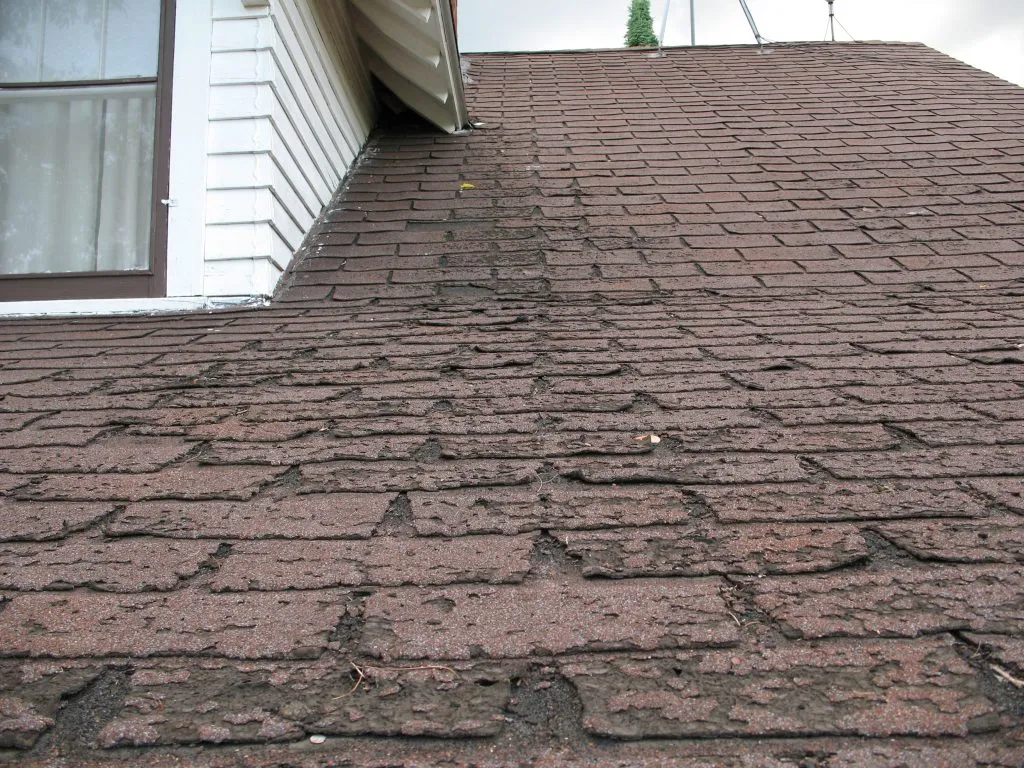
Curling shingles are shingles where the edges are turning upward. Cupping shingles are shingles where the center is higher than the edges. Both indicate that the shingle is losing its structural integrity. According to Amica Insurance’s roof warning sign analysis, curling shingles are caused by age, poor attic ventilation, and moisture infiltration into the shingle mat. Once shingles begin to curl significantly, they lose their wind-uplift resistance and are prone to tearing away in storms. If more than 25% of your roof surface shows curling or cupping, replacement is more cost-effective than ongoing repair.
3. Missing or Cracked Shingles
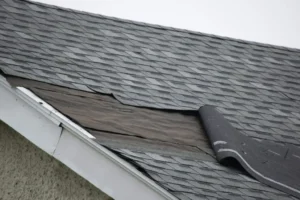
Missing shingles leave the underlayment and deck directly exposed to weather. Even temporary exposure during a Georgia rainy season can allow enough water to reach the deck to cause rot. Cracked shingles function similarly to an open window in your roof system, allowing water to penetrate every time it rains. A few isolated missing or cracked shingles can sometimes be repaired. Widespread cracking or missing sections covering multiple roof faces indicates that the entire system is approaching failure and should be replaced.
4. Granules in the Gutters
Granules are the ceramic-coated crushed stone that covers the surface of asphalt shingles. They protect the asphalt layer beneath from UV radiation. When granules erode, the asphalt binder is exposed directly to sunlight and heat, causing it to dry out and crack rapidly. According to the Insurance Institute for Business and Home Safety (IBHS), granules provide the primary protection against UV degradation, and significant granule loss shortens remaining roof life measurably. Finding heavy granule accumulation in gutters on a roof more than 10 years old is a clear sign to schedule a professional inspection.
5. Dark Algae or Moss Streaks
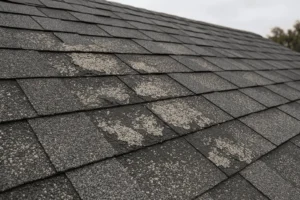
The black streaks visible on many Georgia roofs are caused by Gloeocapsa magma, a blue-green algae that feeds on the limestone filler in asphalt shingles. It thrives in the warm, humid climate of Oconee County and the shaded mountain-area homes near Hiawassee. Algae growth causes dark staining and retains moisture against the shingle surface, accelerating deterioration. Moss is even more damaging. According to Amica Insurance, moss acts as a sponge that holds water against the shingle surface, and in cooler seasons, that trapped moisture freezes, expands, and physically lifts shingles away from the deck. Widespread moss or algae on an older roof is a sign the surface protection is compromised.
6. Sagging Roofline
A sagging or wavy roofline is the most urgent sign on this list. According to Angi’s roofing warning sign analysis, droopy or sagging sections indicate that the roof decking has been weakened by prolonged moisture exposure. The decking, which is the structural wood layer beneath the shingles, cannot support the weight of the roof system properly once rot begins. A sagging roofline is a structural emergency that requires immediate attention. Waiting on this sign risks not just the roof but the interior framing and walls below it.
7. Failed or Rusted Flashing
Flashing is the thin metal material installed around chimneys, skylights, vents, valleys, and any other roof penetrations. It creates a watertight seal at every point where two surfaces meet. According to Farm Bureau Financial Services’ roof warning analysis, cracked, rusted, or separated flashing is one of the most common entry points for water infiltration. In older homes around Watkinsville that still have original tar-cement flashing rather than metal, replacing the flashing as part of a full roof replacement is strongly advisable. Flashing failure on an aging roof is rarely an isolated repair. It usually signals that the entire roofing system is at or near the end of its life.
8. Daylight Through the Attic Boards
Any beam of light coming through the roof boards in your attic means there is a gap in your roof system. If light can get through, so can rain, wind-driven moisture, and pests. Daylight in an attic is a clear signal for replacement, not repair, because the presence of a gap significant enough to let light through almost always means the surrounding shingles and deck material have been compromised by the same failure that created the opening.
9. Water Stains on Ceilings or Walls
Water stains on interior ceilings or walls are not just a cosmetic problem. By the time you see a stain on a ceiling below the attic, water has already penetrated the roof surface, traveled through the insulation and attic framing, and saturated the ceiling material. According to WeatherShield Roofing’s roof failure analysis, wet insulation loses up to 50% of its R-value, meaning your home’s heating and cooling efficiency is already compromised. Mold growth in the attic space often begins before a stain is visible from inside the living area. Water stains demand immediate inspection to assess how much hidden damage has already occurred.
10. Steadily Rising Energy Bills
A roof that has developed gaps, lost granule coverage, or has compromised ventilation allows heat to enter in summer and escape in winter more freely than a healthy roof does. If your heating or cooling bills in your Watkinsville or Hiawassee home have been climbing without a clear explanation, your roof is worth inspecting. A failing roof degrades the thermal envelope of your home steadily over time, and the bill increase is often gradual enough that many homeowners attribute it to utility rate increases rather than the actual cause.
What Is the 25% Rule in Roofing?
The 25% rule in roofing is the guideline that when more than 25% of a roof’s surface shows significant damage or deterioration, full replacement is more cost-effective than targeted repairs. Patching a quarter or more of a roof’s shingle area rarely solves the underlying problem. Repairs to large damaged sections typically lead to ongoing maintenance costs that accumulate to more than a full replacement would have cost if done at the first major damage threshold.
Insurance adjusters and licensed contractors both use this benchmark when evaluating hail or wind storm damage. After a summer storm rolls through the Watkinsville area or across Towns County near Hiawassee, a contractor who finds 30% of the shingle surface with broken seals, cracked shingles, or granule loss will recommend full replacement rather than spot repair. The rule reflects real economics: when the majority of a system is failing, repairing the minority extends nothing.
If your roof’s damage is clearly contained to a smaller area, a professional assessment for shingle roof repair in Watkinsville can determine whether targeted repair is a viable path. An honest contractor will tell you clearly whether repair or replacement is the right financial decision for your specific roof.
How Many Years Should a Roof Last on a House?
A roof should last 15 to 30 years on a house for asphalt shingles, 40 to 70 years for metal, 50 to 100-plus years for tile, and 75 to 150 years for slate, according to the National Association of Home Builders (NAHB). The exact lifespan depends on the material quality, installation precision, attic ventilation, and local climate.
For Georgia homeowners in Watkinsville and Hiawassee, the realistic asphalt shingle lifespan is closer to 14 to 25 years depending on the shingle type. Georgia’s warm, humid summers place more UV and heat stress on asphalt shingles than cooler northern climates do. According to J&M Roofing’s regional lifespan research, shingles in southern states average around 14 years of effective service life compared to 19 or more years in northeastern states. This is not a reason to avoid asphalt shingles, which remain the best-value option for most Georgia homeowners. It is a reason to choose architectural or impact-resistant shingles with algae-resistant granules and to prioritize proper attic ventilation during installation.
How Much Does It Cost to Put a Roof on a 2,000-Square-Foot House?
It costs between $8,000 and $20,000 to put an asphalt shingle roof on a 2,000-square-foot house in Georgia, with the midpoint around $12,000 for architectural shingles, according to RST Roofing & Renovations’ 2025 Georgia pricing data. According to Angi’s July 2025 cost data, the national average for roof replacement is approximately $9,519, with a typical range of $5,868 to $13,213 for most standard homes.
Georgia’s roofing costs tend to run about 10% below the national average according to Roof Observations’ Georgia cost guide, which benefits homeowners in the Watkinsville and Hiawassee areas. Per-square-foot costs for asphalt shingles in Georgia run approximately $1.50 to $6.00 for materials, with labor accounting for roughly 60% of the total project cost, according to NerdWallet’s 2025 roofing cost analysis.
Factors that push the price higher include steeper roof pitch, complex valleys and dormer details, multiple layers of existing shingles requiring tear-off, roof deck repairs, and premium shingle products. Homes near Hiawassee in the north Georgia mountains often have steeper pitches than homes in lower-elevation Watkinsville, which adds to labor costs per square.
The most reliable number for your specific home comes from a written, itemized estimate from at least three licensed local contractors. The roof replacement page for Watkinsville provides an overview of the full process and what to expect when requesting a quote.
What Time of Year Is the Cheapest to Replace a Roof?
The cheapest time of year to replace a roof is late winter, from January through early March. Roofing contractors in Georgia are least busy during these months, and temperatures remain mild enough to install asphalt shingles correctly. Less demand translates to faster scheduling and occasionally more competitive pricing on both materials and labor.
Late fall, from October through November, is the second-best window. The summer storm rush has ended, crews are available, and contractors want to fill their books before the slower winter months. Both of these off-peak windows are better than attempting to schedule right after a major storm event, when demand spikes and every licensed contractor in Oconee County or Towns County gets booked weeks out almost immediately.
If your roof has active leaks or sustained storm damage, schedule replacement immediately regardless of season. A damaged roof left through a Georgia summer rainy season accumulates water damage to the deck, insulation, and interior framing that costs far more to repair than any seasonal pricing savings could offset.
What Not to Say to a Roof Insurance Adjuster?
You should never tell a roof insurance adjuster that you are unsure when the damage occurred, that the roof has been showing problems for a while, that you knew the roof was getting old, or that you agree with their initial assessment before your own contractor has reviewed the damage independently. Each of these statements can give the insurer grounds to classify storm damage as age-related wear or a pre-existing condition, reducing or eliminating your claim.
Keep your statements factual and specific. State the date of the storm event, describe what you observed after the storm, and say you are filing a claim for storm damage. Let the adjuster complete their inspection without your commentary guiding their conclusions. Before the adjuster arrives, photograph all visible damage from the ground with clear timestamps on every photo. If possible, have a licensed roofing contractor inspect the roof independently before the adjuster’s visit so you have a professional written assessment to present.
Wind and hail drove more than half of all residential roofing insurance claims in 2024, according to Fixr.com’s 2025 U.S. Roofing Industry Statistics, and roof-related line items accounted for more than 25% of all residential claim value that year. This means insurance adjusters evaluate many claims and have strong financial incentives to look for reasons to classify damage as wear rather than storm-caused. A professional contractor’s independent written assessment is your strongest counter to this dynamic.
What Is the Most Expensive Part of Replacing a Roof?
The most expensive part of replacing a roof is the roofing material itself, which typically accounts for 40% to 50% of the total project cost. Labor is the second-largest expense at 30% to 40% of the total. Tear-off, disposal, underlayment, flashing, and permits make up the remainder.
Within material costs, the choice of shingle product is the biggest variable. Three-tab shingles are the most affordable material choice. Architectural shingles cost more but deliver 20 to 30 years of service. Impact-resistant Class 4 shingles cost more still, but can qualify homeowners for insurance premium discounts that partially offset the additional expense over time. Premium luxury shingles sit at the top of the material cost range but offer the longest lifespan of any asphalt product.
Labor accounts for roughly 60% of all roofing costs according to NerdWallet, and it is not interchangeable. A cheap labor price almost always reflects either unlicensed workers, improper installation techniques, or both. Improper installation is the leading cause of premature roof failure according to Bill Ragan Roofing’s installation analysis, and its effects are often invisible at installation but show up within three to five years as leaks, lifted shingles, and flashing failures.
The tear-off and deck repair portion of a replacement adds cost that many homeowners do not anticipate. Georgia building code limits roofs to two shingle layers. If your home has two existing layers, both must be removed, adding approximately $1 per square foot in removal costs according to RST Roofing & Renovations’ pricing data. Any deck rot or damage found during tear-off must be repaired before new shingles go on, adding further to the final invoice.
How to Tell If a Roofer Is Lying?
You can tell if a roofer is lying by identifying these specific patterns: same-day pressure to sign, inflated damage claims that exceed what a licensed contractor would document, refusal to provide a written itemized estimate, large upfront cash demands, inability to show a valid Georgia contractor’s license, and no verifiable local presence or community reviews.
The most common form of roofing fraud in Georgia occurs after major storms. Out-of-area contractors drive through neighborhoods in Oconee County and Towns County soliciting homeowners with promises of free or fully covered replacements. They often claim they can “work with your insurance” to eliminate your out-of-pocket costs. This is almost always a setup for either an insurance fraud scheme, a low-quality installation using inferior materials, or both. Legitimate contractors in Watkinsville and Hiawassee do not make guarantees about what your insurance will pay.
Protecting yourself is straightforward. Verify the contractor’s Georgia license number independently. Request a certificate of general liability and workers’ compensation insurance. Get at least three written quotes with itemized line items. Check reviews from homeowners specifically in your community, not just generic online ratings. Do not pay more than 10% to 15% as a deposit before work begins. If a deal feels pressured or too good to be true, it is.
At What Age Is a Roof Considered Old?
A roof is considered old at 15 to 20 years for 3-tab asphalt shingles and 20 to 25 years for architectural asphalt shingles. According to RubyHome’s 2025 Roofing Statistics, the average U.S. roof being replaced at the time of replacement was slightly over 19 years old. In Georgia’s warm, humid climate, those thresholds arrive earlier than in cooler parts of the country.
A roof that feels old is also one that shows multiple warning signs simultaneously. A 15-year-old roof in Watkinsville showing curling shingles, heavy granule loss, and dark algae streaks is functionally old regardless of what the calendar says. A 25-year-old roof near Hiawassee with no visible damage, proper ventilation, and algae-resistant shingles may have more useful life remaining than its age suggests.
The best way to know exactly where your roof stands is a professional inspection, not a calendar. A licensed contractor can assess the shingles, flashing, deck, ventilation, and all penetrations and give you a realistic picture of remaining service life.
Is a 20-Year-Old Roof Too Old?
Yes, a 20-year-old roof in Georgia is at or very near the end of its useful life for 3-tab asphalt shingles, and it is entering the final phase of its lifespan for architectural shingles. It should be professionally inspected immediately. A 3-tab shingle roof at 20 years has exceeded its rated lifespan in Georgia’s climate. An architectural shingle roof at 20 years may have 5 to 10 years left if installation was correct and maintenance has been consistent, but it is past the point where you can afford to skip annual inspections.
Owens Corning’s manufacturer guidance recommends beginning replacement planning once a roof approaches the 20-year mark, even if no obvious signs of failure are yet visible. The structural components beneath the shingles, including the underlayment, pipe boots, and flashing sealants, also have limited lifespans that often expire around the same time as the shingles themselves. A 20-year-old roof is rarely just a shingle problem.
For homes in the Hiawassee area that have experienced more freeze-thaw cycles, higher wind events, and mountain storm exposure, the 20-year threshold is even more significant. The additional weathering stress compounds the normal aging process in ways that may not be obvious from a ground-level inspection.
What Is the Average Cost to Replace Shingles on a Roof?
The average cost to replace shingles on a roof in Georgia runs from $8,000 to $20,000 for most standard homes using architectural asphalt shingles, with a midpoint around $12,000 for a 2,000-square-foot home, according to RST Roofing & Renovations’ 2025 Georgia data. Nationally, Angi’s July 2025 cost data puts the average roof replacement cost at $9,519, with a range of $5,868 to $13,213 for most projects.
Three-tab shingle replacements start lower, around $5,000 to $8,000 for smaller or simpler homes. Premium shingle systems push the upper end of the range. Metal roofing on the same footprint averages $17,762 for a standard installation according to the State of Roofing in 2025 industry analysis, but lasts significantly longer than any asphalt product.
These are Georgia-specific ranges that reflect the state’s slightly below-national-average labor and material costs. The only number that matters for your specific home is the one on a written estimate from a licensed local contractor who has seen your roof in person.
How Much Does It Cost to Change a Whole Roof?
It costs between $8,000 and $40,000 to change a whole roof in Georgia depending on the home size, roof complexity, and material selected. Asphalt shingles on a standard 2,000-square-foot home run $8,000 to $20,000. Metal roofing on the same home runs $10,800 to $40,000. Tile and slate systems run considerably higher.
The total cost of changing a whole roof includes materials, labor, tear-off and disposal of the old roof, new underlayment, replacement flashing at all penetrations, and any deck repairs. It does not include gutters, siding, or chimney work unless those are specifically added to the scope of the project.
Material costs have risen approximately 15% since 2022 due to supply chain disruptions and raw material price increases, according to the State of Roofing in 2025 industry analysis. Major manufacturers including Owens Corning, GAF, and CertainTeed announced additional 6% to 10% price increases in early 2025. Homeowners who are on the fence about whether to replace now or wait should understand that roofing costs are not expected to decrease in the near term.
Is Roof Replacement Tax Deductible?
Roof replacement is not tax deductible for most homeowners as a standard income tax deduction. The IRS classifies a residential roof replacement as a capital improvement rather than a deductible repair expense. Capital improvements increase the tax basis of your home, which can reduce capital gains taxes if you sell the home at a profit, but they do not generate an immediate tax deduction.
There are two meaningful exceptions. First, if your roof includes solar-generating components such as solar shingles or solar roofing tiles that both generate electricity and function as structural roofing, you may qualify for the Residential Clean Energy Credit under IRS Section 25D, which covers 30% of qualifying costs. This credit was available for qualifying installations through December 31, 2025. Second, if a portion of your home is used exclusively and regularly for business, you may be able to deduct a proportional share of the roofing cost as a business expense.
For rental properties and commercial buildings, roof replacement is typically deductible as a business operating expense or can be depreciated over time. Always consult a qualified tax professional before making any claims related to roof replacement costs. Tax rules are complex and change with legislation, and the specific treatment of your project depends on your personal circumstances.
How Long Does It Take to Reroof a 2,000-Square-Foot House?
It takes one to three days to reroof a 2,000-square-foot house under normal conditions with an experienced crew. Most standard single-story homes are completed in a single full workday. Two-story homes, complex rooflines with multiple valleys and dormers, or roofs requiring significant deck repairs can extend the project to two or three days.
The sequence on a standard replacement day runs: tear-off of existing shingles, inspection and repair of the deck, installation of ice-and-water shield at eaves and valleys, new synthetic underlayment across the full deck, starter strip installation along eaves and rakes, shingle installation from the bottom up, ridge cap installation, and flashing at all penetrations. Cleanup and a magnetic nail sweep of the yard happen at the end of each workday.
Weather is always a variable in Georgia. Summer afternoon thunderstorms can interrupt work mid-project, especially in the Hiawassee area where mountain storms build quickly in July and August. A reputable contractor plans the project around the forecast and will not leave your home without adequate temporary weather protection overnight if the project spans multiple days.
What Is the Cost to Tear Off an Existing Roof?
The cost to tear off an existing roof typically adds $1 to $5 per square foot to the total project cost, depending on the number of existing layers and the disposal method required. For a standard 2,000-square-foot home with one layer of existing shingles, tear-off typically adds $1,000 to $3,000 to the project total. A second layer of shingles adds additional cost at roughly $1 per square foot per layer removed, according to RST Roofing & Renovations’ Georgia pricing data.
Georgia building code limits roofs to two total shingle layers. If your home already has two layers, both must be removed before a new roof goes on, regardless of the condition of either layer. The additional disposal weight and labor of a two-layer tear-off is a fixed cost that cannot be avoided when two layers exist.
Some homeowners ask about skipping tear-off with a shingle overlay. This is only permitted when one layer exists, the deck is in solid documented condition, and the additional weight does not exceed structural limits. Most licensed contractors in the Watkinsville and Hiawassee areas recommend against overlays because they conceal the deck from inspection, preventing discovery of rot or soft spots that will only worsen once buried under new materials.
Should a 20-Year-Old Roof Be Replaced?
Yes, a 20-year-old roof in Georgia should be replaced or at minimum inspected and assessed by a licensed contractor as soon as possible. At 20 years, a 3-tab asphalt shingle roof has exceeded its rated lifespan and should be considered at end of life. An architectural shingle roof at 20 years is in the final phase of its rated lifespan and should be closely evaluated for signs of failure.
The question is not whether to replace eventually. The question is whether to replace now on your terms or wait until the roof forces the issue with leaks, structural damage, or a failed home inspection during a sale. Replacing on your terms allows you to select materials, compare contractors, time the project during an off-peak season, and use financing if needed. Replacing after a failure means higher urgency, less time to compare quotes, and the added cost of any interior damage the failing roof caused.
According to Owens Corning’s manufacturer guidance, planning for replacement should begin once a roof approaches the 20-year mark even when it looks intact from the ground. The materials beneath the surface, including underlayment, sealant strips, and pipe boots, often have lifespans similar to the shingles and are deteriorating on the same timeline even when invisible from the exterior.
Homeowners near Watkinsville or Hiawassee with 20-year-old roofs can start with a free inspection from Ridgeline Roofing and Exteriors to get a clear, honest assessment of remaining roof life before committing to any decision. The roof installation page in Watkinsville provides an overview of what the replacement process involves from start to finish.
What’s the Cheapest Way to Fix a Roof?
The cheapest way to fix a roof is to catch problems early and repair them before they spread. A single cracked shingle replaced for a few hundred dollars is far cheaper than the water damage that cracked shingle causes to deck, insulation, and interior framing if ignored through a full Georgia rainy season. Early, targeted repairs are consistently the lowest-cost path when damage is genuinely limited.
For homeowners facing a larger repair decision, the cheapest roofing material choice is 3-tab asphalt shingles, which start as low as $5,000 to $8,000 for a full replacement on a smaller home in Georgia. Scheduling during late winter or late fall, comparing at least three written quotes, and working with a contractor who can help with insurance documentation if storm damage is involved are the most practical cost-reduction strategies available.
The cheapest short-term option and the cheapest long-term option are not always the same. Choosing 3-tab shingles to minimize upfront cost on a home where you plan to stay for 25 years may mean replacing that roof again in 15 years instead of benefiting from the 25-year or longer lifespan of architectural or premium shingles. For homeowners in Oconee County or Towns County who plan to stay long-term, spending slightly more now on architectural shingles or, for the right budget, metal roofing, can lower the lifetime cost per year of protection significantly.
For homeowners who need a quality roof but do not have the cash to pay for it upfront, residential roof financing through Ridgeline Roofing and Exteriors offers flexible payment options so cost does not force a delay on a necessary replacement.
How Do Most People Afford a New Roof?
Most people afford a new roof through a combination of homeowner’s insurance claims, contractor financing programs, home equity loans or lines of credit, and personal savings. According to Fixr.com’s 2025 U.S. Roofing Industry Statistics, 40% of homeowners use a credit card for roofing costs, followed by 31% who pay by check. Only 9% use cash, suggesting that the majority of homeowners use some form of extended payment method rather than paying fully out of pocket.
Insurance coverage is the first path to explore when damage was caused by a storm, hail, or wind. Georgia homeowners who experience weather damage should file a claim promptly and have a licensed contractor provide a written damage assessment before or alongside the insurance adjuster’s inspection. Wind and hail accounted for more than half of all residential roofing claims in 2024 according to Fixr.com, making insurance the most common single funding source for storm-damaged roofs.
Contractor financing is the second most common path. Many roofing contractors partner with third-party lenders to offer 12 months of interest-free financing for qualified homeowners. This allows the project to start immediately without the full cost coming out of a savings account. Home equity loans and HELOCs typically carry lower interest rates than personal loans and are another strong option for homeowners with meaningful equity in their homes. According to NerdWallet’s 2025 roof financing analysis, personal loans, HELOCs, and home equity loans are among the most common independent financing routes when insurance does not cover the full cost.
Ridgeline Roofing and Exteriors works with GreenSky to offer financing up to $65,000 with 12 months interest-free for qualified homeowners, making it possible to get a quality roof installed now and manage the cost in monthly payments rather than absorbing the full amount at once. Details are available on the residential financing page.
Quick Reference: Warning Signs and What They Mean
| Warning Sign | What It Means | Repair or Replace? | Urgency Level |
|---|---|---|---|
| Roof age 20+ years | At or past rated lifespan for most asphalt shingles in GA | Replace (plan now) | High |
| Curling or cupping shingles | UV damage, heat, poor ventilation breaking down shingle structure | Replace if >25% of surface | High |
| Missing shingles | Deck directly exposed to weather; risk of rapid water damage | Repair if isolated; replace if widespread | Immediate |
| Granules in gutters | Asphalt binder exposed; UV degradation accelerating | Inspect; replace if roof is 10+ years old | Medium to High |
| Dark algae streaks / moss | Active biological deterioration; moisture retention on shingle | Treat if minor; inspect for underlying damage | Medium |
| Sagging roofline | Structural deck failure from moisture; weight-bearing concern | Replace immediately | Emergency |
| Failed or rusted flashing | Water entry at penetrations; common if roof is aging overall | Repair if isolated; replace if roof is aging | High |
| Daylight in attic | Physical gap in roof system; rain and pests can enter | Replace | Immediate |
| Ceiling water stains | Active leak; insulation and framing already impacted | Inspect and replace | Immediate |
| Rising energy bills | Thermal envelope compromised; heat entering or escaping | Inspect; may indicate ventilation or deck failure | Medium |
Sources: Amica Insurance Roof Warning Signs Analysis, Angi Roof Replacement Warning Signs, National Roofing Contractors Association (NRCA), IBHS FORTIFIED Roof Research, RubyHome 2025 Roofing Statistics, Fixr.com 2025 U.S. Roofing Industry Statistics.
Frequently Asked Questions About Roof Replacement in Watkinsville and Hiawassee, GA
How do I know if my roof needs replacing or just repairing in Oconee County?
Your roof needs replacing rather than repairing in Oconee County if more than 25% of the shingle surface shows damage, if multiple warning signs are present at the same time, if the roof is over 20 years old with recurring issues, or if there is sagging, daylight in the attic, or active interior water stains. Isolated damage to a handful of shingles on an otherwise sound 10-year-old roof is a strong candidate for repair. A 20-year-old roof with curling shingles, granule loss, and algae staining across multiple surfaces is a strong candidate for replacement. A professional inspection gives you a definitive answer based on your specific roof’s actual condition.
What causes roofs to fail faster in Georgia’s climate?
Georgia’s climate causes roofs to fail faster primarily because of intense UV exposure, high summer heat, long rainy seasons, and endemic algae growth. J&M Roofing’s regional research shows asphalt shingles in southern climates average around 14 years of service life, compared to 19 or more years in cooler northern states. Heat and UV cause the asphalt binder to dry out and lose flexibility. Gloeocapsa magma algae, which thrives in warm, humid conditions throughout Oconee County and the mountain communities near Hiawassee, feeds on limestone filler in shingles and accelerates granule loss. Proper attic ventilation is the single most impactful factor homeowners can control to counteract Georgia’s climate effects on shingle life.
Will my homeowner’s insurance cover my roof replacement in Georgia?
Your homeowner’s insurance will cover roof replacement in Georgia if the damage was caused by a sudden, covered event such as a storm, hail, wind, or falling tree. Normal wear and tear, age-related deterioration, algae damage, and deferred maintenance are not covered. Wind and hail drove more than half of all residential roofing insurance claims in 2024 according to Fixr.com, making storm-related claims the most common path to covered replacement. Homeowners near Watkinsville and Hiawassee who experience storm damage should photograph all visible damage immediately after the event and contact a licensed contractor for an independent assessment before the insurance adjuster’s visit.
How do I find a trustworthy roofing contractor near Hiawassee, GA?
You can find a trustworthy roofing contractor near Hiawassee, GA by verifying a current Georgia contractor’s license, confirming general liability and workers’ compensation insurance, reading reviews from homeowners specifically in Towns County and the surrounding mountain communities, and getting at least three written itemized quotes. Avoid any contractor who knocks on your door unsolicited after a storm, pressures you to sign the same day, asks for large upfront cash payments, or makes promises about what your insurance will pay. A legitimate local contractor has a verifiable physical address, established community reviews, and will give you time to review any contract before signing.
What type of shingles hold up best in the Watkinsville, GA area?
Algae-resistant architectural shingles hold up best in the Watkinsville, GA area for most homeowners’ budgets. Architectural shingles deliver 20 to 30 years of rated service life and resist the dimensional stress of Georgia’s summer heat better than 3-tab shingles. The algae-resistant granule treatment is particularly important in Oconee County’s warm, humid climate where Gloeocapsa magma is endemic. For homeowners who experience hail damage regularly or who want maximum wind resistance, Class 4 impact-resistant architectural shingles add meaningful durability at a modest premium. GAF Timberline HDZ and Owens Corning Duration with SureNail technology are both strong performers in Georgia’s conditions and are available through certified contractors.
Does Ridgeline Roofing offer financing for roof replacements?
Yes, Ridgeline Roofing and Exteriors offers residential roof financing for qualifying homeowners in the Watkinsville and Hiawassee service areas. Financing helps homeowners get a quality roof replacement done now rather than delaying a necessary project while the underlying damage continues to worsen. The financing page covers available programs, terms, and how to apply. Waiting on a failing roof in Georgia’s climate rarely saves money. Every storm season that passes on a deteriorating roof adds potential interior water damage costs that exceed what the financing would have cost to access the replacement sooner.
How much does a roof inspection cost near Watkinsville, GA?
A professional roof inspection near Watkinsville, GA typically costs between $307 and $571, according to Fixr.com’s 2025 roofing industry data. Ridgeline Roofing and Exteriors offers free roof inspections for homeowners in the Watkinsville and Hiawassee service areas. Their Drone Zone AI Roofing Inspection provides a high-resolution documented assessment of your roof’s condition without anyone walking on the surface, which is particularly valuable for identifying storm damage, granule loss patterns, and flashing issues that are not visible from the ground. A documented inspection report is also useful documentation when filing an insurance claim for storm-related damage.
Final Thoughts
The warning signs covered in this guide exist on a spectrum from early caution flags to structural emergencies. Granule loss in your gutters and algae streaks across your shingles are early warnings that give you time to plan. A sagging roofline and daylight through the attic boards are emergencies that require immediate action. Most of the damage that turns roof replacement into a financial crisis happens in the gap between when a homeowner first notices a warning sign and when they finally act on it. Every storm season in Watkinsville or Hiawassee that passes on a deteriorating roof brings more water into places that are expensive to repair.
The cost of a proactive roof replacement is predictable and manageable. The cost of a reactive one, after water damage, mold remediation, deck replacement, and insulation loss are added in, is significantly higher and often happens at the worst possible time. If your roof is showing any of the signs covered in this guide, or if it is approaching 15 to 20 years of age in Georgia’s climate, schedule a professional inspection now and get the information you need to make a confident decision.
See Exactly What Your Roof Needs, for Free
Ridgeline Roofing and Exteriors is a GAF Master Elite certified contractor serving Watkinsville, Hiawassee, and homeowners throughout Oconee and Towns County, GA. Free inspections, transparent written estimates, and no-pressure guidance on whether repair or replacement is the right call for your specific roof.
Call 770-706-ROOF (7663) or schedule your free inspection online today. If you are ready to explore what a replacement would involve, the Watkinsville roof replacement page is your best starting point. Do not wait for the next storm to make the decision for you.