Skip to content
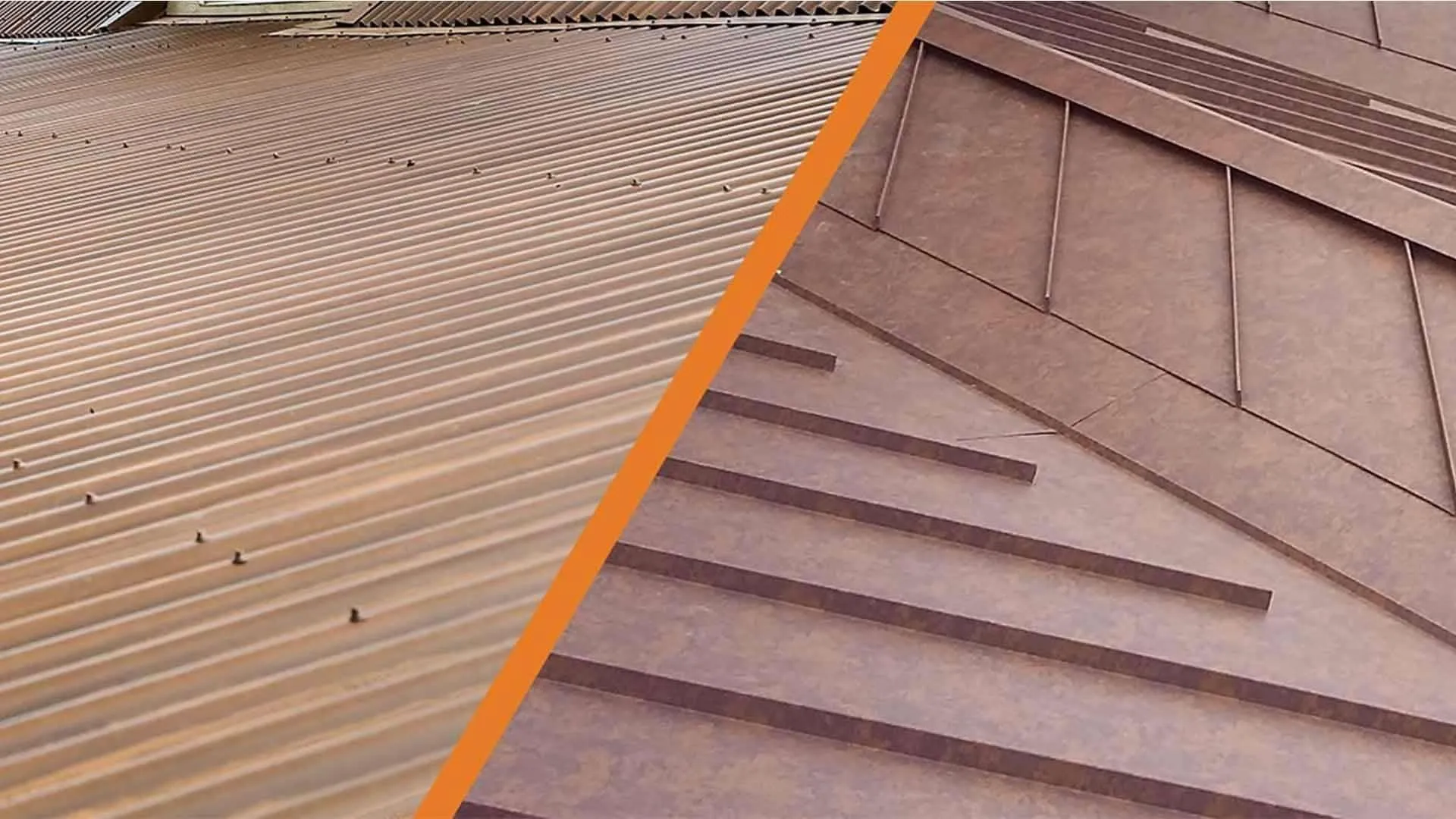
Standing seam metal roofing is better than corrugated for most residential homes because it uses hidden fasteners that seal out water, requires less maintenance, and lasts longer. Corrugated metal is a legitimate and more affordable option for budget-conscious homeowners, barns, shops, and cabins where the exposed-fastener profile fits the aesthetic and the cost matters more than maximum longevity. This guide walks through every major question homeowners in Watkinsville and Hiawassee ask before choosing between the two, including cost, lifespan, insurance implications, and what each type does well.
Is Standing Seam Better Than Corrugated Metal Roofing?
Yes, standing seam is better than corrugated metal for residential roofing in most situations. Standing seam uses concealed fasteners locked beneath raised vertical seams, which eliminates the primary leak risk that comes with corrugated metal’s exposed screws. It is also more durable, produces less maintenance over its lifetime, and carries a longer lifespan. Corrugated metal is better in situations where upfront cost is the primary concern, the project is a barn, shop, or outbuilding, or the homeowner prefers the classic wavy-panel look for a cabin or rural property.
Metal roofing installations have been increasing by over 15 percent annually as homeowners across the country discover the long-term value, according to FoxHaven Roofing’s 2026 industry analysis. In communities like Watkinsville and Hiawassee, that trend is visible in new builds and roof replacements alike, particularly as Georgia’s storm seasons push homeowners toward more durable systems.
What Are the Disadvantages of a Standing Seam Metal Roof?
The disadvantages of a standing seam metal roof are higher upfront cost, more complex installation requiring skilled labor, and limited DIY repair options compared to other roofing systems. Standing seam panels are typically made at 24 to 26 gauge, which is thicker than most corrugated panels, and the hidden fastener system requires trained installers to execute correctly. Mistakes during installation are less forgiving than with shingles or corrugated metal.
According to Monastery Roofing’s comparison data, standing seam can cost 30 to 40 percent more than corrugated metal, and the specialized labor required drives that gap wider on complex residential rooflines. A standing seam roof on a simple gable is more straightforward than one with multiple dormers, valleys, and penetrations, where the premium labor cost compounds.
Another disadvantage that is rarely mentioned is that standing seam panels can exhibit a condition called “oil canning,” which is a visible waviness in the flat areas of the panel that occurs from stress during manufacturing or installation. The Metal Construction Association recognizes this as a known characteristic of light-gauge metal products. It does not affect structural performance, but it can be visible under certain lighting conditions.
What Are the Disadvantages of Corrugated Metal Sheets?
The disadvantages of corrugated metal sheets are exposed fasteners that require ongoing maintenance, a higher risk of leaks over time as those fasteners age, and a limited aesthetic profile that does not complement most residential architectural styles. Every screw that penetrates a corrugated metal panel is a potential water entry point. The rubber EPDM washers under each screw seal the hole when installed, but those washers degrade under UV exposure and Georgia’s heat over time. Joyland Roofing recommends that corrugated metal roofs be inspected annually specifically to verify that fasteners remain tight and washers have not deteriorated.
Corrugated metal roofs also require more careful slope consideration. According to the Metal Roofing Alliance, corrugated panels need a minimum roof slope of 3:12 to ensure adequate water shedding. On slopes below that threshold, water moves too slowly across the surface and can work its way beneath the laps. Standing seam panels can be used on slopes as low as 1:4 in some mechanically seamed systems because the hidden, raised seam keeps water from penetrating regardless of speed.
The aesthetic limitation is real as well. Corrugated panels have an industrial and agricultural look that works beautifully on Hiawassee cabins, lakeside outbuildings near Lake Chatuge, and rural properties in Towns County. On a traditional or craftsman-style residential home in Watkinsville’s established neighborhoods, however, standing seam’s clean vertical lines are typically the better visual fit.
How Much Does a Standing Seam Metal Roof Cost for a 2,000-Square-Foot House?
A standing seam metal roof for a 2,000-square-foot house typically costs between $15,000 and $19,000 for a standard residential installation, according to Monastery Roofing’s price comparison data. Using premium materials, the cost can rise to $35 per square foot or higher depending on gauge, finish, and roof complexity. FoxHaven Roofing’s 2026 cost guide puts the installed range at $8 to $14 per square foot for standing seam across the country.
For a 2,000-square-foot house, corrugated metal typically costs $4 to $8 per square foot installed, making it roughly half the cost of standing seam in materials and labor. That price difference is meaningful upfront, but the math shifts when you factor in longevity. A standing seam roof that lasts 50 years costs less per year of protection than a corrugated roof replaced at 30 years.
The best way to get an accurate number for a specific home in Watkinsville or Hiawassee is a free inspection and written estimate from a licensed contractor. Roof pitch, number of penetrations, panel gauge choice, and the local labor market all affect the final number. Metal roofing in Watkinsville starts with exactly that kind of transparent estimate before any commitment is made.
What Is the Lifespan of a Standing Seam Metal Roof?
The lifespan of a standing seam metal roof is 40 to 70 years with proper care. Some high-quality standing seam installations using Galvalume steel or aluminum have documented lifespans exceeding 50 years, and copper standing seam roofs can last over 100 years. The Metal Roofing Alliance confirms that metal roofs generally last 40 to 70 years depending on material and installation quality.
That lifespan is two to three times longer than standard asphalt shingles and meaningfully longer than corrugated metal. For homeowners in Oconee County who are doing a permanent or very long-term roof replacement, standing seam is the product that most often means never replacing the roof again during their ownership of the home.
What Is the Lifespan of a Corrugated Metal Roof?
The lifespan of a corrugated metal roof is 20 to 50 years depending on material quality, maintenance regularity, and climate. Well-maintained corrugated steel with EPDM-washered screws inspected annually can reach the higher end of that range. Corrugated panels in high-humidity environments like Oconee County and the Hiawassee area, where moisture and heat accelerate screw washer breakdown, tend toward the lower end without diligent upkeep. According to Recon Roofing’s comparison data, corrugated roofs typically last 30 to 45 years, with more frequent maintenance required than standing seam systems.
How Much Would It Cost to Put a Metal Roof on a 1,000-Square-Foot House?
A metal roof on a 1,000-square-foot house would cost approximately $4,000 to $8,000 for corrugated metal or $8,000 to $14,000 for standing seam, depending on the pitch and complexity of the roof and local labor rates. Simpler gable roofs with few penetrations land at the lower end of those ranges. A more complex roofline with chimneys, valleys, and multiple slope changes costs more per square foot because of the additional labor and custom flashing work involved.
For small homes, barns, and workshops near Hiawassee, corrugated metal is frequently the practical choice at this size range. The lower installed cost and simpler profile make it a sound investment for outbuildings and secondary structures where long-term aesthetics and maximum longevity are less critical than budget efficiency.
Does Homeowners Insurance Go Down with a Metal Roof?
Yes, homeowners insurance generally goes down with a metal roof. Most insurance carriers offer premium discounts for homes with metal roofs because metal is significantly more resistant to fire, wind, hail, and storm damage than asphalt shingles. According to data from the Metal Roofing Alliance reported by Tadlock Roofing, homeowners who install metal roofs may see premium reductions of up to 35 percent. APC Roofing’s analysis of homeowner outcomes puts the typical discount range at 10 to 35 percent.
The discount reflects the reduced claims risk metal roofs represent to insurers. A well-installed metal roof on a home in Oconee County is far less likely to generate a hail or wind claim than an asphalt shingle roof of the same age, which means the insurer’s projected payout is lower. Insurance carriers reward that reduced risk with lower premiums.
To maximize insurance savings, the metal roof should carry a Class 4 impact resistance rating under UL 2218 and a Class A fire resistance rating. Standing seam roofs with these ratings qualify for the strongest discounts. Homeowners should contact their specific insurer before installation to confirm discount eligibility and get the discount amount in writing. According to Progressive Insurance, the age, material, and shape of the roof are all factors that influence homeowners insurance rates, and metal is among the materials viewed most favorably.
Why Do Insurance Companies Not Like Metal Roofs in Some Cases?
Some insurance companies do not like metal roofs because they can be more expensive to repair or replace than standard shingles, which means a larger claim payout if the roof is damaged. This is the primary reason some carriers may charge higher premiums on metal roofs despite their superior durability. The issue is most pronounced with older metal roofs where the product or gauge is no longer available for matching, creating a scenario where partial damage leads to a full replacement claim.
Standing seam roofs mitigate this concern because their hidden-fastener design and durable gauge mean they are rarely damaged by anything short of a direct impact or a falling tree. The exposure risk that drives higher premiums on some metal products is much lower for quality standing seam systems than for lower-grade corrugated metal or thin exposed-fastener panels. The bottom line: checking with your insurance carrier before choosing a specific metal product is always the right first step.
Do Metal Roofs Leak More Than Shingles?
No, metal roofs do not leak more than shingles when properly installed. In fact, a properly installed metal roof is often more resistant to leaks because of its interlocking panel design and, in the case of standing seam, hidden fasteners that create a watertight seal without any screw penetrations in the field of the panel.
The most common source of metal roof leaks is improper installation, not the material itself. According to Mountaintop Metal Roofing’s analysis, most problems with metal roofs leaking stem from poor installation practices. Misaligned panels, overtightened screws, poorly sealed penetrations around chimneys or vents, and incorrect flashing at wall transitions are all installation errors, not material failures. This is why the contractor you choose matters significantly more than the specific metal product you choose. Metal roofing is less forgiving of installation errors than asphalt shingles, which means an inexperienced installer can create leak risks on an otherwise excellent product.
For corrugated metal specifically, exposed fasteners are the primary ongoing leak risk. Each screw penetrates the panel and relies on an EPDM washer to seal the hole. As those washers age, they lose flexibility and can allow water entry. This is the core maintenance requirement that differentiates corrugated from standing seam over a 20 to 30-year horizon. Roof repair in Watkinsville for metal systems most often involves addressing failed fastener seals or corroded flashing, both of which a skilled contractor can fix cleanly before they become structural issues.
What Is the Biggest Problem with Metal Roofs?
The biggest problem with metal roofs is upfront cost combined with a limited pool of contractors who are fully qualified to install them correctly. Metal roofing installation, particularly standing seam, requires specialized tools, training, and experience that not every roofing contractor has. An improperly installed metal roof can leak, oil can, expand unevenly, or fail at the flashings in ways that are both expensive to fix and difficult to diagnose without expertise.
Secondary problems include thermal expansion noise, which occurs when large metal panels heat up and cool down during Georgia’s temperature swings between warm summers and cooler nights. This is most noticeable on standing seam panels without proper clip systems that allow free movement. Oil canning, as noted earlier, is an aesthetic issue common to lighter gauge panels. And for homes near the ocean, saltwater corrosion can affect some metal products, though this is not a concern for inland properties in Oconee County or Towns County.
Why Not Put a Metal Roof Over Shingles?
You can put a metal roof over shingles in many situations, but it is not always the best approach. The main risk is that old shingles trap moisture beneath the metal panels, which can cause underlayment and deck damage over time. Sheffield Metals warns that installing metal directly over granulated shingle underlayment can scratch the protective backside coating of the metal panels, leading to underside corrosion that starts from within the system.
A complete tear-off before metal installation allows the contractor to inspect the roof deck for any rot, soft spots, or water damage that has been building under the old shingles. That deck inspection is one of the most valuable parts of the metal installation process. It is also required if the insurance discount is tied to a full new installation, as many carriers specify a clean tear-off to qualify for their best discount terms. When budgeting for a metal roof in Watkinsville, the cost difference between tear-off and overlay is usually modest relative to the total project, and the long-term benefit of starting on a clean, inspected deck is significant.
Standing Seam vs Corrugated Metal: Full Side-by-Side Comparison
| Feature | Standing Seam | Corrugated Metal |
|---|---|---|
| Fastener type | Hidden, concealed beneath seam | Exposed screws with EPDM washers |
| Installed cost (per sq ft) | $8 to $14 | $4 to $8 |
| Lifespan | 40 to 70+ years | 20 to 50 years |
| Minimum slope | As low as 1:4 (mechanically seamed) | 3:12 minimum recommended |
| Maintenance required | Low; biennial inspection sufficient | Annual fastener and washer check required |
| Leak risk | Very low when installed correctly | Low when new; increases as washers age |
| Wind resistance | Up to 140+ mph | Strong; varies by gauge and fastener spacing |
| Aesthetic | Sleek, modern, residential-grade | Classic wavy pattern; rural and industrial |
| Insurance discount | 10–35% (strongest for Class 4 rated) | Some discount available; varies by carrier |
| Best use case | Residential homes, commercial, high-end remodels | Barns, cabins, workshops, budget residential |
| Solar panel compatibility | Excellent; no penetrations required | Possible; requires penetration-based mounting |
| Recyclable | 100% recyclable at end of life | 100% recyclable at end of life |
Sources: FoxHaven Roofing 2026 cost and lifespan guide; Monastery Roofing price comparison data; Joyland Roofing pros and cons analysis; Metal Roofing Alliance lifespan data; Recon Roofing corrugated metal overview.
When Should You Not Use a Metal Roof?
You should not use a metal roof when the roof slope is too low for the product type, the existing deck has extensive rot or structural damage that needs to be addressed first, or when the budget does not allow for proper installation by a trained contractor. A poorly installed metal roof due to cost-cutting on labor is far worse than a properly installed asphalt shingle roof.
You should also reconsider metal roofing if your home is in a high-corrosion coastal environment and you cannot access the right metal alloy for those conditions, though this is not a concern for homes in inland Oconee County or the Hiawassee area. In these Georgia communities, metal roofing is a strong choice for most residential applications and commercial buildings. Commercial roofing in Watkinsville increasingly uses standing seam for its minimal maintenance and long service life on low-slope commercial applications as well.
Why Don’t All Houses Use Metal Roofs?
All houses do not use metal roofs primarily because of the higher upfront cost compared to asphalt shingles, which remain the most affordable roofing material per installed square foot. According to Rubyhome’s national roofing statistics, metal roofing still accounts for only about 1 in 10 roofing projects in the U.S., while asphalt shingles dominate with approximately 80 percent market share.
Other factors include availability of qualified installers, homeowners association restrictions in some neighborhoods, and the reality that many homeowners plan to sell within 10 to 15 years, which can make the long-term durability argument for metal less compelling than for someone staying permanently. The calculation changes when you factor in insurance savings, reduced maintenance, energy efficiency gains from reflective metal surfaces, and the value it adds at resale. A study cited by Tadlock Roofing found that homeowners can recoup an average of 85.9 percent of metal roof costs in home resale value, which is a strong return for an exterior upgrade.
For long-term homeowners in Watkinsville and Hiawassee, the financial case for metal is often compelling. The combination of lower lifetime maintenance, insurance premium reductions of 10 to 35 percent per year, and energy savings of 7 to 15 percent on cooling costs can offset the higher initial investment over a realistic ownership horizon. Roof replacement in Watkinsville is a good opportunity to run through that comparison with a local contractor before settling on a material.
Does a Metal Roof Devalue a House?
No, a metal roof does not devalue a house. Metal roofs add measurable value to residential properties in most markets. According to Remodeling Magazine’s 2022 Cost vs. Value Report, metal roofs received a 54.8 percent return on investment in that report cycle. Tadlock Roofing cites the same study with an average cost recoup figure of 85.9 percent when accounting for the full product range and market conditions.
In storm-active areas like Oconee County and Towns County, where buyers are aware of the ongoing cost of maintaining an asphalt shingle roof through Georgia’s hail and wind seasons, a documented metal roof can be a meaningful positive differentiator at the time of sale. Buyers know they are not inheriting an imminent replacement project, and they may benefit from the insurance premium discounts already in place on the property.
Frequently Asked Questions
Is Standing Seam or Corrugated Metal Better for Homes Near Hiawassee and Lake Chatuge?
Standing seam metal is better for most residential homes near Hiawassee and Lake Chatuge because of its sealed fastener system, which handles the area’s heavy spring rains and occasional mountain storm events without the ongoing maintenance that corrugated metal requires. Corrugated metal is an excellent choice for outbuildings, camps, and cabins near the lake where the rural aesthetic is appropriate and the budget is the primary constraint. Both options perform well in the climate of Towns County, but standing seam offers significantly lower lifetime maintenance for a primary residence.
What Is the Minimum Slope for a Corrugated Metal Roof?
The minimum slope for a corrugated metal roof is generally 3:12, meaning the roof rises three inches for every twelve inches of horizontal run. Below this slope, water moves too slowly across the corrugated surface and can work its way beneath the panel laps, creating leak risk. Some manufacturers specify 2:12 for their products with additional sealant requirements, but 3:12 is the widely accepted practical minimum for corrugated metal in residential applications. Standing seam panels with mechanically seamed joints can be used on much lower slopes, sometimes as low as a 1:4 pitch, because the raised seam height keeps water from backing up regardless of the slope angle.
What Are the Top 5 Metal Roofs Available in Watkinsville?
The top five metal roof product types available through qualified contractors in the Watkinsville area are Galvalume standing seam steel panels, aluminum standing seam panels, corrugated galvanized steel, stone-coated metal shingles, and metal shake or tile profiles. Galvalume steel at 24 gauge is the most common installation for residential standing seam because it balances cost and durability well for Georgia’s climate. Aluminum is preferred for properties with higher moisture exposure. Stone-coated metal shingles are a growing option for homeowners who want the aesthetic of dimensional shingles with the lifespan of metal. Talking with a licensed local contractor is the best way to identify which specific products are currently available and how each fits your roof design and budget.
Does Homeowners Insurance Discount Apply in Georgia for Metal Roofs?
Yes, homeowners insurance discounts for metal roofs are available in Georgia, though the specific discount amount varies by carrier. Insurers operating in Oconee County and Towns County recognize that metal roofs generate fewer claims from hail and wind events than asphalt shingle roofs. Typical discounts range from 10 to 35 percent depending on the policy type, the roof’s impact resistance rating, and the insurer’s own discount program. Homeowners should contact their specific carrier before installation to confirm the discount amount and what documentation is required to qualify, typically a manufacturer’s product certification and proof of installation by a licensed contractor.
What Is the Cheapest Longest-Lasting Metal Roof Option?
The cheapest longest-lasting metal roof option is corrugated galvanized or Galvalume steel, which offers meaningful durability at an installed cost of $4 to $8 per square foot. With proper annual maintenance, corrugated steel can deliver 30 to 45 years of service. For those willing to invest more upfront, 24-gauge Galvalume standing seam steel delivers the best combination of cost and lifespan across the full metal roofing category, lasting 40 to 70 years with very low ongoing maintenance. Compared to asphalt shingles that need replacement every 15 to 25 years, either metal option delivers a lower cost per year of protection over a 50-year ownership horizon.
Are Metal Roofs Cheaper to Install Than Shingles?
No, metal roofs are not cheaper to install than shingles at the time of installation. Architectural asphalt shingles typically cost $4 to $6.50 per square foot installed, while corrugated metal runs $4 to $8 and standing seam runs $8 to $14. The financial advantage of metal roofing is in the long-term cost per year of service life, not in the upfront number. Over 50 years, a homeowner who replaces an asphalt shingle roof twice at $10,000 per replacement pays more total than one who installs a standing seam metal roof once at $18,000. Add in lower maintenance, insurance savings, and energy efficiency over that span, and the math typically favors metal for anyone planning to stay in the home for 20 or more years.
What Type of Roof Adds the Most Value to a Home in Oconee County?
Standing seam metal roofing adds the most value to a home in Oconee County when you combine resale impact, insurance premium savings, maintenance reduction, and energy efficiency. According to Tadlock Roofing’s analysis of Remodeling Magazine data, metal roofs offer an average cost recoup of 85.9 percent at resale, which is among the highest for any exterior home improvement. Buyers in Watkinsville and the surrounding Oconee County area increasingly recognize the value of a metal roof, particularly those who have experienced the cost of repeated asphalt shingle repairs after storm seasons. A standing seam roof with a Class 4 impact rating is the strongest combination of durability, insurance advantage, and resale value available in the residential roofing market today.
Ready to Explore Metal Roofing for Your Home?
Whether you are comparing standing seam to corrugated, or weighing metal against asphalt shingles, the right answer depends on your specific roof, your budget, how long you plan to stay, and what your insurance carrier offers for each product type. Getting those answers does not require guesswork.
The team at Ridgeline Roofing and Exteriors serves homeowners across Watkinsville, Hiawassee, and the surrounding Oconee and Towns County communities. They offer free inspections and transparent written estimates that let you compare your options with real numbers for your specific home.
Visit the Watkinsville roofing services page to schedule your free inspection and get the information you need to make the right call for your roof.