Skip to content
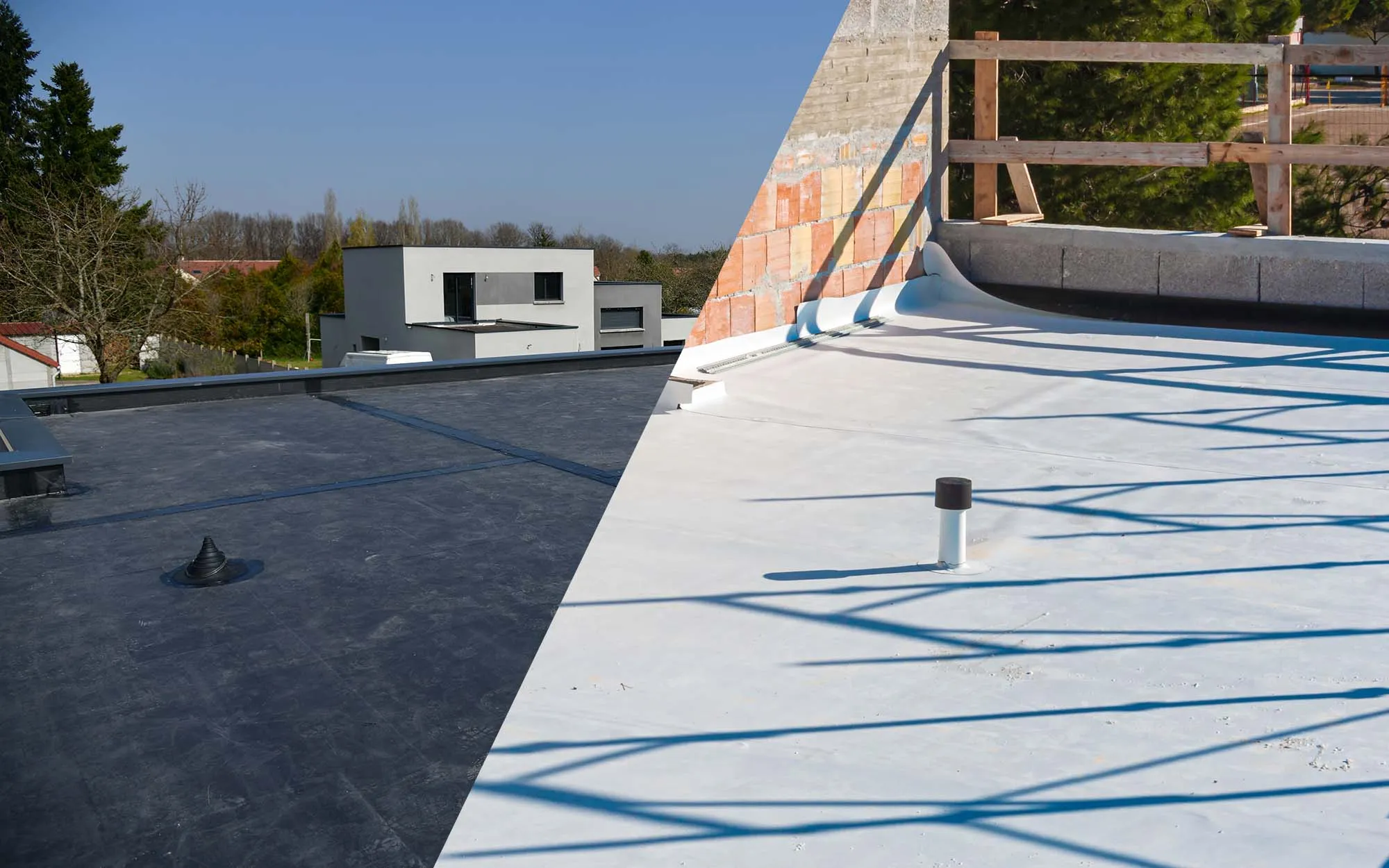
TPO and EPDM are both single-ply membrane roofing systems designed for flat and low-slope commercial roofs, but they differ significantly in composition, energy performance, cost, and ideal application. TPO is a thermoplastic membrane that reflects solar heat, uses heat-welded seams, and commands approximately 40% of the commercial flat roofing market according to the National Roofing Contractors Association. EPDM is a synthetic rubber membrane that has been in use since the 1960s, offers excellent cold-weather flexibility, and generally provides a longer service life. For commercial building owners in Watkinsville and Hiawassee, choosing between the two systems depends on your building’s energy goals, budget, local climate, and how long you plan to own the property. This guide answers every question building owners ask about TPO versus EPDM so you can make a fully informed decision.
Why Choose TPO Over EPDM?
You choose TPO over EPDM primarily for its energy efficiency, stronger seams, and better performance in hot, sunny climates. TPO’s white or light-colored surface reflects UV radiation rather than absorbing it, which reduces cooling loads and can meaningfully lower energy costs for buildings in warm regions like Georgia. According to Nations Roof, TPO is best for properties prioritizing UV reflection and cooling savings. Heat-welded TPO seams create bonds that are stronger than EPDM’s adhesive-bonded seams, reducing the risk of seam failures that allow water infiltration over time. TPO also resists chemicals, mold, and physical damage better than EPDM, making it the better choice for industrial or commercial environments with rooftop chemical exposure.
According to Hixon’s Roofing, which has installed thousands of commercial flat roof systems across South Carolina and Georgia since 1984, TPO has captured 40% of the commercial roofing market because it combines the heat-welded seam reliability of PVC with the weather resistance of EPDM at a competitive price point. For commercial buildings in the Watkinsville area, where Georgia summers are hot and long, TPO’s reflective surface provides real ongoing energy savings that partially offset its slightly higher initial installation cost compared to basic EPDM systems.
What Type of Roof Do Most Commercial Buildings Have?
Most commercial buildings have flat or low-slope roofs covered with single-ply membrane systems, with TPO being the most widely installed material. According to the National Roofing Contractors Association’s market survey, TPO commands approximately 40% of new commercial flat roofing installations and 30% of the reroofing market. EPDM follows at approximately 22% of new construction and 26% of reroofing according to the same NRCA data. PVC, modified bitumen, and built-up roofing systems make up the remaining market share.
The dominance of flat roofs in commercial construction comes from their practical advantages for large structures: lower installation cost than pitched roofs, easier installation of HVAC and rooftop equipment, and better use of interior ceiling height in warehouses and retail spaces. According to DeMarcо Inc., flat roofs are particularly practical for large buildings with wide spans like warehouses, shopping centers, and multi-story offices. For commercial building owners in Oconee County and Towns County, the specific system installed on their property depends heavily on the age of the building, the original contractor’s material preference, and any upgrades completed since original construction.
What Are the Disadvantages of a TPO Roof?
The disadvantages of a TPO roof are an uncertain long-term track record compared to EPDM, complex installation that requires certified welding professionals, potential seam vulnerability when improperly welded, and quality variability between manufacturers. According to David Maines and Associates, TPO is a relatively newer material than EPDM, so it is still difficult to accurately predict how long each installation will last because there simply are not as many decades of field data. Most estimates put TPO lifespan at 15 to 20 years, though well-installed systems with quality membranes may reach 25 to 30 years.
According to C-Port, some TPO formulations may not last much past the 10-year mark depending on the manufacturer and specific product grade, which reflects the real variability in quality that exists across the market. Heat-welded seams are TPO’s greatest technical advantage, but they are also a liability if the installation is done by an inexperienced contractor. A poorly welded seam on a TPO roof creates a direct water infiltration pathway that adhesive-bonded EPDM seams do not, because EPDM’s seam failure mode is gradual separation rather than an abrupt weld failure. For commercial buildings in the Hiawassee area with complex rooflines or multiple penetrations, ensuring the TPO contractor has verifiable heat-welding experience and certification is a critical qualification check before any contract is signed.
What Is the Life Expectancy of TPO vs EPDM?
The life expectancy of TPO is 15 to 20 years for a standard installation, with well-maintained premium systems potentially reaching 25 to 30 years. The life expectancy of EPDM is 20 to 30 years for standard installations, with properly maintained systems potentially reaching 40 to 50 years. According to Best Roofing LA, EPDM roofs generally have a longer lifespan ranging from 30 to 40 years, and with excellent maintenance, some EPDM installations can even last up to 50 years. According to Nations Roof, EPDM is best for facilities needing long lifespan and proven performance over decades.
The lifespan difference between the two systems reflects both their different material compositions and their different track records. EPDM has been installed on commercial buildings since the 1960s, and the NRCA has decades of real-world performance data across thousands of installations. According to Hixon’s Roofing, EPDM installations from the 1970s are still performing today in some documented cases. TPO was introduced commercially in the 1980s and became widespread in the 1990s and 2000s, meaning the longest available field data on TPO performance is roughly 25 to 35 years. For building owners in Watkinsville who are planning to hold their property for 25 or more years, EPDM’s longer documented lifespan is a meaningful factor in the total cost of ownership calculation.
Which Is Cheaper, TPO or EPDM?
EPDM is generally cheaper per square foot than TPO for materials, but TPO is the least costly of all rolled rubber roofing options when the full installation is considered on a project basis. According to O’Connor Roofing, TPO roofing materials range from $5 to $12 per square foot, while EPDM roofing materials are priced between $4 and $10 per square foot. According to HomeGuide, installed costs for both systems range from $5 to $10 per square foot for standard commercial projects, with the total project cost varying based on roof size, complexity, insulation thickness, and labor rates.
On a raw materials basis, EPDM is usually cheaper by 10% to 20% per square foot because its installation method, particularly ballasted systems using loose-laid membrane weighted with river rock, requires less labor and less specialized equipment than TPO’s heat-welded installation. However, when energy costs are factored in over the building’s lifespan, TPO’s reflective surface provides cooling savings that can close or eliminate the initial cost gap, particularly in Georgia’s hot summers. For commercial building owners in the Watkinsville area with significant air conditioning loads, the energy cost calculation over 10 to 15 years often makes TPO the more cost-effective system overall despite the higher material cost.
How Long Does 60 Mil TPO Last?
60 mil TPO lasts 20 to 30 years under good installation and maintenance conditions, with some manufacturers offering extended warranty coverage up to 30 years for 60 mil systems. Mil refers to membrane thickness; standard commercial TPO is 45 mil or 60 mil, with 60 mil being the thicker and more durable option. According to multiple roofing sources, thicker membranes provide better resistance to punctures from rooftop foot traffic and equipment installation, better UV resistance over time, and generally support longer manufacturer warranty periods.
The 60 mil thickness is specifically recommended for commercial buildings with rooftop equipment access, regular maintenance foot traffic, or buildings in hail-prone regions. For commercial properties in North Georgia, where afternoon thunderstorms regularly produce hail and high winds, the additional cost of 60 mil TPO over standard 45 mil is a sound investment in durability. A licensed commercial roofing contractor can assess your specific building’s rooftop traffic patterns and equipment layout to recommend the appropriate membrane thickness before any installation or replacement project begins.
What Is the Best Material for a Commercial Flat Roof?
The best material for a commercial flat roof depends on the building’s location, use, energy goals, and budget, but TPO is the best overall choice for most commercial buildings in warm climates like Georgia. According to Hixon’s Roofing, TPO offers the best balance of cost, performance, and energy efficiency for most commercial buildings. TPO’s white reflective surface addresses the heat absorption problem that affects EPDM and modified bitumen systems in hot climates, its heat-welded seams provide superior waterproofing compared to adhesive-bonded systems, and its market maturity means certified installers and compatible repair materials are widely available.
EPDM is the better choice for buildings where the primary priority is proven longevity and maximum lifespan, where the climate involves extreme cold that benefits from EPDM’s superior low-temperature flexibility, or where the budget requires minimizing upfront installation cost. PVC is the best choice when chemical resistance is the overriding concern, such as buildings with restaurant exhaust systems or chemical storage near the roof surface. For standard commercial, retail, and office buildings in Watkinsville and Hiawassee, TPO with 60 mil membrane thickness installed by a certified contractor is the starting recommendation for most new installations and replacements.
What Is the 25% Rule in Roofing?
The 25% rule in roofing is a building code standard that requires a full permitted roof replacement when more than 25% of a commercial roof surface is repaired or replaced within a 12-month period. This rule applies in most Georgia jurisdictions including Oconee County and Towns County and prevents property owners from making large piecemeal repairs that bypass the permitting and code compliance requirements of a complete replacement. For flat commercial roofs, this rule matters because widespread storm damage or age-related membrane failure often affects more than a quarter of the roof surface, making the full replacement both the code-required and the practically sound outcome.
When a full commercial roof replacement is triggered, the decision between TPO and EPDM becomes a significant one because it sets the building’s roofing performance for the next 20 to 30 or more years. Taking the time to evaluate both systems against the building’s specific energy use, climate exposure, rooftop traffic, and long-term ownership plans before selecting the replacement system is worth the effort. A licensed local commercial roofing contractor can provide guidance based on actual field experience with both systems in Georgia’s climate.
How to Tell If a Roofer Is Lying
You can tell if a roofing contractor is lying if they cannot explain the specific material specifications they are recommending including membrane thickness and manufacturer, if they propose one system over another without explaining the technical reasons relevant to your building’s specific conditions, if they cannot provide verifiable certification for heat-welding TPO if that is what they are proposing, or if their written proposal lacks itemized line items separating membrane cost, insulation, labor, edge metal, and flashing. For commercial roofing specifically, a contractor who recommends TPO but does not have documented heat-welding experience or training certification is telling you what you want to hear, not what your building needs.
A trustworthy commercial roofing contractor will explain why they are recommending TPO versus EPDM for your specific building based on factors including roof pitch, rooftop equipment, climate, energy costs, and ownership timeline. They will provide manufacturer product data sheets, warranty documentation, and an itemized proposal that makes every component of the cost transparent. For business owners in Watkinsville and Hiawassee, a licensed local contractor who has installed both TPO and EPDM on Georgia commercial buildings will give you an informed recommendation based on real-world experience in this specific climate, not generic national marketing claims.
What Is Better Than TPO Roofing?
PVC roofing is better than TPO in specific applications where chemical resistance is the overriding concern, such as buildings with rooftop kitchen exhaust systems, chemical processing facilities, or industrial plants where grease and solvents come in contact with the roof membrane. According to M&M Roofing, using EPDM or TPO in those conditions means premature failure, and PVC is the correct specification for those environments. Standing seam metal roofing is better than TPO when the building’s long-term ownership plan exceeds 40 years and the budget allows for the higher upfront investment, because metal roofing can last 50 or more years with minimal maintenance.
EPDM is better than TPO specifically for cold-climate applications where the roof experiences extended periods of sub-freezing temperatures, and for buildings where proven longevity over 30 to 40 years is the highest priority. For the large majority of standard commercial buildings in the Watkinsville and Hiawassee areas, TPO represents the best overall value among single-ply systems. But for a restaurant with a commercial kitchen exhaust system discharging onto the roof surface, or an industrial building with chemical storage, PVC is the right specification regardless of cost. The best material for your building is the one that matches your specific application, and that determination requires a physical inspection and technical assessment from a qualified commercial roofing contractor.
Why Do Insurance Companies Not Like Flat Roofs?
Insurance companies do not like flat roofs because they are more susceptible to water pooling, drainage failures, and membrane deterioration than pitched roofs, which leads to more frequent and more expensive claims. According to David Maines and Associates, poorly installed EPDM roofs in particular are more likely to develop ponds of standing water, which can cause mold growth and long-term structural damage. The flat geometry of commercial roofs means that any drainage system failure, whether clogged drains, scuppers, or internal drains, immediately creates ponding conditions that a pitched roof would naturally shed.
Some insurers apply separate deductibles or coverage limitations to flat roofs, particularly for older membranes, in regions with high storm activity. For commercial building owners in North Georgia, maintaining a documented inspection and maintenance schedule for the flat roof system is one of the most important steps to preserving both the physical condition of the roof and the coverage terms of the insurance policy. According to GEICO’s insurance guidance, gradual seepage and long-term deterioration from neglect are excluded from standard commercial property coverage, which means maintenance documentation is also a financial protection tool against claim denials.
How Many Years Does a TPO Roof Last?
A TPO roof lasts 15 to 20 years for standard installations and up to 25 to 30 years for premium 60 mil systems with proper maintenance and professional installation. According to Roof Medic, the average lifespan for TPO ranges from 15 to 20 years, though some manufacturers claim extended warranties of up to 30 years for their premium product lines. According to EverSeal, many TPO roofing systems have failed much sooner than their anticipated lifespan, especially in areas known for excessive heat and ultraviolet light, which is a real caveat for Georgia’s climate.
The installation quality has the largest single impact on how long a TPO roof actually lasts. A properly heat-welded 60 mil TPO system installed by a certified contractor with quality membrane from a reputable manufacturer has a realistic expectation of 20 to 25 years in Georgia’s climate. The same membrane installed by an inexperienced crew with improperly welded seams may develop leaks within 5 to 7 years. This is why verifying contractor certification and installation experience is not optional for commercial TPO projects in Watkinsville or Hiawassee, where summer heat and UV intensity create an environment that will test every seam from the first year onward.
What Is the Cheapest Longest Lasting Roof?
The cheapest longest lasting flat commercial roof is a properly installed EPDM system. EPDM has the lowest material cost among single-ply membranes, with materials ranging from $4 to $10 per square foot, and it has the longest documented lifespan, reaching 30 to 40 years with proper maintenance and in some cases up to 50 years. The combination of relatively low upfront cost and exceptional longevity gives EPDM the best total cost per year of service life among single-ply roofing systems for commercial buildings where energy efficiency is not the primary concern.
For pitched commercial roofs, standing seam metal provides the longest lifespan at 40 to 70 years or more, but at a higher upfront cost. For commercial buildings in North Georgia that are primarily warehouses, industrial facilities, or rural structures where cooling costs are less critical and the owner’s priority is maximum lifespan per dollar invested, EPDM is the honest answer to cheapest longest lasting. For buildings with significant HVAC loads where TPO’s reflective savings matter, the calculation shifts and TPO becomes competitive over its service life despite the higher initial cost. A licensed commercial roofing contractor can run the actual numbers for your specific building’s energy profile.
Can Water Sit on an EPDM Roof?
Water should not sit on an EPDM roof for extended periods, but EPDM can tolerate temporary ponding better than many other membrane systems because of its inherent elasticity and waterproofing properties. According to David Maines and Associates, EPDM’s susceptibility to ponding is a real concern specifically when the roof is poorly installed, because accumulated standing water can cause mold to grow on the membrane surface and cause long-term damage to both the membrane and the insulation below. The EPDM membrane itself is waterproof and will not immediately degrade from water contact, but prolonged standing water adds structural load, promotes biological growth, and accelerates the deterioration of seam adhesives and edge flashings.
The correct approach to ponding water on any flat commercial roof, whether EPDM or TPO, is to address the drainage system that is allowing the ponding rather than to accept it as a condition the membrane will tolerate indefinitely. Drains should be inspected and cleaned at least twice per year for commercial flat roofs in Georgia’s climate, where leaf fall, storm debris, and organic growth can block drains quickly. A rooftop that accumulates standing water after every rain event has a drainage deficiency that will shorten the membrane life of any system installed on it.
What Is the Cheapest Time of Year to Get a New Roof?
The cheapest time of year to get a new commercial roof is late fall through early winter, from November through February in Georgia. Roofing contractors in the Watkinsville and Hiawassee areas are at peak capacity from spring through early fall when storm season keeps commercial repair and replacement crews fully booked. Scheduling a commercial roof replacement in the winter months typically means better contractor availability, faster project scheduling, and in many cases more competitive pricing from local contractors who have schedule capacity to fill during the slower season.
For commercial building owners with a planned membrane replacement on their capital expenditure schedule, the off-season timing advantage is real and worth planning for. The savings of 5% to 15% on a $50,000 to $100,000 commercial roofing project represent several thousand dollars. That said, a failing commercial roof that is actively leaking cannot wait for seasonal pricing. Water intrusion into a commercial building’s insulation, structure, and interior disrupts operations and causes damage that rapidly exceeds any seasonal cost differential.
What Are the Common Problems With TPO Roofing?
The common problems with TPO roofing are seam failures from improper heat welding, shrinkage that pulls seams and flashings apart over time, membrane punctures from foot traffic or rooftop equipment, and premature aging from UV exposure in some lower-quality membrane formulations. According to C-Port, heat welding the seams requires very high-quality installation to hold up over time, and some TPO formulations may not last much past the 10-year mark depending on the manufacturer and product grade. According to McElroy Metal, TPO is prone to shrinkage like EPDM, which can lead to leaks at penetrations, curbs, and seams.
The most preventable TPO problem is seam failure from poor installation. A contractor who uses an improperly calibrated heat welder, performs welding in cold or wet conditions without the proper setup, or rushes the installation to reduce labor time creates seams that look acceptable during construction but fail within three to five years as the membrane cycles through temperature changes. Ensuring the contractor you hire for a commercial TPO project in Watkinsville has documented training and manufacturer certification for TPO heat welding is the single most effective quality control step available to any building owner before a project begins.
Is EPDM 100% Waterproof?
Yes, EPDM membrane itself is 100% waterproof when it is intact, but a completed EPDM roof system is only as waterproof as its seams, flashings, and penetration details. The EPDM membrane is a synthetic rubber material that will not allow water passage through an undamaged section. However, EPDM seams sealed with adhesive and tape are the weakest points in the system and can separate over time. According to American WeatherStar, EPDM seams are prone to failure because they are not as strong as the heat-welded seams that TPO and PVC offer. When an EPDM seam separates, the system is no longer waterproof at that location regardless of how intact the surrounding membrane is.
Proper EPDM installation includes lapping seams according to manufacturer specifications, using compatible adhesives and tapes rated for the installation conditions, and terminating the membrane correctly at all roof edges and penetrations with appropriate flashing details. A well-installed EPDM roof with all seams, flashing, and terminations done correctly functions as a fully waterproof system for its full rated service life. An EPDM installation with shortcuts at the seams or penetrations will fail in those specific locations first, and the rest of the membrane’s waterproof integrity is irrelevant if water is entering through a failed lap or termination bar.
What Is the Longest Lasting Flat Roof Material?
The longest lasting flat roof material is EPDM, with documented installations from the 1970s still performing today and maximum lifespans reaching 40 to 50 years under ideal maintenance conditions. According to Best Roofing LA, some EPDM roofing installations can last up to 50 years with excellent maintenance, making them the most durable choice among standard single-ply commercial roofing systems. For applications where absolute maximum lifespan is the priority and energy efficiency is secondary, EPDM is the honest answer.
Among all commercial roofing material categories including pitched systems, standing seam metal roofing provides the longest lifespan at 40 to 70 years or more, but it is not a flat roof material in the traditional sense. For a building with an existing flat roof structure that requires a flat or low-slope roofing system, EPDM provides the longest expected service life of the available membrane options at competitive cost. For commercial properties in Hiawassee and Watkinsville where the owner’s intent is to hold the asset for 30 or more years without a second roof replacement, the total cost picture for a quality EPDM system is compelling.
How Much Does a 10 Foot Roll of 60 Mil TPO Weigh?
A standard 10-foot wide roll of 60 mil TPO weighs approximately 80 to 100 pounds per 100 linear feet of material, with the exact weight depending on the specific manufacturer’s formulation and reinforcement layer. The 60 mil thickness is heavier than 45 mil TPO, which runs approximately 55 to 75 pounds per 100 linear feet. Commercial TPO is delivered in 10-foot, 12-foot, and wider rolls that require a boom truck or crane to hoist onto the roof, as most commercial rolls are too heavy and large to carry up a ladder by hand.
The weight and handling requirements for commercial TPO rolls are a practical reason why this material should be installed by experienced commercial roofing crews with the proper equipment, not by residential roofing contractors who are unfamiliar with the material handling and heat-welding requirements. For commercial building owners in the Watkinsville area vetting potential contractors for a TPO installation, asking about the equipment and crew size used for material handling on a commercial project is a reasonable question that will quickly differentiate experienced commercial contractors from those who have primarily done residential work.
How Long Can Water Sit on a TPO Roof?
Water should not sit on a TPO roof for more than 48 to 72 hours after a rain event. According to industry guidelines and building code standards, ponding water on any flat commercial roof system is considered a drainage deficiency. Prolonged ponding on a TPO membrane accelerates UV degradation at the waterline where the membrane repeatedly cycles between wet and dry, adds structural load to the roof deck, and can degrade the insulation below the membrane if any seam or penetration detail is not perfectly sealed. FoxHaven Roofing confirms that commercial roofs should be inspected for standing water after rain events, and persistent ponding is a maintenance issue that must be addressed.
For commercial buildings in Georgia with flat TPO roofs, fall debris buildup in internal drains is the most common cause of ponding after storms. A simple maintenance commitment to cleaning roof drains twice per year, and after every significant storm that deposits leaves or debris, is the most cost-effective way to prevent the drainage problems that shorten flat roof system lifespans regardless of material type. A licensed commercial roofing contractor can evaluate your current drainage design and recommend improvements like additional drains, scupper modifications, or tapered insulation to eliminate chronic ponding areas.
How Thick Should a TPO Roof Be?
A TPO roof should be at least 45 mil thick for standard commercial applications and 60 mil thick for buildings with rooftop foot traffic, heavy equipment, or locations in storm-prone regions. The National Roofing Contractors Association and major TPO manufacturers recommend 60 mil for most commercial installations because it provides significantly better puncture resistance, better UV resistance over the membrane’s full lifespan, and typically supports longer manufacturer warranty coverage. The modest cost difference between 45 mil and 60 mil TPO per square foot is easily justified by the extended performance and warranty terms the thicker membrane provides.
For commercial buildings in North Georgia that experience regular hail events in addition to heavy foot traffic from HVAC maintenance crews, 60 mil TPO is the correct specification. The Watkinsville and Hiawassee areas see afternoon thunderstorms capable of producing hail throughout the spring and summer, and the thicker membrane provides meaningful additional hail impact resistance compared to 45 mil products. A licensed commercial roofing contractor will specify the appropriate thickness as part of the design and proposal process for any new installation or replacement project.
Is TPO or EPDM Better?
TPO is better for commercial buildings in hot climates where energy savings from solar reflectance are significant, where heat-welded seam strength is a priority, and where the building owner wants a white, modern-looking roof. EPDM is better for buildings where maximum lifespan is the primary goal, where cold-weather flexibility is important, where the budget requires the lowest possible upfront cost, and where the proven multi-decade track record of the material provides confidence that TPO’s shorter history cannot yet match. According to Nations Roof, TPO is best for properties prioritizing UV reflection and cooling savings, and EPDM is best for facilities needing long lifespan and cold-weather flexibility.
For most commercial buildings in the Watkinsville and Hiawassee areas of Georgia, TPO with 60 mil membrane is the better all-around choice because Georgia’s hot summers make the energy savings from a reflective roof real and ongoing. The one clear exception is for buildings with planned ownership of 30 or more years where maximizing lifespan per dollar invested is the overriding priority, in which case EPDM’s documented longevity gives it the edge. Both systems are legitimate choices that perform well when properly specified and installed by a qualified commercial roofing contractor.
What Is the Most Common Type of Commercial Roofing?
The most common type of commercial roofing is TPO (Thermoplastic Polyolefin) single-ply membrane, which commands approximately 40% of new commercial flat roofing installations according to the National Roofing Contractors Association. EPDM is the second most common, capturing approximately 22% of new construction installations. Together, TPO and EPDM account for well over half of all new commercial flat roof installations in the United States, with PVC, modified bitumen, and built-up roofing making up most of the remainder according to NRCA market data.
In the Southeast and Georgia specifically, TPO’s market dominance is likely even higher than the national average because the hot, sunny climate makes the energy savings from a reflective white TPO surface especially valuable compared to EPDM’s heat-absorbing dark surface. For commercial building owners in Oconee County and Towns County evaluating roofing options for the first time, the widespread availability of qualified TPO contractors, compatible repair materials, and established manufacturer warranty programs is another practical advantage of choosing the market-leading system.
What Are the Disadvantages of EPDM?
The disadvantages of EPDM roofing are seam vulnerability, heat absorption from the dark membrane surface, susceptibility to shrinkage in high-temperature zones, reduced puncture resistance compared to TPO, and the requirement for periodic adhesive maintenance at seams over the roof’s lifespan. According to McKinnis Roofing, one of the primary weaknesses of EPDM is that the seams between rolls can allow water in because they rely on adhesive bonding rather than heat welding. According to C-Port, EPDM is prone to shrinkage that can pull away at the seams and penetrations especially in high-temperature zones.
The black color of most EPDM systems is both an aesthetic disadvantage and an energy disadvantage in hot climates. EPDM absorbs solar heat rather than reflecting it, which contributes to higher interior temperatures and increased air conditioning costs. According to David Maines and Associates, EPDM provides passive heating in cold climates, which is an advantage in the northern United States but is the opposite of what Georgia commercial building owners need through the summer months. White EPDM is available but is less common, costs more, and does not have the same reflectance performance as TPO’s standard white membrane. For commercial buildings in the Watkinsville area with significant air conditioning loads, the energy cost difference between EPDM and TPO over 15 years can be substantial.
Why Do Insurance Companies Not Like Rolled Roofing?
Insurance companies do not like rolled roofing, including EPDM and some modified bitumen systems, primarily because these systems have historically shown higher claim rates from ponding water, seam failures, and drainage issues than other commercial roofing types. Flat roofs in general present a higher risk profile for insurers because they cannot shed water by gravity the way pitched roofs do, making them more dependent on properly functioning drains and seams. An EPDM roof with adhesive seams that are beginning to separate will allow water infiltration with every significant rainfall, which leads to repeated claims over a short period.
For commercial building owners in Georgia seeking to maintain strong insurance coverage at competitive premiums, keeping documentation of annual professional roof inspections, prompt repair of any identified seam separations or membrane damage, and clear records of drain cleaning and maintenance is the most practical approach. According to the Insurance Information Institute, gradual deterioration and deferred maintenance are not covered perils under standard commercial property policies, which means a building owner whose EPDM seams have been failing progressively for two years before causing an interior water claim will likely find that claim disputed or denied.
What Are Common Problems With EPDM Roofs?
The common problems with EPDM roofs are seam separation and adhesive failure, membrane shrinkage that pulls seams and termination bars away from the deck, ponding water in areas with drainage deficiencies, punctures from HVAC equipment installation or maintenance foot traffic, and in older systems, brittleness and cracking at seams and flashings as the rubber ages. According to American WeatherStar, EPDM seams are prone to failure because they are not as strong as heat-welded seams, and seam maintenance is an ongoing requirement over the roof’s lifespan to prevent water infiltration.
The most significant EPDM problem for commercial buildings in Georgia’s climate is the combination of membrane shrinkage from heat cycling and adhesive deterioration from UV exposure at exposed seam areas. Over 15 to 20 years, repeated summer heat causes the EPDM membrane to contract and pull, which stresses the seam adhesive and can cause delamination along the lap. Regular professional inspections that include walking all seams and flashings, re-adhering any lifting edges, and applying compatible sealant to any cracked termination areas is the maintenance protocol that keeps an EPDM roof functioning well through its full rated lifespan. A licensed commercial roofing contractor offering an annual maintenance program is the most cost-effective way to manage this risk for building owners in Watkinsville and Hiawassee.
What Not to Say to a Roof Insurance Adjuster
There are specific things you should not say to a commercial roof insurance adjuster when filing a membrane damage claim. Do not speculate about the cause of the damage if you are not certain, because statements suggesting the membrane was already deteriorating before the storm can be used to deny the storm damage portion of the claim. Do not agree to limit the repair scope on the spot before your licensed commercial roofing contractor has assessed the full extent of the damage. Do not tell the adjuster that maintenance has been deferred for an extended period, because deferred maintenance is the primary basis for excluding gradual deterioration claims from standard commercial property coverage.
For TPO and EPDM claims, the documentation that most strongly supports a covered claim is a written inspection report from a licensed commercial roofing contractor that identifies specific areas of storm-caused damage, photos of the damage with date and location metadata, and weather service records confirming the storm event. Claims that attempt to include gradual aging alongside storm-caused damage will be disputed. Having your contractor clearly distinguish in writing between new storm damage and any pre-existing aging conditions is the honest and legally sound approach that gives the legitimate portion of the claim its best chance of full payment.
What Makes a Roof Uninsurable?
A commercial roof becomes uninsurable when it has exceeded its useful service life, has documented deferred maintenance that reflects systemic neglect, has widespread membrane failure across a large percentage of the surface, or when the building owner has filed multiple claims in a short period suggesting ongoing deterioration rather than isolated covered events. According to McKnight Insurance, insurers increasingly refuse to write new policies or renew existing ones for commercial properties with roofs past a certain age threshold, typically 15 to 25 years depending on the system, unless a recent professional inspection certifies the roof has adequate remaining service life.
For commercial building owners in the Watkinsville area with aging EPDM or TPO systems, getting a professional roof condition assessment before the insurance renewal date each year is the most reliable way to identify coverage risk before the insurer raises it. A certified roof inspector’s report confirming that the membrane has sound seams, adequate remaining thickness, and proper drainage function gives the insurer documentation that the property does not represent an imminent claim liability. Commercial building owners who replace aging membranes proactively rather than reactively maintain better insurer relationships and avoid the surprise of a renewal non-renewal on a roof that has reached the insurer’s maximum acceptable age.
What Are the Red Flags for Roofing Contractors?
The red flags for commercial roofing contractors are no verifiable certification for the specific membrane system they are proposing, a written proposal that does not itemize materials separately from labor or does not specify membrane thickness and manufacturer, no physical business address in the area and no local project references available for verification, request for full payment upfront before work begins, inability to provide proof of commercial general liability insurance and workers’ compensation coverage, and suggesting they can install a TPO system without a robotic or hand-held heat welder and trained operator.
For commercial TPO installations specifically, heat-welding certification is a non-negotiable qualification. A contractor who proposes to heat-weld a commercial TPO roof but cannot demonstrate specific training and equipment for that process is the most dangerous type of unqualified contractor because the resulting seam failures are not immediately visible. They are discovered months or years later when water has been infiltrating for an extended period, by which time the contractor has long since moved on. Licensed commercial roofing contractors in the Watkinsville and Hiawassee communities who specialize in commercial membrane systems will have no difficulty demonstrating their qualifications and providing local commercial references.
TPO vs EPDM: Side-by-Side Comparison for Commercial Buildings
| Factor | TPO | EPDM |
|---|---|---|
| Material type | Thermoplastic membrane | Synthetic rubber membrane |
| Standard lifespan | 15 to 20 years; up to 30 with 60 mil | 20 to 30 years; up to 50 with premium care |
| Material cost (per sq ft) | $5 to $12 | $4 to $10 |
| Installed cost (per sq ft) | $5 to $12 | $4 to $10 |
| Seam method | Heat-welded (strongest) | Adhesive and tape (adequate; less durable) |
| Energy efficiency | High: white surface reflects UV, reduces cooling | Low: dark surface absorbs heat in standard black |
| Cold weather performance | Good flexibility; less proven than EPDM | Excellent: highly flexible in sub-freezing temps |
| Chemical resistance | Better: resists oils, grease, ozone | Good, but inferior to TPO for chemical exposure |
| Market share | ~40% of commercial flat roofing (NRCA) | ~22% new construction; ~26% reroofing (NRCA) |
| Best for | Warm climates; energy efficiency; modern buildings | Long lifespan priority; cold climates; budget projects |
| Maintenance cost (per sq ft/yr) | $0.05 to $0.08 | $0.04 to $0.06 (lowest of single-ply systems) |
Sources: National Roofing Contractors Association (NRCA), Hixon’s Roofing, Nations Roof, O’Connor Roofing, HomeGuide, Best Roofing LA, David Maines and Associates, Roof Medic
Frequently Asked Questions
Which is better for commercial buildings in Watkinsville, GA: TPO or EPDM?
TPO is generally the better choice for commercial buildings in Watkinsville, GA because Georgia’s hot, sunny summers make the energy savings from a white reflective TPO surface significant and ongoing. EPDM’s dark surface absorbs heat rather than reflecting it, which increases cooling loads in a climate where air conditioning runs for 6 to 7 months of the year. According to Nations Roof, TPO is best for properties prioritizing UV reflection and cooling savings, which describes most commercial buildings in the Watkinsville area. The exception is for building owners whose primary goal is maximum lifespan over 30 or more years with the lowest possible lifecycle cost, in which case EPDM’s proven longevity makes it competitive. A licensed local commercial roofing contractor can evaluate your specific building’s energy profile and ownership timeline to give you a recommendation grounded in real numbers.
How much does a TPO or EPDM roof replacement cost in Oconee County, GA?
A TPO or EPDM commercial roof replacement in Oconee County costs approximately $5 to $12 per square foot installed for most standard commercial buildings, with the total project cost depending on roof size, membrane thickness, insulation requirements, and the number and complexity of penetrations that need individual flashing. For a typical 5,000 to 10,000 square foot commercial building in the Watkinsville area, a complete TPO replacement with 60 mil membrane runs approximately $25,000 to $120,000. EPDM replacements on similar buildings run slightly less on materials but are comparable in total installed cost when accounting for all components. Getting detailed written proposals from at least two licensed commercial roofing contractors, with materials, labor, and warranty terms itemized separately, is the reliable way to establish a fair market price for your specific project.
Do commercial roofs in Hiawassee, GA need special considerations for mountain weather?
Yes, commercial roofs in Hiawassee need specific considerations for the mountain climate in Towns County. The higher elevation around Hiawassee brings greater temperature swings between summer and winter than lower-elevation Georgia locations, which stresses membrane seams and flashings through more extreme thermal cycling. The area also receives higher annual rainfall than Watkinsville, which puts greater demand on flat roof drainage systems. For EPDM systems in the Hiawassee area, the cold-weather flexibility advantage is real: EPDM’s elasticity prevents the brittleness cracking that can affect some TPO formulations at very low temperatures. For both systems, increasing membrane thickness to 60 mil and specifying enhanced seam details at all penetrations and terminations is appropriate for the mountain climate’s more demanding performance requirements.
How often should a commercial TPO or EPDM roof be inspected in Georgia?
A commercial TPO or EPDM roof in Georgia should be inspected professionally at least twice per year, in spring after winter and in fall after storm season, and after any significant hail or wind event that could have caused physical membrane damage. According to Hixon’s Roofing, the shift toward predictive maintenance strategies in commercial roofing means inspections should identify issues before leaks occur, not after. In Georgia’s storm-active climate, the fall inspection is particularly important because summer thunderstorm season can produce hail, high winds, and debris impacts that damage flat roof membranes without creating immediately visible symptoms. Establishing a maintenance program with a licensed local commercial roofing contractor who provides written inspection reports and same-year repair scheduling is the most cost-effective approach to protecting a flat roof investment in Oconee County or Towns County.
Can a commercial EPDM roof be converted to TPO in Watkinsville?
Yes, a commercial EPDM roof in Watkinsville can be converted to TPO when the existing membrane is replaced. The conversion happens as part of a full membrane replacement: the existing EPDM is torn off down to the insulation board, any damaged insulation is replaced, and new TPO is installed. In some cases, the insulation can be retained if it is in good condition, which reduces the conversion cost. Converting from EPDM to TPO is appropriate when the existing EPDM has reached end of life and the building owner wants to upgrade to TPO’s energy efficiency benefits for the next membrane’s service life. A licensed commercial roofing contractor will assess the existing substrate condition during a pre-project inspection to determine whether the insulation and deck are suitable for the new membrane system or whether additional preparation work is required before installation begins.
What is the warranty difference between TPO and EPDM?
Standard commercial TPO warranties run 15 to 20 years for most manufacturer programs, with extended warranties of 20 to 30 years available for premium 60 mil systems installed by certified contractors. EPDM warranties typically run 10 to 20 years for most standard programs, with some manufacturers offering 30-year warranties for premium installations. In both cases, the warranty is valid only when the system is installed by a contractor certified by the specific membrane manufacturer and when maintenance requirements are met throughout the warranty period. Choosing a contractor who is certified by the membrane manufacturer they are installing is not optional for warranty coverage: an uncertified installation, even with quality materials, typically provides no manufacturer warranty and only the contractor’s own workmanship warranty, which is only as reliable as the contractor’s ongoing business existence.
Final Thoughts
TPO and EPDM are both proven, reliable commercial roofing systems that serve different needs well. TPO commands 40% of the commercial flat roofing market for good reason: its white reflective surface saves energy costs in hot climates, its heat-welded seams outperform adhesive bonds in long-term waterproofing reliability, and its material costs are competitive. EPDM earns its place with the longest documented service life of any standard single-ply membrane, superior cold-weather flexibility, and the lowest maintenance cost per square foot annually. For commercial building owners in Watkinsville and Hiawassee, the right choice between the two comes down to your building’s energy profile, climate exposure, planned ownership timeline, and budget. The most important decision you make is not which membrane to choose, but which contractor installs it.
If you own or manage a commercial building in Watkinsville, Hiawassee, or the surrounding North Georgia communities and are evaluating TPO versus EPDM for a roof replacement or new installation, the team at Ridgeline Roofing and Exteriors provides honest assessments, detailed written proposals, and professional commercial installations. Contact Ridgeline Roofing today to schedule your free commercial roof inspection and get clear guidance on which system makes the most sense for your specific building and budget.
Ready to move forward on a commercial roofing project? Start with the commercial roofing specialists in Watkinsville who install both TPO and EPDM and will recommend the right system for your property, not just the one that happens to be on the truck.