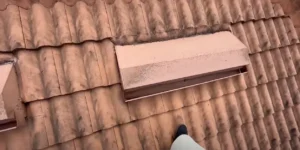
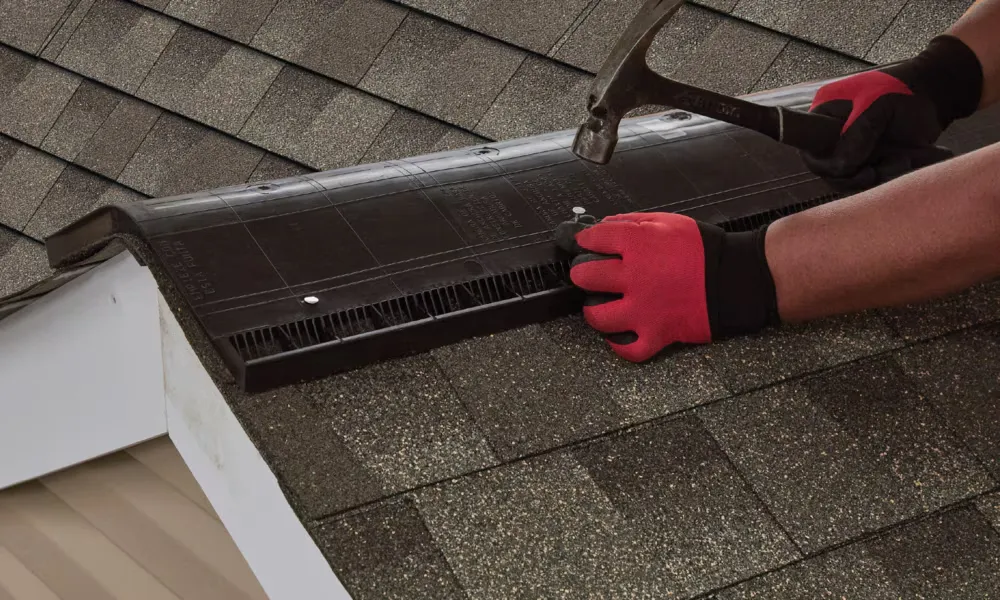
A ridge vent is a type of passive exhaust vent installed along the entire length of the peak, or ridge, of a sloped roof. It works by allowing hot, humid air that accumulates in the attic to escape continuously through a narrow slot cut in the roof deck at the ridge line. As heat naturally rises to the highest point in the attic, it exits through the ridge vent while fresh, cooler air enters through intake vents at the soffits below. This continuous airflow keeps attic temperatures lower, reduces moisture buildup, extends the life of the roof deck and shingles, and lowers cooling costs. Ridge vents are considered the best exhaust ventilation option for most sloped roofs with a traditional gable design and functioning soffit intake vents. For homeowners in Watkinsville and Hiawassee, where Georgia’s hot, humid summers put attic ventilation under real stress, understanding how ridge vents work and whether your roof has an adequate system is worth your attention.
What Are the Disadvantages of Ridge Vents?
The disadvantages of ridge vents are the potential for water infiltration during severe wind-driven rain, higher installation cost compared to box or static vents, reduced effectiveness on hip roofs with short ridge lines, and dependency on functioning soffit intake vents to work correctly. According to Today’s Homeowner, ridge vents are prone to leaking, especially during heavy rain and high winds, and installation quality is a direct factor in how well the vent resists weather. According to Angi, certain roof design styles such as hip roofs do not work well with roof ridge vents, while gable roof designs accommodate them well. The effectiveness of a ridge vent also depends entirely on balanced intake ventilation from below: if soffit vents are blocked by insulation or debris, the ridge vent cannot draw fresh air through the attic and becomes largely ineffective.
A second practical disadvantage is cost. According to Sellers Roofing Company, anticipate a ridge vent installation to run around $500 or more on average when added to an existing roof, and the cost can be higher on larger or more complex roofs. Ridge vents without proper baffles are also a disadvantage in areas that receive frequent storms. According to Snap-Z, ridge vents without baffles can allow debris, snow, rain, insects, and other pests to enter the attic. For Georgia homeowners in the Watkinsville and Hiawassee areas where afternoon thunderstorms regularly produce wind-driven rain, specifying a ridge vent with a solid baffle during a new roof installation or replacement is the correct approach, and the modest cost difference between baffled and non-baffled products is easily justified.
How Does Water Not Get Into a Ridge Vent?
Water does not get into a properly installed ridge vent because of three design features that work together: an external baffle that deflects rain and wind away from the vent opening, a filter or mesh material that blocks debris and most water from entering the slot, and cap shingles applied directly over the vent body that direct water down and away from the ridge like a small roof over the vent itself. According to Angi, most ridge vents use flashing or baffling to keep out rain, snow, and debris. The physics also help: because wind and rain typically travel horizontally or at angles, and the ridge vent opening faces downward toward the eaves rather than directly into the weather, most storm rain passes over the vent without entering the attic below.
The honest answer is that no ridge vent is completely immune to water under every possible condition. According to McLeran Roofing, in cases of heavy wind-driven rain, water can be forced up and under the ridge vent due to the angle and intensity of the wind, particularly when the vent is at end of its service life and the sealant has deteriorated. According to Fine Homebuilding, a properly installed ridge vent is a reasonable possibility for some minor water entry during the most severe wind-driven rain events, but leaks that occur with normal rain should not happen with a correctly installed baffled product. For homeowners in North Georgia where summer thunderstorms can bring intense wind and rain, verifying during an annual inspection that the ridge vent’s baffle and cap shingles are intact and the sealant at the vent edges is not cracking is the most practical preventive maintenance step.
Do Ridge Vents Make a House Colder in Winter?
Ridge vents do not make a house colder in winter when the attic is properly insulated and air-sealed at the ceiling level. The ridge vent ventilates the attic space, not the living space below it. When insulation is correctly installed at the attic floor and the air barrier between the conditioned living area and the attic is intact, the cold outside air that moves through the attic through the ridge vent system does not affect the temperature of the rooms below. In fact, a well-ventilated cold attic in winter is exactly what a properly designed roof system should have, because keeping the attic cold prevents snowmelt ice dams by ensuring the roof surface stays uniformly cold.
The concern that ridge vents make a house colder often comes from homes where attic insulation is inadequate or where the air barrier has gaps that allow conditioned air from the living space to leak into the attic. In those situations, the ventilation system draws heated air out of the attic space, and the heating system works harder to replace it. According to building science expert Joe Lstiburek writing in GreenBuildingAdvisor, the problem is not the ridge vent itself but a leaky attic ceiling that allows warm conditioned air from the house to enter the attic and be drawn out through the exhaust vents. The correct solution is improving attic insulation and air sealing at the ceiling level, not blocking or eliminating the ridge vents. For homeowners in the Hiawassee area where winter temperatures are colder than lower-elevation Georgia, ensuring adequate attic insulation is installed before attributing heating costs to the ridge vent system is the right diagnostic sequence.
Does Every Roof Need a Ridge Vent?
Not every roof needs a ridge vent specifically, but every enclosed attic in a residential roof is required to have adequate ventilation by building code. According to the International Residential Code (IRC) Section R806.2, enclosed attics require a minimum of 1 square foot of net free ventilation area for every 150 square feet of attic floor space, which can be reduced to 1 square foot per 300 square feet when specific conditions are met. This ventilation can be provided by ridge vents, box vents, turbine vents, power vents, or other approved systems. A ridge vent is simply the best and most efficient way to meet that requirement on most sloped gable roofs, according to Joyland Roofing, which identifies ridge vents as the best type of exhaust vent for typical steep-roof applications with an open attic and proper soffit intake.
The specific roof designs that do not work well with ridge vents alone are hip roofs with very short ridge lines, roofs with multiple ridge lines at different levels that create isolated attic sections, and roofs on older homes that were never designed with adequate soffit intake venting. According to Findlay Roofing, power vents are a better choice for hip roofs that lack sufficient ridge line footage for venting. According to RoofCrafters, ridge vents are not ideal for all roof types, as they are most effective in roofs with a clear, unobstructed ridge line. For most standard gable-roofed residential homes in Watkinsville and throughout Oconee County, a ridge vent running the full length of the ridge paired with functioning soffit intake vents is the code-appropriate and performance-optimal ventilation solution. A licensed roofing contractor can assess your specific roof design and recommend the right system for your home.
What to Use Instead of a Ridge Vent?
The alternatives to ridge vents are box vents (also called static or turtle vents), turbine vents (also called whirlybird vents), power attic vents (electric or solar-powered fans), and gable vents. According to IKO, the exhaust vents can be ridge vents, box vents, turbine vents, powered roof vents, solar attic fans, and more. Box vents are the most common alternative. They are installed in the upper third of the roof surface as individual vent openings, cost less per unit than ridge vents, and are easier to retrofit on an existing roof. A significant limitation is that they only ventilate the area of the attic immediately around each unit, while a ridge vent ventilates the entire attic length from a single installation point at the highest possible location. According to IIBEC, it takes 15 static exhaust vents to equal the exhaust ventilation capacity of 42 linear feet of continuous ridge vent.
Power vents are the best alternative for hip roofs or other designs where ridge vent installation is not feasible. According to RoofCrafters, power fans are better for hip roofs that lack ridge line footage. However, power vents should never be combined with ridge vents on the same attic space, because the powered fan can draw air backward through the ridge vent, pulling in rain, snow, and outdoor air through the opening that should be exhaust-only. According to IKO, mechanical ventilation is not typically recommended for residential roofs because it may actually draw snow and rain into the attic. Turbine vents are wind-powered and actively draw attic air when wind is present, making them more dynamic than box vents but less consistent than a well-designed ridge and soffit system. According to Joyland Roofing, turbines and roof louvers are the least effective form of attic ventilation but are better than nothing.
Can Rain Come in Through Ridge Vents?
Rain can come in through ridge vents under specific conditions, most commonly during severe wind-driven rain events that push water horizontally against the vent, when the vent has been improperly installed, when the baffle or filter has deteriorated, or when the vent is reaching end of its service life and the sealant at the edges has failed. According to Angi, rain shouldn’t come in through your ridge vents unless your vents are damaged or the rain is accompanied by very high winds. According to Today’s Homeowner, ridge vents are prone to leaking especially during heavy rain and high winds, and this is more likely when installation used wrong nails, sections were not properly overlapped, or the vent was not placed correctly at the peak of the roof.
The difference between a minor, occasional moisture event and a genuine leak problem is important for homeowners to understand. According to Fine Homebuilding, about once every three years in coastal or storm-exposed areas, a severe blow from a specific wind direction can produce a small amount of moisture entry through a ridge vent, but the cellulose or fiberglass insulation in a well-designed attic absorbs and disperses it without causing damage. A genuine leak that produces standing water, stained decking, or wet insulation after every significant rainstorm is not normal ridge vent behavior and indicates either an installation defect, a failed baffle, or a vent that has deteriorated past its service life. For homeowners in Watkinsville and Hiawassee where afternoon thunderstorms regularly produce intense, wind-driven rain throughout spring and summer, specifying a high-quality baffled ridge vent installed by an experienced roofing contractor is the most effective way to prevent water entry through this component.
Do Ridge Vents Cause Leaks?
Ridge vents do not inherently cause leaks when they are properly designed, properly installed, and maintained. According to Snap-Z, when properly installed, ridge vents are leakproof and designed to keep out rain and snow while allowing air to escape. According to Angi, ridge vents can last as long as the roof itself and will need very little upkeep when installed correctly by a qualified professional. The situations in which ridge vents do cause leaks are specific and preventable: improper installation using incorrect fasteners or incorrect overlap between sections, failure to seat the vent correctly at the peak of the roof, sealant deterioration at the vent edges after many years of UV exposure, and use of low-quality vent products that do not have adequate baffling for the local storm conditions.
For homeowners who suspect their ridge vent is leaking, the diagnostic process matters. Water intrusion near the ridge could come from the ridge vent itself, from flashing failures at chimneys or dormers near the ridge, from damaged cap shingles at the ridge line, or from ice dam conditions at the eaves that back water up under the shingles to the highest point. According to McLeran Roofing, over time the sealant used to secure the ridge vent can deteriorate due to exposure to sunlight, moisture, and temperature changes, which can allow water to seep in during heavy wind-driven rain events. A professional roof inspection from a licensed roofing contractor is the most reliable way to identify whether the ridge vent is the source of any water intrusion around the ridge area versus another component that needs attention.
How to Tell If a Roofer Is Lying
You can tell if a roofing contractor is lying when they tell you your ridge vent is leaking and needs full replacement without conducting an inspection of the vent, cap shingles, baffle condition, and surrounding flashings. A contractor who immediately recommends removing your ridge vent and replacing it with box vents without explaining why that system is better for your specific roof is likely recommending the easier and faster option for them rather than the correct option for you. A contractor who says a ridge vent is not needed at all is ignoring building code ventilation requirements that apply to every enclosed attic in a Georgia residence.
For roofing work in general, the red flags that indicate a contractor is not being truthful are an inability to provide their Georgia contractor’s license number, no proof of current general liability and workers’ compensation insurance, pressure to sign before you can get competing proposals, no itemized written proposal separating materials from labor, and an unusually low bid that cannot be explained by any specific difference in scope or materials. A trustworthy roofing contractor in the Watkinsville and Hiawassee areas will inspect your ventilation system as part of any roof assessment, explain what they find in plain language, specify every component of their proposed solution in writing, and pull the required permit before any work begins.
Should You Block Roof Vents in Winter?
No, you should not block roof vents in winter. Ridge vents and other attic exhaust vents should remain open and unobstructed year-round. Blocking roof vents in winter to reduce heat loss is a common misconception that causes real harm to the roof system. When vents are blocked in winter, moisture from cooking, bathing, and breathing inside the home accumulates in the attic because there is nowhere for it to go. That moisture condenses on the cold roof deck, creating conditions for mold growth, wood rot, and structural deterioration. According to Snap-Z, proper ventilation can extend the roof’s life, reduce energy costs by improving HVAC efficiency, and prevent issues like mold and mildew, all of which require year-round ventilation to achieve.
The second reason not to block vents in winter specifically is ice dam prevention. Ice dams form when a warm attic melts snow on the roof surface, which then refreezes at the cold eaves and creates a dam that backs liquid water up under the shingles. A well-ventilated attic stays cold and uniform in temperature, preventing the differential melting that creates ice dams in the first place. Blocking roof vents in winter warms the attic unevenly and increases ice dam risk rather than reducing it. The correct way to reduce winter heat loss through the attic is to improve attic floor insulation and seal air leaks at the ceiling level, not to block the exhaust vents that are keeping the roof deck healthy and the moisture under control. For homeowners in Hiawassee where mountain winters can bring snow and ice, this is especially relevant to protecting the roof from seasonal damage.
How Does a Ridge Vent Work When Snow Is on the Roof?
A ridge vent works when snow is on the roof in two beneficial ways. First, the continuous exhaust of warm air from the attic through the ridge vent helps keep the attic temperature close to the outdoor temperature, which prevents the uneven roof surface warming that causes ice dams. According to Snap-Z, in colder climates with a lot of snow, ridge vents provide an unexpected benefit by helping turn cold, packed snow into additional insulation layers and keeping the heating system from working too hard. When the attic stays cold and uniform, snow on the roof surface stays frozen and sheds naturally rather than melting and refreezing at the eaves as a destructive ice dam.
A practical concern about ridge vents and snow is whether blowing snow can enter the vent opening. According to Angi, ridge vents with baffles offer better protection against wind, rain, snow, and insects. A baffled ridge vent is specifically designed to deflect wind-driven snow away from the vent opening, and the filter or mesh within the vent body prevents most fine snow from entering. Heavy snowfall that accumulates directly on the ridge vent and blocks the opening temporarily is generally self-resolving as the attic’s exhaust function creates enough warmth at the vent to melt small accumulations. For homeowners in the Hiawassee area where the higher elevation and mountain terrain can produce heavier winter snowfall than lower-elevation Georgia, confirming that a baffled ridge vent is installed and that the vent opening is not obstructed by ice or debris during and after significant snow events is a practical seasonal maintenance check.
Does Homeowners Insurance Go Down With a Metal Roof?
Yes, homeowners insurance often goes down with a metal roof, and this is one of the documented financial benefits of metal roofing. According to the Metal Roofing Alliance, a metal roof can lower homeowner’s insurance premiums by up to 35%. This reduction comes from metal’s non-combustible fire rating, superior wind and hail resistance, and significantly longer service life that reduces the carrier’s exposure to storm damage claims over the policy period. Many major insurance carriers in Georgia recognize metal roofing as a risk reduction that justifies a premium discount, particularly in the hail-active storm corridors of the Piedmont and North Georgia mountain regions.
The practical step is to call your insurance carrier before signing a metal roofing contract and ask specifically what discount they offer for your address with a metal roof installation. The discount amount varies by carrier, by the specific product’s wind and impact rating, and by the storm risk profile of your location. According to several roofing sources, discounts can range from 5% to 35% depending on all of these factors. For homeowners in Oconee County and Towns County evaluating the total cost of ownership of a metal roof versus repeated shingle replacements, factoring in the annual insurance savings over the metal roof’s 40-to-70-year lifespan creates a compelling financial picture that the higher upfront installation cost has to be measured against.
Why Do Germans Open the Windows in the Winter?
Germans open windows in winter as part of a ventilation practice called Stoßlüften, which means shock or burst ventilation. The practice involves fully opening windows for a short, concentrated period, typically five to ten minutes, to completely exchange the stale, humid indoor air with fresh outdoor air, then closing the windows again. This approach is considered more effective than cracking windows slightly for extended periods because the full exchange removes moisture-laden air from the home quickly rather than allowing it to cool the walls and interior surfaces over hours, which causes condensation and moisture damage.
This practice is relevant to homeowners in Georgia because it reflects a principle that directly applies to attic ventilation: adequate air exchange prevents moisture accumulation that causes mold, structural damage, and degraded insulation. The same logic that drives German window-opening habits explains why attic ventilation systems, including ridge vents, must be allowed to do their job year-round. A closed, poorly ventilated attic in Georgia’s humid climate accumulates moisture the same way a closed room does in Germany in winter: slowly, invisibly, and with compounding damage to the materials it contacts. The ridge vent’s role in continuous attic air exchange protects your roof deck and insulation from that same process. For homeowners in Watkinsville and Hiawassee replacing a roof, ensuring the ridge vent and soffit intake system is properly designed and installed is the equivalent of keeping the attic’s equivalent of “the window” open year-round.
Do Roofers Install Ridge Vents?
Yes, roofers install ridge vents as a standard part of a new roof installation or replacement. A complete roofing job on a gable-roofed home includes cutting the slot in the roof deck at the ridge line, installing the ridge vent product over that slot, and applying cap shingles over the vent to integrate it into the finished roof surface. A licensed roofing contractor will specify the ridge vent product as part of the written proposal, and the cost is typically included in the overall roof replacement quote. According to IKO, ridge vents can be simpler for roofers to install than box vents because they do not require cutting holes in existing roof shingles at multiple locations across the field of the roof.
The installation of a ridge vent on an existing roof that does not currently have one is also something roofers handle routinely. This involves opening the slot at the ridge, installing the vent product, and applying cap shingles to finish the ridge. According to Angi, ridge vents cost between $300 and $650 to install on average, though costs vary by roof complexity and linear footage of the ridge. For homeowners in Watkinsville and Hiawassee who are not sure whether their current roof has a ridge vent or whether it is functioning correctly, a licensed roofing contractor can inspect the system as part of an annual roof inspection and recommend whether the existing ventilation setup is meeting the minimum code requirements for their home’s attic size and design.
What Is the Cheapest Time of Year to Get a New Roof?
The cheapest time of year to get a new roof in Georgia is late fall through early winter, from November through February. Roofing contractors in the Watkinsville and Hiawassee areas are at peak capacity from spring through early fall, driven by post-storm demand, active construction season, and the busy insurance claim cycle that follows Georgia’s spring hail season. Scheduling a replacement during the winter months typically means better contractor availability, faster project scheduling, and more competitive pricing from local contractors who have schedule capacity during the slower season. According to Columbus Roofing Company, scheduling a project during the off-peak season can save 10% to 20% compared to summer peak pricing.
For Georgia homeowners, there is no meaningful weather barrier to fall or winter roof installation the way there is in northern states. Architectural asphalt shingles require approximately 40 degrees Fahrenheit for their adhesive strips to seal, and Georgia winters rarely sustain temperatures below that threshold for the extended periods that would prevent installation. A licensed local roofing contractor can confirm the appropriate installation temperature for your specific material and weather window and will schedule work on days that meet those conditions. The one exception is a roof that is actively leaking and causing interior damage, which must be addressed immediately regardless of season rather than waiting for the pricing advantage that winter scheduling provides.
What Is the 25% Rule in Roofing?
The 25% rule in roofing is a building code standard that requires a full permitted roof replacement when more than 25% of the roof surface is repaired or replaced within a 12-month period. This rule applies in most Georgia jurisdictions including Oconee County and Towns County, and is designed to prevent piecemeal repairs that exceed the scope of a normal repair project without triggering the permitting and code-compliance requirements of a complete replacement. When cumulative repairs cross the 25% threshold in a year, the entire roof must be brought up to current code standards, including ventilation requirements that may necessitate the addition or upgrade of ridge vent and soffit intake systems that were not part of the original repair scope.
For homeowners dealing with storm damage that affects a significant portion of their roof, the 25% rule is an important factor in the financial and planning conversation with their roofing contractor. If storm damage affects 30% of the roof surface, the 25% threshold is exceeded and a full replacement with full code compliance is the correct path forward. Understanding this rule prevents surprises when a contractor explains that what seemed like a large repair actually triggers a full replacement, and it protects homeowners from contractors who propose a large repair scope without disclosing that it crosses into full replacement territory under local building code.
What Is Better, an Attic Fan or a Ridge Vent?
A ridge vent paired with soffit intake vents is better than a power attic fan for most residential homes in Georgia. According to Joyland Roofing, a ridge vent is the best type of exhaust vent for typical steep-roof applications where there is an open attic and proper soffit intake. The ridge vent works passively with no energy cost, no moving parts to fail, and no risk of depressurizing the attic space. According to building science expert Joe Lstiburek writing in GreenBuildingAdvisor, powered attic fans can depressurize the attic and, if the attic ceiling is not perfectly airtight, draw conditioned air from the living space rather than outdoor air, effectively making the HVAC system pay to air-condition the attic. According to Findlay Roofing, combining an attic power vent fan with a ridge vent is usually not recommended because it could reverse the natural flow of hot air out the ridge vent and pull in rain, snow, and outdoor air through the opening instead.
The specific situation where a power attic fan makes more sense than a ridge vent is a hip roof with a very short ridge line that does not have enough linear footage to install adequate ridge venting for the attic’s square footage. According to Findlay Roofing, power vents are a better choice for hip roofs, which often lack ridge line footage for venting. For all other standard gable-roofed residential homes in Watkinsville and Hiawassee, a properly designed passive system with a continuous ridge vent and balanced soffit intake is the most effective, most energy-efficient, and most code-appropriate ventilation solution available.
Does Rain Get Into Whirlybirds?
Rain can get into whirlybirds (turbine vents) under severe wind-driven rain conditions, but a quality turbine vent with properly designed slats is engineered to keep most rain out during normal weather events. The spinning blades and angled slats of a turbine vent create a centrifugal effect that throws water outward rather than allowing it to fall through to the attic below. According to Bill Ragan Roofing, there is a common misconception that turbine vents let rain, snow, and insects enter through the slats, but they are specifically designed to prevent this. The risk of water entry is highest when a turbine vent’s bearings have worn out and the turbine has stopped spinning, because a stationary turbine acts as an open hole in the roof rather than a dynamic deflection system. Maintaining turbines so they continue to spin freely is the most important maintenance step for these systems.
The broader question about whirlybirds for Georgia homeowners is whether turbine vents are the right system at all. According to Joyland Roofing, turbines and roof louvers are the least effective form of attic ventilation. They work only when wind is blowing, leaving the attic unventilated during calm conditions. They require more than one unit per roof, creating multiple penetrations with multiple sealant and flashing details to maintain. And the spinning mechanism wears out over time, leaving the units stationary and ineffective without visible indication that they have stopped functioning. For homeowners in Watkinsville and Hiawassee planning a new roof or replacing ventilation components, upgrading from aging turbine vents to a properly designed ridge and soffit system is an upgrade that improves both performance and long-term reliability.
Why Don’t People Use Attic Fans Anymore?
People use attic fans less than they once did because building science research has shown that powered attic fans can actively harm ventilation performance rather than helping it when the attic ceiling is not perfectly airtight. According to Joe Lstiburek at GreenBuildingAdvisor, power fans depressurize the attic, and if the attic ceiling is not perfectly airtight, they suck air-conditioned or heated air out of the house rather than pulling outdoor air in through the vents. This makes the HVAC system work harder to compensate for the conditioned air the attic fan is drawing out of the living space. According to IKO, mechanical ventilation is not typically recommended for residential roofs because it may actually draw snow and rain into the attic, damaging it. The result is a growing professional consensus that passive systems, primarily ridge vents with balanced soffit intake, outperform powered fans for most residential applications.
The modern preference for ridge vent systems over power fans also reflects lower lifecycle cost and maintenance demand. A continuous ridge vent has no moving parts, requires no electricity, produces no operating costs, and has a service life equal to the roof itself when properly installed. A powered attic fan requires electrical wiring, consumes electricity during operation, has motor and thermostat components that fail over time, and must be replaced when those components wear out. For homeowners in Oconee County and Towns County who currently have powered attic fans and are planning a roof replacement, discussing with their licensed roofing contractor whether transitioning to a passive ridge and soffit system is appropriate for their specific roof design is a worthwhile part of the pre-project conversation.
Do You Need a Power Vent If You Have a Ridge Vent?
No, you do not need a power vent if you have a properly designed and functioning ridge vent system. According to IKO, combining a ridge vent with a power vent is actually a mistake that undermines the quality of ventilation rather than improving it. When both are present on the same attic space, the power vent draws air from the path of least resistance, which is often the ridge vent opening rather than the soffit intake vents below. This creates a short-circuit in the ventilation system where air flows only through the top portion of the attic, leaving lower sections of the attic unventilated and allowing moisture and heat to accumulate there. According to Findlay Roofing, combining an attic power vent fan with a ridge vent is usually not recommended because it could reverse the natural flow of hot air out the ridge vent.
The ridge vent and soffit intake system is designed to work as a complete, self-contained passive ventilation circuit. Cool outdoor air enters through the soffit vents at the eaves, is warmed by the attic and rises to the top of the space, and exits through the ridge vent at the peak. This flow is continuous, quiet, energy-free, and effective when the system is correctly balanced. The U.S. Federal Housing Authority recommends a minimum of 1 square foot of attic ventilation for every 300 square feet of attic floor space, evenly split between intake and exhaust. A properly designed ridge and soffit system meets and often exceeds that standard without any powered component. For homeowners in Watkinsville and Hiawassee, a licensed roofing contractor can calculate the required ventilation for your specific attic square footage and confirm whether the existing or proposed ridge vent system meets the code standard without the need for any powered supplement.
What Is the Best Roof Vent for a House?
The best roof vent for a house is a continuous ridge vent paired with functioning soffit intake vents. According to Joyland Roofing, a ridge vent is the best type of exhaust vent for typical steep-roof applications with an open attic and proper soffit intake. According to IKO, ridge vents are well-positioned to provide complete roof ventilation because they are installed at the highest point of the attic, where the hottest air collects, and they run the entire length of the roof, providing maximum exhaust capacity in a single installation. According to IIBEC, it takes 15 static exhaust vents to equal the exhaust ventilation capacity of 42 linear feet of continuous ridge vent, which illustrates why the ridge vent is the most efficient single exhaust component available for residential roofing.
For homes where a ridge vent is not practical due to roof design, the best alternative is a power vent with a humidistat sensor, installed without any ridge vent on the same attic space, according to Joyland Roofing. The humidistat ensures the fan activates when moisture levels rise regardless of temperature, which is more effective than thermostat-only control, particularly in Georgia’s high-humidity climate where moisture buildup can occur even in relatively cool temperatures. For the large majority of standard gable-roofed residential homes in the Watkinsville and Hiawassee areas, a continuous ridge vent with matched soffit intake ventilation is the best, most code-appropriate, and most long-lasting ventilation solution available.
Why Do Insurance Companies Not Like Metal Roofs?
Insurance companies generally do like metal roofs, and this framing is actually the opposite of the documented reality. The Metal Roofing Alliance reports that a metal roof can lower homeowner’s insurance premiums by up to 35%, because metal is non-combustible, highly resistant to wind and hail damage, and produces fewer storm-related claims than comparable asphalt shingle roofs. Major carriers recognize metal roofing’s superior performance profile and many offer premium discounts specifically for homes with metal installations. According to Great State Roof, modern metal roofing often receives Class 4 impact resistance ratings, the highest available, which qualifies for additional premium discounts with many carriers.
The narrow situation where an insurer might have concerns about a metal roof is when the replacement value of the roof is significantly higher than a shingle replacement, which can affect the liability exposure for the carrier if the metal roof is damaged in a total loss event. This is not the same as disliking metal roofs: it is a cost accounting consideration that carriers address through appropriate coverage limits rather than through refusal to insure. For homeowners in Georgia planning a metal roof installation, the practical recommendation is to call your specific carrier, ask for the exact discount available for a metal installation at your address, and confirm the replacement cost coverage limits so the new roof’s value is fully insured. Most Georgia homeowners will find that metal roofing improves their insurance situation rather than complicating it.
Do Whirlybirds Make Your House Colder in Winter?
Whirlybird turbine vents do not make your house colder in winter when the attic insulation and air barrier at the ceiling level are adequate. Turbine vents ventilate the attic space, not the conditioned living space. As long as the insulation between the attic and the living area is intact and the air barrier has no significant gaps, the cold air that moves through the attic via the turbine vent does not affect the temperature of the rooms below. The same logic that applies to ridge vents applies to turbine vents: the ventilation is attic ventilation, not home ventilation, and a well-insulated attic ceiling acts as the thermal barrier that keeps the cold out of the living space regardless of how well the attic is ventilated.
The situation where turbine vents could contribute to higher heating costs is when the attic ceiling is poorly insulated or has significant air leaks, and the turbine is depressurizing the attic space by pulling air out faster than it enters through soffit vents, causing it to draw conditioned house air from the living space below through ceiling gaps. This is the same mechanism that building scientists have identified as a problem with powered attic fans, and it applies to turbines on homes with leaky attic ceilings. According to Joe Lstiburek in GreenBuildingAdvisor, depressurizing the attic is a problem when the attic ceiling is not perfectly airtight, because it causes the system to draw conditioned indoor air rather than outdoor air. The correct solution, as with ridge vents and power fans, is to improve attic insulation and ceiling air sealing rather than to remove or block the ventilation components doing their job.
Ridge Vent vs. Other Exhaust Vent Options
| Vent Type | How It Works | Best For | Key Limitation |
|---|---|---|---|
| Ridge vent | Passive; hot air exits along full length of ridge; works with soffit intake | Gable roofs with adequate soffit venting; most residential homes | Requires balanced soffit intake; less effective on hip roofs |
| Box/static vent | Passive; individual openings in upper roof surface; convection-driven | Supplementing existing systems; roofs where ridge vent cannot run full length | 15 units needed to equal 42 linear feet of ridge vent (IIBEC) |
| Turbine vent (whirlybird) | Wind-powered spinning blades draw air from attic when wind is present | Areas with consistent wind; budget-conscious upgrades; vintage aesthetics | Least effective of main vent types; ineffective in still air (Joyland Roofing) |
| Power attic fan | Electric or solar motor actively pulls air from attic when thermostat triggers | Hip roofs lacking ridge line footage; short ridge designs | Never combine with ridge vent; can depressurize attic and draw conditioned air from house |
| Gable vent | Passive; vents through gable end walls; cross-ventilation in wind | Older homes without soffit or ridge vent capability | Leaves upper attic air uncirculated; experts prefer ridge over gable (Lstiburek/GBA) |
Sources: Joyland Roofing, IIBEC, IKO, Angi, Findlay Roofing, GreenBuildingAdvisor/Lstiburek, RoofCrafters, Today’s Homeowner, Snap-Z, Bill Ragan Roofing
Frequently Asked Questions
Does my home in Watkinsville, GA need a ridge vent?
If your Watkinsville home has a standard gable-style sloped roof with an enclosed attic, it almost certainly benefits from a continuous ridge vent as part of a balanced ventilation system. Georgia’s long, hot, humid summers create significant attic heat and moisture loads that passive ridge ventilation addresses better than any other exhaust system available for standard residential roofs. According to the International Residential Code Section R806.2, every enclosed residential attic requires a minimum of 1 square foot of net free ventilation area per 150 square feet of attic floor space, which most homes achieve through a combination of ridge exhaust and soffit intake vents. A licensed roofing contractor can inspect your existing ventilation setup, measure the net free ventilation area currently provided, and confirm whether your system meets code and whether the ridge vent component is functioning or needs attention.
How long does a ridge vent last in Hiawassee, GA?
A quality baffled ridge vent installed correctly on a Hiawassee home should last as long as the roof itself, typically 20 to 25 years for a standard asphalt shingle roof or 40 to 70 years for a metal roof installation. According to Angi, as long as ridge vents are installed correctly by a qualified professional, they will need very little upkeep. The specific challenge for Hiawassee’s mountain climate is UV degradation of the vent’s plastic or rubber baffle components over time and the potential for sealant at the vent edges to crack from the more extreme temperature swings between summer and winter compared to lower-elevation Georgia. Annual inspection of the ridge vent’s cap shingles, baffle condition, and edge sealant is the most practical maintenance step to extend the vent’s service life and prevent the water entry that deteriorating sealant can cause during heavy storms.
Can I add a ridge vent to my existing roof in Oconee County?
Yes, a ridge vent can be added to an existing roof in Oconee County without a full replacement, provided the existing shingles and roof deck are in adequate condition and the ridge design is compatible with a continuous vent. The installation involves cutting the slot in the roof deck along the ridge, installing the ridge vent product, and applying new cap shingles over the vent. A licensed local roofing contractor will assess whether the existing shingles can be integrated with the new ridge vent or whether cap shingle replacement is needed to achieve a weather-tight finish. The installation also requires confirming that adequate soffit intake ventilation exists below, because a ridge vent installed without balanced intake vents does not improve attic ventilation and may actually reduce it by interfering with the convection patterns of existing box or gable vents. The contractor’s assessment will include both the exhaust and intake sides of the ventilation equation.
What is a baffled ridge vent and do I need one in Georgia?
A baffled ridge vent has an external shield or baffle above the vent opening that deflects wind, rain, and debris away from the slot in the roof deck. The baffle creates a zone of reduced air pressure above the vent opening that actually improves the drawing effect of the ventilation system while simultaneously protecting the opening from direct weather exposure. For Georgia homeowners, a baffled ridge vent is the correct specification for virtually every installation. Georgia’s storm season produces wind-driven rain regularly from spring through early fall, and the afternoon thunderstorms that characterize the Watkinsville and Hiawassee areas are exactly the type of weather event that causes non-baffled ridge vents to admit moisture. According to Angi, ridge vents with baffles offer better protection against wind, rain, snow, and insects, and are the recommended choice in areas with regular rainfall. The cost difference between baffled and non-baffled products is modest and is fully justified by the protection benefit in Georgia’s climate.
How much does ridge vent installation cost in Watkinsville, GA?
Adding a ridge vent to an existing roof in Watkinsville typically costs $300 to $650 on average according to Angi, with the final number depending on the linear footage of the ridge, the specific vent product specified, whether the cap shingles need to be replaced as part of the installation, and whether the installer charges for the permit and inspection. When a ridge vent is included as part of a full roof replacement, the additional cost above a box-vent system is typically modest, because the ridge vent installation is integrated into the replacement workflow at minimal extra labor. Getting a written proposal from a licensed local roofing contractor that specifies the ridge vent product by name, the linear footage being installed, and the method of cap shingle integration is the most reliable way to understand what your specific project will cost and to compare proposals on a like-for-like basis.
Should I replace my turbine vents with a ridge vent when I replace my Watkinsville roof?
Yes, transitioning from turbine vents to a continuous ridge vent system during a full roof replacement is a worthwhile upgrade for most standard gable-roofed homes in Watkinsville. Turbine vents are the least effective form of attic ventilation according to Joyland Roofing, they work only when wind is blowing, they require multiple roof penetrations with multiple flashing details to maintain, and their spinning mechanisms wear out over time leaving them stationary and ineffective. A continuous ridge vent provides better, more consistent ventilation coverage of the full attic length with a single installation at the optimal exhaust location, no moving parts to wear out, and no wind-speed dependency. The transition also reduces the number of roof penetrations, which reduces the number of flashing and sealant details that must be maintained and inspected over the new roof’s lifespan. A licensed roofing contractor replacing your shingles can integrate the ridge vent into the installation without significant additional cost.
Final Thoughts
A ridge vent is one of the most important components of a healthy residential roof system, and it is often the least visible and least discussed. When properly designed with a baffle, correctly installed with matched soffit intake ventilation, and inspected annually alongside the rest of the roof, a continuous ridge vent keeps attic temperatures lower in summer, prevents moisture accumulation year-round, protects the roof deck and insulation from deterioration, and extends the service life of the shingles above it. For homeowners in Watkinsville, Hiawassee, and throughout Oconee County and Towns County, ensuring your home’s attic ventilation system is adequate, functional, and code-compliant is a foundation of long-term roof performance that deserves the same attention as the shingles you can see from the street.
If you are not sure whether your home has a functioning ridge vent, whether your attic ventilation is balanced and code-compliant, or whether your current system is adequate for Georgia’s climate, the team at Ridgeline Roofing and Exteriors provides free roof inspections that include a full ventilation assessment. We serve Watkinsville, Hiawassee, and the surrounding North Georgia communities and give you honest, straightforward answers about what your roof needs.
Schedule your free inspection through our roof installation page or learn more about roof repair services in Watkinsville and contact us today.