Skip to content
Roof flashing is thin metal material installed at every joint, edge, and penetration on a roof to direct water away from areas where shingles alone cannot create a watertight seal. It is placed around chimneys, skylights, vent pipes, roof valleys, and wall intersections. Flashing is necessary on every roof, and its failure is one of the leading causes of residential roof leaks. This article explains what flashing is, where it goes, how long it lasts, when insurance will pay for it, and what happens when it fails.
Is Flashing Necessary on a Roof?
Yes, flashing is necessary on every roof without exception. The International Residential Code mandates flashing installation at chimneys, valleys, roof edges, and all roof penetrations. Shingles protect broad, flat roof surfaces well, but they cannot form a watertight seal at the complex joints where the roof meets a chimney, a skylight, a vertical wall, or a vent pipe. Flashing fills those gaps by mechanically directing water over and away from the joint rather than allowing it to find its way in.
According to FoxHaven Roofing’s 2026 flashing guide, properly installed and maintained roof flashing prevents up to 95 percent of water intrusion issues around roof penetrations. When flashing is absent or failing, even a brand-new shingle roof is vulnerable to leaks at every one of those intersections. Mr. Roofer Atlanta’s field records document that in properties 40 to 80 years old, flashing failure is often the number one reason behind persistent leaks and water stains, more common than shingle failure in older homes.
Many homeowners misdiagnose a leak as a shingle problem when the actual cause is flashing. Good’s Roofing notes that the most expensive repair consequence is not the flashing replacement itself but the water damage that accumulates in decking, framing, and interior finishes when failing flashing is left unaddressed. In humid climates like Watkinsville and the Hiawassee area, that damage compounds faster than in drier regions.
What Happens If You Don’t Have Roof Flashing?
If you don’t have roof flashing, or if the flashing you have is failing, water will penetrate at every joint and transition point on the roof during rainfall. The consequences begin as small water stains and progress to wood rot in the decking and rafters, mold in the attic and wall cavities, and eventually structural damage if the intrusion continues long enough without repair.
The damage pathway is predictable. Water enters at an unflashed chimney base, a missing valley liner, or a deteriorated pipe boot. It soaks into the underlayment and then into the plywood decking beneath. Once the decking is wet repeatedly, wood rot follows. Wet insulation loses its effectiveness and can grow mold within 24 to 48 hours in warm, humid conditions like those found in Oconee County and Towns County, Georgia. By the time a ceiling stain appears in the living space, the damage in the attic may already be significant.
According to Roofing Cube’s flashing material guide, shingle manufacturers like GAF and CertainTeed require correct flashing installation as a condition of their warranty coverage. A roof installed without proper flashing at required locations is a roof whose warranty can be denied at the first claim. This is not a technicality. It is the manufacturer’s acknowledgment that flashing is as essential to the system as the shingles themselves.
What Are the Types of Roof Flashing?
The types of roof flashing are step flashing, counter flashing, apron (continuous) flashing, valley flashing, drip edge flashing, pipe boot flashing, skylight flashing, and kickout flashing. Each is designed for a specific location on the roof, and each works differently to direct water away from its target joint.
Step Flashing
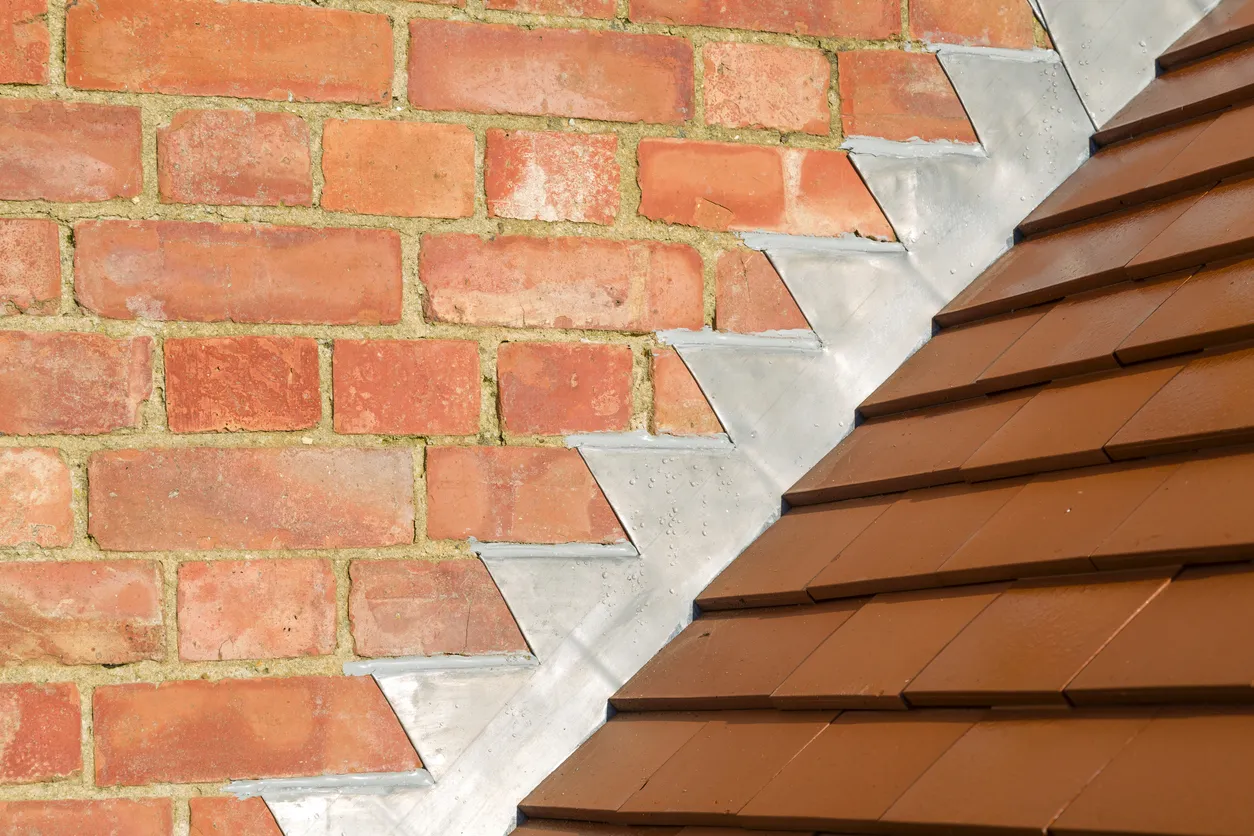
Step flashing is the most common flashing type on residential roofs. It consists of small L-shaped pieces of metal, typically 10 inches long by 2 inches by 8 inches, that are installed one per shingle course wherever a sloped roof meets a vertical wall, such as at a dormer, a sidewall, or a chimney. Each piece overlaps the one below it in a stair-step pattern so water that runs behind the shingles is deflected outward at each step rather than finding a path into the wall. Proper step flashing is completely hidden under the shingles once installed.
Counter Flashing
Counter flashing is installed over step flashing, embedded into masonry at the chimney or wall to cover the top edge of the step flashing below. Counter flashing is what you see as the visible metal strip at the base of a chimney. It protects the step flashing from direct water exposure and prevents water from running behind it from above. When counter flashing pulls away from the masonry, it creates a direct water entry path regardless of how good the step flashing is underneath.
Valley Flashing
Valley flashing is installed in the V-shaped channels where two roof planes meet. Roof valleys concentrate more water flow than any other surface on the roof, making them among the highest-risk leak locations. Valley flashing is either an open metal liner that is visible between the shingle courses, a closed metal liner hidden beneath interwoven shingles, or in some modern systems a self-adhering waterproof membrane. According to the Roofing by Midsouth guide, chimneys and valleys together represent the most common locations for flashing-related leaks on residential homes.
Drip Edge Flashing
Drip edge flashing is a metal strip installed along the eaves and rakes of the roof. It directs water off the roof edge into the gutter rather than allowing it to run back under the shingles or drip down the fascia board. The International Residential Code requires drip edge installation on all residential roofs. Most building inspectors will not pass a final inspection without it. Drip edge flashing is one of the most commonly missed items on budget contractor estimates, and its absence is a clear sign of workmanship concerns.
Pipe Boot (Vent Pipe Flashing)
Pipe boots seal the area around plumbing vents and other circular penetrations. They consist of a metal base that lays flat on the roof with a rubber or neoprene collar that grips the pipe. According to RoofingCube’s flashing lifespan data, rubber pipe boots need replacement every 10 to 15 years because the rubber collar cracks and separates from the pipe under UV exposure and thermal cycling. A cracked pipe boot collar is one of the single most common causes of roof leaks and one of the easiest to miss from the ground. On a warm summer afternoon in Hiawassee, the black rubber on a 12-year-old pipe boot is often already visibly cracked.
Kickout Flashing
Kickout flashing is installed at the bottom end of step flashing where the roof meets a wall and the wall continues downward. Without kickout flashing, water running down behind the step flashing has nowhere to go except into the wall framing below the roof. Kickout flashing redirects that water outward onto the roof surface and into the gutter. It is one of the most frequently omitted pieces of flashing in budget installations, and its absence causes persistent water damage to exterior walls that is often misattributed to window leaks or siding failure.
Skylight Flashing
Skylight flashing includes head flashing at the top of the skylight, sill flashing at the bottom, and step flashing along the sides. Many skylight manufacturers provide flashing kits designed specifically for their products, and using those manufacturer-provided kits preserves warranty coverage on the skylight itself. Non-kit flashing around skylights frequently fails because the dimensions do not account for the thermal expansion characteristics of the specific skylight frame.
Can Flashing Cause Roof Leaks?
Yes, flashing can cause roof leaks, and flashing failure is one of the most common causes of roof leaks in both older and newer homes. Flashing leaks occur when the metal lifts, rusts, or separates from the surface it is sealing, when the sealant used at joints dries out and cracks, when pipe boot rubber deteriorates, or when flashing is installed incorrectly in the first place with laps going in the wrong direction.
A correctly installed piece of flashing works purely by gravity. Water flows over the top of each flashing layer and onto the layer below, ultimately draining off the roof. When flashing is installed backward, or when the laps are too short, water can work its way upstream and behind the metal. This is most common in valleys and around chimneys where improper installation creates a gap that fills with water during a sustained rainfall.
According to GEICO’s homeowners insurance resource, if a roof leak is caused by cracked flashing that has not been replaced in years, insurance will typically deny the claim because it falls under maintenance neglect rather than a covered sudden event. This is the real cost of ignoring old flashing: not just the repair itself, but the loss of insurance coverage for the water damage it eventually causes. Shingle roof repair in Watkinsville always includes a flashing inspection as part of any leak diagnosis, because repairing shingles without checking the flashing often produces temporary results at best.
What Is the Lifespan of Roof Flashing?
The lifespan of roof flashing varies significantly by material. Aluminum flashing lasts 20 to 30 years. Galvanized steel lasts 20 to 25 years. Copper flashing lasts 70 years or more and is the premium choice for long-lasting installations. Rubber pipe boot collars typically need replacement every 10 to 15 years due to UV degradation, which is shorter than the lifespan of the shingles they serve.
These figures are from Roofing Cube’s flashing material lifespan data, which also notes that proper installation and maintenance can extend these lifespans significantly. The key practical point is matching flashing material to the expected lifespan of the roof system. FoxHaven Roofing’s 2026 guide recommends never installing 20-year flashing on a 50-year roof system, because the flashing will need replacement mid-life while the rest of the roof is still performing.
For homeowners in Oconee County and Towns County considering a roof replacement, discussing flashing material with your contractor before the job starts is an important step. Many standard bids use galvanized steel flashing, which is appropriate for most applications, but if you are putting a Class 4 impact-rated roof on a home you plan to own for 30 years, asking about aluminum or copper flashing for the high-exposure areas around chimneys and valleys is a reasonable question.
Is $500 Expensive to Replace Roof Flashing?
No, $500 is not expensive to replace roof flashing for a small, straightforward repair. According to Lemonade Insurance’s cost data, roof flashing replacement costs between $400 and $1,000 depending on how much flashing needs to be replaced. FoxHaven Roofing’s 2026 guide notes that small flashing repairs covering one or two feet of damaged material can run $400 to $600, while ValuePenguin’s insurance resource puts significant flashing repairs involving new metal, underlayment corrections, and shingle integration at $700 to $3,000.
The specific number depends on where the flashing is, what material is used, and how much shingle work is required to access and reinstall it properly. Chimney and skylight flashing repairs cost more because they involve more labor and custom fabrication. Valley liner repairs are less expensive per linear foot but cover more area. A simple pipe boot replacement is one of the most affordable flashing repairs and one of the most impactful for stopping an active leak.
The more important cost comparison is between replacing deteriorated flashing now versus repairing the interior damage that failing flashing eventually causes. Replacing a pipe boot for a few hundred dollars today is dramatically less expensive than repairing rotted decking, saturated insulation, and mold-contaminated drywall after a leak runs for a full rainy season without being addressed.
Does Home Insurance Cover Roof Flashing?
Yes, homeowners insurance covers roof flashing replacement when the flashing damage was caused by a covered peril such as a windstorm, hail, or a fallen tree. Insurance does not cover flashing replacement caused by gradual wear and tear, age-related deterioration, or poor maintenance. This distinction follows the same rule that applies to all roof insurance claims: sudden and accidental damage is covered; predictable aging is not.
According to GEICO’s homeowners insurance guide, if a roof develops a leak due to cracked flashing that has not been replaced in years, that damage falls under maintenance neglect and is typically excluded from coverage. Fassbender Insurance’s claims guidance agrees: a slow drip caused by deteriorated chimney flashing will generally not be covered, while flashing that is damaged and lifted by a storm event will typically qualify for a claim.
The practical implication for homeowners in Watkinsville and Hiawassee is to document the condition of your flashing annually. If a storm damages your roof and flashing is involved, photograph everything before any temporary repairs are made. A licensed roofer’s written inspection report that ties the flashing damage to the storm event strengthens your claim significantly. Ground Up Construction’s insurance claim guidance recommends filing within a few days of storm damage and having a licensed contractor document the findings in an inspection report that clearly describes the cause. Roof repair in Watkinsville includes this kind of documentation as part of any storm damage assessment.
Do Roofers Replace Flashing During a Roof Replacement?
Yes, roofers should replace flashing during a full roof replacement. Reusing old flashing is one of the most common quality shortcuts in the roofing industry, and it creates a real risk for homeowners. When new shingles go on over old flashing, the flashing’s remaining service life may be significantly less than the new roof’s expected lifespan. A new roof that starts leaking within five years because the flashing underneath was reused is a frustrating and avoidable outcome.
Good’s Roofing’s installation guidance states that for roof systems from GAF or CertainTeed, the flashing materials and installation techniques must align with manufacturer guidelines to preserve warranty coverage. Reusing old, out-of-spec flashing during a warranted re-roof may invalidate the manufacturer warranty on the new shingles if the flashing is cited as a contributing cause of any subsequent leak.
Before signing a roofing estimate, homeowners should confirm in writing whether all flashing will be replaced or whether any existing flashing will be reused and why. A contractor who plans to reuse flashing should explain specifically which pieces, what condition they are in, and what their expected remaining service life is. Vague assurances that the old flashing is “fine” are not sufficient. For roof replacement in Watkinsville, every job includes a flashing assessment with a clear written scope so homeowners know exactly what is being replaced and what they are getting.
Can I Replace Roof Flashing Myself?
You can replace roof flashing yourself for simple, accessible repairs like a cracked pipe boot collar or a lifted section of drip edge on a single-story home with a low-pitch roof. The tools required are minimal and the materials are available at any home improvement store. For these basic repairs, follow the principle that each layer of flashing must shed water onto the layer below it, flowing toward the edge of the roof rather than pooling against any surface.
Chimney flashing, valley flashing, skylight flashing, and step flashing at sidewalls are not appropriate DIY projects for most homeowners. These systems involve multiple overlapping components, counter-flashing embedded into masonry, and a precise sequence of installation that interleaves with the underlayment and shingle courses. Getting the sequence wrong traps water instead of shedding it. According to ValuePenguin’s repair guidance, DIY flashing repairs that are inadequate can lead to wood rot and mold damage that costs far more than a professional repair would have, and insurance may refuse to cover damage that results from homeowner-performed work that made the problem worse.
The safest approach for most homeowners is to handle minor flat-surface repairs on accessible areas and call a licensed roofer for anything involving the chimney, valleys, or skylight transitions. A two-hour professional repair on a problem flashing location is a better investment than a DIY patch that allows water in for another season before the damage becomes visible indoors.
Do You Nail Down Roof Flashing?
Yes, most roof flashing is nailed or screwed into place, but the specific fastening method depends on the flashing type and location. Step flashing pieces are nailed through the flashing into the roof deck and the wall framing with corrosion-resistant nails. Drip edge is nailed along the roof edge. Valley metal is typically fastened at the edges rather than through the center to allow for thermal expansion.
Counter flashing at chimneys is different. It is embedded into masonry by cutting a reglet (a horizontal slot) in the mortar joint and folding the top edge of the counter flashing into that slot, then sealing the slot with elastomeric caulk rather than nailing into the masonry. Pipe boots are fastened with screws through the base flange into the roof deck. All metal-to-metal or metal-to-masonry joints that are not mechanically fastened must be sealed with appropriate roofing sealant, but sealant alone without mechanical fastening is not a proper installation for most flashing types. Sealant supplements fastening; it does not replace it.
Flashing Types, Materials, and Lifespan: Full Comparison
| Flashing Type | Location | Common Material | Approx. Lifespan | Most Common Failure Mode |
|---|---|---|---|---|
| Step flashing | Wall-roof intersections, dormers | Aluminum or galvanized steel | 20–30 years | Rust, improper lapping, missing pieces |
| Counter flashing | Chimney base | Aluminum, copper, or lead | 20–70 years by material | Pulling away from masonry; sealant failure |
| Valley flashing | V-channel where two slopes meet | Galvanized steel or aluminum | 20–30 years | Corrosion; debris buildup; improper install |
| Drip edge | Eaves and rake edges | Aluminum or galvanized steel | 20–30 years | Lifting from wind; omitted by budget contractors |
| Pipe boot | Around plumbing and exhaust vents | Metal base with rubber collar | 10–15 years (rubber) | UV cracking of rubber collar |
| Skylight flashing | Around skylight perimeter | Aluminum or manufacturer kit | 20–25 years | Non-manufacturer kits; thermal expansion gaps |
| Kickout flashing | Bottom end of step flashing at wall | Aluminum or galvanized steel | 20–30 years | Frequently omitted; causes wall water damage |
| Copper flashing | Any location; premium install | Copper | 70+ years | Galvanic corrosion if touching dissimilar metals |
Sources: Roofing Cube flashing lifespan by material data; FoxHaven Roofing 2026 complete flashing guide; Roofing by Midsouth types and installation overview; International Residential Code flashing requirements; Mr. Roofer Atlanta flashing failure patterns in aging homes; Lemonade Insurance flashing replacement cost data.
Frequently Asked Questions
Is Flashing Necessary on a Roof in Watkinsville and Hiawassee?
Yes, flashing is necessary on every roof in Watkinsville and Hiawassee without exception. Georgia’s humid climate and storm activity make properly installed flashing even more critical than in drier regions. Heavy spring rains, summer thunderstorms, and the mountain weather patterns near Lake Chatuge all concentrate large amounts of water flow across roofs in a short period. Any gap in the flashing system at a chimney, valley, or penetration can allow significant water entry during one of these events. The International Residential Code requires flashing at all penetrations and transitions on residential roofs in Georgia as it does across the country.
How Expensive Is Roof Flashing Repair in Oconee County?
Roof flashing repair in Oconee County typically ranges from $400 to $600 for small localized repairs like a cracked pipe boot or a lifted drip edge section. More extensive flashing work around chimneys or skylights with shingle removal and reinstallation runs $700 to $3,000 depending on the scope. The most cost-effective time to replace flashing is during a full roof replacement, when labor costs for shingle removal are already absorbed into the project. Homeowners who address failing flashing proactively before it causes interior water damage avoid the additional costs of decking repair, insulation replacement, and mold remediation that follow prolonged leak exposure.
What Not to Say to a Roof Insurance Adjuster About Flashing?
You should not tell a roof insurance adjuster that you knew the flashing was old or damaged before the storm, that you noticed the leak months ago but had not gotten around to fixing it, or that you have been patching it yourself for a few years. Any statement that implies ongoing maintenance neglect gives the adjuster grounds to categorize the damage as wear and tear rather than a covered storm event. Let the physical evidence and a licensed roofer’s inspection report tell the story. Take photos of storm-related damage and describe what happened during the event itself without speculating about the pre-existing condition of the flashing. Having a licensed contractor document the damage before the adjuster arrives is the most protective step you can take.
Does Roof Flashing Need to Be Replaced with New Shingles Near Hiawassee?
Yes, roof flashing should be replaced along with new shingles in Hiawassee whenever the existing flashing is approaching the end of its service life. Reusing old galvanized steel or aluminum flashing on a new shingle roof means the flashing may fail before the new shingles do, requiring costly re-flashing work that involves removing shingles that have already been installed. The additional cost of new flashing during a re-roof is modest compared to the full installed cost of the roof, and it ensures that the entire system performs at the same level for the same duration. Ask your contractor to specify which flashing is being replaced and which is being reused before any work begins.
Can Pipe Boot Flashing Be Replaced Without Replacing the Whole Roof?
Yes, pipe boot flashing can be replaced without replacing the whole roof. It is one of the more straightforward standalone repairs a licensed roofer can perform. The surrounding shingles need to be lifted carefully to remove the old boot and slide the new one in place, then the shingles are refastened and sealed. The key is matching the replacement pipe boot to the existing pipe diameter and choosing a product with high-quality EPDM rubber rated for UV and thermal cycling. Most residential plumbing vents are either 1.5-inch or 3-inch diameter, but measuring before ordering is important. Given that rubber pipe boot collars degrade in 10 to 15 years, any roof over 12 years old in the Watkinsville area that has not had its pipe boots replaced should have them checked during the next inspection.
What Are the Signs of Failing Flashing on a Roof in Watkinsville?
The signs of failing flashing on a roof in Watkinsville include water stains on interior ceilings or walls near chimneys, skylights, or exterior walls, a musty smell in the attic or upper floors, visible rust or corrosion on metal around roof features when inspected from the ground with binoculars, lifted or separated metal at the base of a chimney, granule accumulation around penetrations from shingles being disturbed by water movement, and peeling paint on exterior walls near roof edges. Any one of these signs warrants a professional inspection. Flashing leaks do not heal on their own and typically worsen with each rain event until the underlying failure is repaired.
Should I Use 1/2 or 3/4 Plywood for Roofing Decking Under Flashing?
For most residential roofing applications, 7/16-inch OSB or 1/2-inch plywood is the standard and code-compliant decking thickness. The choice of 3/4-inch plywood is typically reserved for roofs with unusual structural loads or specific design requirements, and it adds unnecessary weight and cost for standard residential shingle applications. Under flashing specifically, the most important decking consideration is condition and flatness rather than thickness. Flashing installed over warped, damaged, or wet decking will not lie flat and will not seal properly regardless of the material quality. A decking inspection before any new flashing installation confirms that the substrate can support a lasting repair.
Suspect a Flashing Problem? Get a Definitive Answer.
Flashing issues are among the most misdiagnosed roofing problems because the entry point is rarely where the ceiling stain appears. A qualified inspection traces the water path from the damage back to the source and identifies exactly what needs to be fixed.
The team at Ridgeline Roofing and Exteriors inspects all flashing locations as a standard part of every roof assessment in Watkinsville, Hiawassee, and the surrounding Oconee and Towns County communities. Free inspections, written documentation for insurance claims, and transparent estimates with a clear scope for every repair or replacement.
Visit the Watkinsville roofing services page and schedule your free inspection today. A small flashing repair now prevents a much larger problem later.