 Skip to content
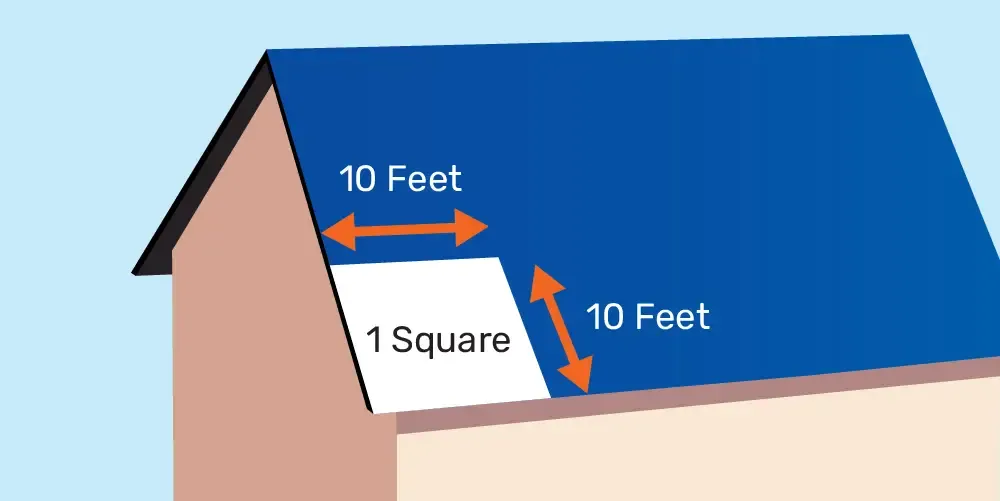
A roof square is a unit of measurement equal to exactly 100 square feet of roof surface. That is it. One roofing square equals a 10-foot by 10-foot area. Every contractor, manufacturer, and supplier in the roofing industry uses this standard unit when quoting jobs, ordering materials, and calculating labor costs. If you have ever gotten a roofing estimate and wondered what the numbers meant, the square is where everything starts. A 2,000-square-foot roof is 20 squares. A 3,000-square-foot roof is 30 squares. Understanding this measurement helps homeowners in Watkinsville, GA and the surrounding Oconee County area read estimates accurately, compare contractor bids fairly, and understand why roof size and pitch affect cost the way they do. This article covers exactly how roofers measure squares, what affects the final count, and what the numbers on your estimate actually mean.
How Big Is 1 Square in Roofing?
One square in roofing is 100 square feet of roof surface, which is the equivalent of a 10-foot by 10-foot area. This is the standard unit the entire roofing industry uses across every material type, from asphalt shingles and metal panels to clay tile and slate. When a contractor quotes a price “per square,” they are quoting for every 100 square feet of finished roof coverage.
The square has been the standard measurement unit in roofing for decades because it simplifies communication between contractors, suppliers, and manufacturers. It allows consistent pricing, standardized material ordering, and clear comparisons between bids. Whether a job is quoted in Watkinsville, GA or anywhere else in the country, one square always means 100 square feet.
Most homeowners think about their home’s size in square feet of living space, which is the footprint of the floors inside. The roof square footage is a different number entirely, and almost always larger, because the roof surface includes overhang beyond the exterior walls and rises at an angle that adds surface area above what the footprint shows. More on that when we get to pitch.
What Does 40 Squares Mean in Roofing?
Forty squares in roofing means the roof has 4,000 square feet of surface area. This is a fairly large residential roof. On a standard home in Oconee County with moderate complexity and a 6:12 pitch, 40 squares corresponds roughly to a home with a footprint of around 2,800 to 3,200 square feet, depending on overhang, roof complexity, and slope.
At 40 squares, material costs alone for standard architectural asphalt shingles typically run between $4,000 and $8,000 based on current industry pricing of $100 to $200 per square for materials. Labor adds another $250 to $450 per square in most Georgia markets, bringing the fully installed cost for a 40-square architectural shingle roof to somewhere in the range of $14,000 to $26,000 depending on pitch, complexity, and specific product selection. The 2024 Cost vs. Value Report placed the national average for an architectural shingle roof replacement at $30,680 for a 30-square job, which puts a 40-square project in similar per-square territory when adjusted for size.
What Does 20 Squares Mean in Roofing?
Twenty squares in roofing means the roof has 2,000 square feet of surface area. This is a common size for a mid-size single-story home in Georgia, including many residential properties in the Watkinsville area. A 2,000-square-foot roof divided by 100 equals 20 squares.
At 20 squares, three bundles of shingles per square means you need approximately 60 bundles of standard architectural asphalt shingles to cover the roof. Some premium or luxury shingles require four or more bundles per square, which would push that number to 80 or more bundles for a 20-square roof. When you see bundles listed on a roofing estimate, dividing by three (or four, for thicker shingles) gets you back to the number of squares being covered.
What Does 4 Squares Mean in Roofing?
Four squares in roofing means the roof or roof section being discussed has 400 square feet of surface area. This is a small area, about the size of a large garage roof, a small addition, or a single section of a larger roof that needs replacement or repair. Contractors typically use this scale when quoting individual sections, dormers, or small commercial flat roof areas rather than full residential replacements.
How Many Roofing Squares Are in 1,200 Square Feet?
There are 12 roofing squares in 1,200 square feet. The calculation is always the same: divide the total square footage by 100. So 1,200 divided by 100 equals 12 squares. This is a relatively small residential roof or a mid-size addition.
That said, 12 is the number before pitch and waste are factored in. If the roof has a 6:12 pitch, the actual surface area is about 12 percent larger than the footprint, pushing the material requirement to about 13.5 squares before waste. After adding a standard 10 to 15 percent waste factor for a simple gable roof, you would order 14 to 16 squares of material for a 1,200-square-foot footprint roof with moderate pitch.
What Is 100 Square Feet of Roof Called?
100 square feet of roof is called one roofing square, or simply one square. This is the foundational unit of measurement in all residential and commercial roofing. When a contractor says your roof is “22 squares,” they mean it has 2,200 square feet of actual roofing surface after accounting for pitch and overhangs.
The term “square” does not refer to the shape of the area. It refers to the quantity: 100 square feet. The roof section could be rectangular, triangular, or any other shape. As long as the total surface area adds up to 100 square feet, it is one roofing square.
How Many Squares of Shingles for a 2,000 Square Foot House?
A 2,000-square-foot house requires approximately 20 to 25 squares of shingles, depending on the roof pitch and complexity. The 2,000 square feet is the home’s footprint, not the roof surface area. The roof is always larger than the footprint because of overhangs and the angle of the slope.
Here is how the calculation works in practice. Start with the footprint: 2,000 square feet. Divide by 100 to get 20 squares as the baseline. Now apply a pitch multiplier. A 6:12 pitch adds about 12 percent, bringing the actual surface area to 22.4 squares. A 9:12 pitch adds 25 percent, bringing it to 25 squares. Then add a waste factor of 10 to 15 percent for a simple gable roof. The final material order for a 2,000-square-foot footprint home with a common 6:12 pitch and 12 percent waste factor works out to approximately 25 to 26 squares of shingles ordered.
For homeowners in Watkinsville planning a replacement and trying to understand their estimate, these numbers give you a framework. Reviewing the full range of shingle and material options is a helpful next step when budgeting a new roof. You can start with the roofing material choices page to compare what product types are available for your specific home design and budget.
How Much Does a 20-Square Roof Cost to Replace?
A 20-square roof costs approximately $8,000 to $18,000 to replace with architectural asphalt shingles, including materials and labor, based on current industry pricing. The range reflects differences in shingle grade, labor rates by region, pitch, complexity, and whether the old roofing requires a full tear-off.
Material costs for standard architectural asphalt shingles run roughly $100 to $200 per square. Labor in most Georgia markets adds $250 to $450 per square. For a straightforward 20-square gable roof at a walkable pitch, the total installed cost lands around $7,000 to $13,000. Add steep-pitch labor surcharges, decking replacement, or premium shingle upgrades and the number climbs. A 20-square metal roof runs considerably more per square upfront but delivers a 40 to 70-year lifespan compared to 20 to 30 years for asphalt.
Homeowners who need help managing a roof replacement cost can look into residential roof financing options to spread the investment without deferring a roof that needs to be replaced.
How Many Roofing Nails for 22 Squares?
A 22-square asphalt shingle roof requires approximately 880 to 1,320 nails for the shingles themselves, based on the standard installation requirement of 4 to 6 nails per shingle and about 22 shingles per bundle. Most architectural shingle manufacturers specify a minimum of four nails per shingle for standard installations and six nails for high-wind applications or steep-pitch roofs.
At 22 squares and three bundles per square, that is 66 bundles total. At 22 shingles per bundle, the job uses approximately 1,452 shingles. At four nails per shingle, that is 5,808 nails. Roofing nails are typically sold in 1-pound boxes covering about 140 to 180 nails, or in 5-pound boxes. A 22-square job typically goes through 35 to 45 pounds of nails depending on the nailing pattern, starter course nailing, and any supplemental high-wind fastening required by local code.
In Oconee County and across Georgia, local building codes and manufacturer warranty requirements can specify minimum fastening patterns. Always confirm with your contractor that the fastening schedule meets both local code requirements and manufacturer warranty specifications for the shingle product being installed.
How Big Is a 2,000-Square-Foot Roof?
A 2,000-square-foot roof is 20 roofing squares in area. Visually, it covers roughly the same surface as eight standard two-car garage floors placed side by side. In residential terms, a 2,000-square-foot roof surface typically belongs to a home with a footprint of roughly 1,600 to 1,800 square feet after pitch adds area beyond the ground-level measurement.
A 2,000-square-foot roof is considered a mid-size residential project. It is not small enough that labor setup costs dominate the budget, and not so large that it requires multiple crews or extended timelines. Most experienced residential roofing crews in the Watkinsville area can complete a standard 2,000-square-foot shingle replacement in one to two days under normal weather conditions.
Do Darker Shingles Make the House Hotter?
Yes, darker shingles make the house hotter, to a measurable degree. Dark roofing materials absorb more solar radiation than light or reflective ones. According to the U.S. Department of Energy, conventional dark roofs can reach surface temperatures of 150 degrees Fahrenheit or more on a sunny summer afternoon. That heat transfers downward into the attic and into the living space, increasing the load on the home’s air conditioning system.
The difference between a dark and a light-colored shingle roof is most significant in homes with poor attic insulation or ventilation. According to the U.S. Environmental Protection Agency, reflective or cool roofing products can reduce roof surface temperatures by more than 50 degrees Fahrenheit compared to dark conventional roofs under the same conditions. In Georgia’s climate, where summer cooling costs are a real concern for homeowners in Watkinsville and the surrounding region, lighter shingle colors and products with reflective granule coatings meaningfully reduce cooling energy use.
That said, shingle color alone does not determine heat performance. Attic ventilation quality, insulation R-value, and the presence of a proper radiant barrier all play significant roles. A well-ventilated attic under a darker shingle roof often performs better than a poorly ventilated attic under a light-colored one. The best approach is to address both shingle reflectivity and attic system performance together when replacing a roof.
How Many Bundles of Shingles for 1,600 Square Feet?
A 1,600-square-foot roof footprint requires approximately 54 to 72 bundles of shingles, depending on pitch and waste. Here is the step-by-step breakdown. Start with 1,600 square feet divided by 100, which gives you 16 squares as a flat baseline. Apply a pitch multiplier: a 6:12 pitch adds 12 percent, producing about 17.9 squares of actual surface. Add a 10 to 15 percent waste factor for a standard gable roof, and you are ordering approximately 20 to 21 squares of material. At three bundles per square for standard architectural shingles, that is 60 to 63 bundles. Round up to the nearest full bundle when ordering to avoid running short.
Premium architectural or luxury shingles require four or more bundles per square because each bundle covers less area due to the thicker, heavier construction. For a 1,600-square-foot footprint home using a four-bundle-per-square product, the order climbs to 80 to 84 bundles for the same pitch and waste scenario. Always confirm the bundle coverage on the specific product you are using before ordering, as coverage can vary by manufacturer and shingle line.
How Are Squares Measured in Roofing?
Squares are measured in roofing by calculating the actual surface area of every plane of the roof, adjusting for pitch, and dividing the total by 100. The process has several steps, and each one affects the final count.
Step 1: Measure Each Roof Plane
A roof plane is each flat section of the roof bounded by ridges, hips, valleys, and eaves. A simple gable roof has two planes. A hip roof has four. A complex home with dormers, shed roofs, and multiple pitches can have 10 or more planes. Each plane is measured for length and width, and then multiplied together to get its area in square feet.
Step 2: Apply the Pitch Multiplier
This is where most homeowners get confused. The footprint measurement tells you how big the roof would be if it were flat. But roofs slope upward, which means the actual surface you walk on, and that needs to be covered with shingles, is larger than the footprint. A pitch multiplier corrects for this difference.
A 4:12 pitch has a multiplier of 1.054, meaning a 100-square-foot footprint becomes about 105 square feet of actual surface. A 6:12 pitch uses a multiplier of 1.118. A 9:12 pitch uses 1.250. A very steep 12:12 pitch uses 1.414, meaning the actual roof surface is 41 percent larger than the footprint. For a home in the Hiawassee, GA area with steep slopes common to mountain-style architecture in Towns County, this multiplier has a meaningful impact on both material quantities and installation cost.
Step 3: Add the Waste Factor
After applying the pitch multiplier, contractors add a waste factor to account for cut material at hips, valleys, rakes, and around penetrations like chimneys and skylights. The standard waste factor for a simple gable roof is 10 to 15 percent. A hip roof uses 15 to 17 percent. Complex roofs with multiple valleys, dormers, and varied pitches can run 20 percent or higher. One extreme example documented by EagleView, a roofing measurement company, involved a complex low-slope commercial roof with a measured waste factor of 41 percent.
Step 4: Divide by 100
The final pitch-adjusted and waste-adjusted square footage is divided by 100 to get the number of squares to order. Contractors always round up to the nearest full bundle or square to avoid running short mid-installation.
Professional roofers in Watkinsville use a combination of direct physical measurement, slope gauges, and aerial measurement reports from services like EagleView to confirm square counts before ordering material. Aerial measurement technology now allows accurate roofing square calculations from satellite imagery without requiring the contractor to physically access the roof first. This is particularly useful for insurance claims, initial estimates, and complex multi-pitch roofs.
Pitch Multipliers and Their Effect on Roofing Squares
| Roof Pitch | Pitch Multiplier | Extra Area Added | Squares on 2,000 sq ft Footprint |
|---|---|---|---|
| 4:12 | 1.054 | +5.4% | ~21.1 squares |
| 5:12 | 1.083 | +8.3% | ~21.7 squares |
| 6:12 | 1.118 | +11.8% | ~22.4 squares |
| 7:12 | 1.158 | +15.8% | ~23.2 squares |
| 8:12 | 1.202 | +20.2% | ~24.0 squares |
| 9:12 | 1.250 | +25.0% | ~25.0 squares |
| 10:12 | 1.302 | +30.2% | ~26.0 squares |
| 12:12 | 1.414 | +41.4% | ~28.3 squares |
Sources: Standard pitch multiplier calculations based on the Pythagorean theorem (rise² + 12² / 12); industry application per RoofSnap, EagleView, and Bill Ragan Roofing estimating guidelines. Values are standard approximations used across the roofing industry.
How to Get Roof Measurements for Free
The most accurate way to get roof measurements for free is to have a licensed roofing contractor come out for a free inspection and estimate. The contractor measures the roof, applies pitch multipliers, and produces a detailed square count as part of the estimate process at no charge to the homeowner. This is the standard practice across the roofing industry, and it gives you both an accurate square count and a complete project estimate in one visit.
You can also get a rough estimate yourself using the footprint method. Measure the length and width of your home’s exterior at ground level. Multiply those numbers together to get the footprint in square feet. Divide by 100 to get the baseline square count. Then multiply by the appropriate pitch factor from the table above based on your roof’s slope. This gives you a reasonable ballpark for material planning, though it will not account for dormers, complex geometries, or overhangs with the precision a professional measurement would.
Some online tools and satellite measurement services provide aerial roof reports using property data. These can be useful for rough estimates, but they are not a substitute for a professional measurement when you are actually ordering materials or comparing bids. For homeowners in the Watkinsville area who want an accurate roof measurement as part of a full condition assessment, Drone Zone AI roofing inspections provide detailed aerial documentation of the full roof surface, which supports both accurate measurement and condition evaluation simultaneously.
What Should You Not Say to a Contractor?
There are several things you should not say to a roofing contractor if you want the best outcome on your project. First, do not tell a contractor that another company gave you an unrealistically low number and ask them to match it without seeing that other estimate in writing. Low bids often mean lower-grade materials, missing components, or unlicensed labor. A contractor who matches an unusually low quote without reviewing it is telling you something about how they work.
Do not say you want the cheapest option possible and leave it at that. A roofing contractor who hears that will sometimes steer you toward materials or methods that save money on the front end but cost more in repairs or early replacement. Be specific about what you value: long lifespan, low maintenance, insurance discount eligibility, energy efficiency. That gives the contractor something to work with.
Do not agree to a verbal estimate without getting it in writing, including the square count, the specific product being installed, the warranty terms, the payment schedule, and the scope of work including what happens if damaged decking is found during tear-off. An estimate that covers all of those details in writing is a sign of a professional contractor. One that resists putting things in writing is a warning sign.
Do not pay the full project cost upfront. A reasonable deposit of 10 to 30 percent is standard to secure scheduling and order materials. Full payment before the work begins removes the contractor’s financial incentive to finish the job and address any punch list items. Always hold the final payment until the project is complete and you have done a walkthrough to confirm satisfaction.
What Is the Most Common Contractor Mistake?
The most common contractor mistake in roofing is underestimating the waste factor, which leads to running short on materials mid-job. When a contractor orders too close to the calculated square count without building in enough waste buffer, the crew runs out of shingles before the last section is finished. This causes project delays, additional delivery charges, and in some cases a color-match problem if the replacement bundle comes from a different manufacturing batch that weathers slightly differently.
The second most common mistake is failing to identify and address damaged decking before laying the new roofing material. When rotten or soft decking sections are covered with new shingles without being replaced, the fasteners do not hold properly, the new roof does not lie flat, and the underlying structural problem continues to worsen under the new surface. A professional contractor inspects the deck after tear-off and communicates any decking repair needs before proceeding.
The third common mistake is improper ventilation planning. Installing new shingles on a roof with a blocked or undersized ventilation system accelerates shingle degradation from heat buildup in the attic, shortening the life of a new roof significantly. A contractor who does not evaluate attic ventilation as part of a roof replacement project is leaving a significant performance factor unaddressed.
How Many Years Does a Roof Usually Last?
A roof usually lasts 20 to 30 years with standard architectural asphalt shingles, 40 to 70 years with metal roofing, and 50 to 100-plus years with tile or slate. The actual lifespan of any individual roof depends on the material, installation quality, attic ventilation, climate, and maintenance history.
In Georgia’s hot, humid climate, asphalt shingle roofs typically perform toward the lower end of their rated lifespan. Standard architectural shingles rated for 30 years often deliver 20 to 25 years in sustained heat and humidity. According to roofing industry data, homes with roofs over 20 years old are three times more likely to file a wind or hail insurance claim than homes with newer roofs, both because older shingles are more vulnerable to damage and because aging roofs are already operating closer to failure thresholds.
The single most important factor after material choice is proper attic ventilation. A poorly ventilated attic can shorten a shingle roof’s lifespan by five to ten years by trapping heat that bakes the shingles from below, weakening the granule bond, and accelerating the brittleness that leads to cracking. For homeowners in Watkinsville planning a new installation, ensuring adequate ridge and soffit ventilation before the new shingles go on is one of the highest-value steps in the entire process. Explore roof installation services in Watkinsville to understand what a complete, properly executed replacement involves from start to finish.
At What Age Is a Roof Considered Old?
A roof is considered old when it reaches 20 years for standard asphalt shingles, and old in the context of insurance eligibility when it passes the 20-to-25-year mark for most carriers. At that age, many insurance companies either require a full inspection before renewing coverage, reduce a claim payout to actual cash value rather than replacement cost, or decline to cover the roof at all under a standard homeowners policy.
A roof that is 15 to 20 years old is not at the end of its life but should be inspected annually. By year 20 on a standard shingle roof in Georgia’s climate, granule loss, sealing strip failure, and shingle brittleness have typically advanced enough that a meaningful portion of the roof is operating at reduced capacity. The roof may still be technically keeping water out, but its resilience in a major storm event drops significantly compared to a roof in its first decade.
Homeowners with roofs in the 15-to-25-year range who have not had a professional inspection recently should treat that as a priority. A documented inspection establishes the current condition, identifies any sections that need repair, and gives the homeowner clear information for planning a full replacement on a timeline that makes financial sense rather than waiting for an emergency. Roof replacement planning in Watkinsville starts with understanding the current condition of the existing system, and a free inspection is the right first step.
What Is the Cheapest Time of Year to Replace a Roof?
The cheapest time of year to replace a roof is late fall, typically October through December in Georgia. After the busy storm season ends and before the spring rush begins, contractor scheduling opens up and homeowners who book early often get more attention and flexibility on project timing.
Material costs for roofing products do not drop dramatically by season since shingles and metal panels are manufactured and priced on continuous supply schedules. The real savings in the off-season come from labor availability and the absence of the premium pricing that busy contractors apply during peak demand in spring and summer. For homeowners in Watkinsville and across Oconee County who are not dealing with an emergency repair, planning a fall replacement when everything is on your schedule rather than the contractor’s is the practical approach.
Spring is the busiest season for roofing in Georgia, driven by storm damage claims and homeowners starting projects at the same time. Booking during spring often means longer waits, less scheduling flexibility, and less time per project from busy crews. If you plan ahead and your roof is in the 15-to-20-year range, scheduling a fall replacement gives you the best combination of weather, availability, and contractor attention.
Frequently Asked Questions
How are roofing squares calculated for a home in Watkinsville, GA?
Roofing squares for a home in Watkinsville, GA are calculated by measuring the length and width of each roof plane, multiplying those dimensions together to get each plane’s area, adding all the planes together, adjusting the total upward using a pitch multiplier that accounts for the slope of the roof, adding a waste factor of 10 to 15 percent for a simple roof or higher for complex designs, and then dividing the final number by 100. A contractor doing a free estimate will perform this measurement directly on your roof and provide the complete square count along with the material quantities required. For most homes in the Watkinsville area, a professional measurement takes 20 to 45 minutes and gives you an accurate basis for comparing multiple contractor bids.
How do roofing squares affect the cost of a new roof near Hiawassee, GA?
Roofing squares directly determine material cost, labor cost, and disposal fees for any new roof near Hiawassee, GA. Every square adds approximately $350 to $600 for an installed architectural shingle roof based on current pricing, or $700 to $1,400 per square for a standing seam metal roof. In the mountains around Hiawassee, steeper pitches are common on cabin-style and craftsman homes, which means the actual square count is often 20 to 40 percent higher than the home’s footprint suggests. A home with a 2,000-square-foot footprint and a 12:12 pitch has about 28 to 30 squares of actual roof surface, significantly more than a flat calculation would show. Steep-pitch labor also carries a 20 to 50 percent surcharge above standard rates because installers require harnesses, safety anchors, and slower work pace on slopes above 9:12.
What is the 25 percent rule in roofing and how does it affect square counts?
The 25 percent rule in roofing states that if more than 25 percent of the total roof surface is repaired or replaced within a 12-month period, many local building codes require bringing the entire roof up to current code standards. In terms of roofing squares, this means that if your roof is 20 squares and you repair or replace more than 5 of those squares in a single year, a permit may be required and current code compliance for the full roof may be triggered. For homeowners in Watkinsville and Oconee County planning significant repairs rather than a full replacement, confirming how this rule applies locally before work begins is important. A licensed contractor familiar with local codes can advise you on the scope threshold before any work starts.
How to tell if a roofer is lying about the square count on your estimate?
A roofer may be overstating the square count on an estimate if the numbers significantly exceed what a simple footprint calculation plus pitch and waste would suggest. You can check the estimate by measuring your home’s footprint yourself, applying a pitch multiplier from the table in this article, and adding 10 to 15 percent waste. If the contractor’s square count is more than 20 percent above your rough calculation without a clear explanation involving complex roof geometry, dormers, or a very steep pitch, ask them to show you the plane-by-plane measurement breakdown. A legitimate contractor will have detailed measurements for each roof section that add up to the total they are quoting. Refusal to provide that breakdown is a warning sign. Also, comparing two or three written estimates from licensed contractors in the Watkinsville area for the same roof typically reveals if one contractor is significantly inflating the square count.
How many bundles of shingles does a 2,000 square foot house in Georgia need?
A 2,000-square-foot house in Georgia typically needs 63 to 80 bundles of architectural asphalt shingles, depending on roof pitch, complexity, and the specific shingle product. The baseline is 20 squares for a flat footprint. With a typical 6:12 pitch adding about 12 percent, the actual surface area is roughly 22.4 squares. After a 12 percent waste factor, you are ordering approximately 25 squares of material. At three bundles per square for standard architectural shingles, that is 75 bundles. Thicker luxury shingles requiring four bundles per square would push that to 100 bundles. Always add one to two extra bundles beyond the calculated total to keep on hand for future spot repairs with matching material. Asphalt roofing services in Watkinsville can provide an accurate material breakdown for your specific home during a free estimate visit.
How do roofing squares work for metal roofing projects in Watkinsville?
Roofing squares work the same way for metal roofing as for asphalt shingles: one square always equals 100 square feet of roof surface, and the same pitch multiplier and waste factor calculations apply. The difference with metal is how materials are ordered. Unlike shingles, which are sold in bundles of roughly 33 square feet each, metal panels are ordered by panel length and width based on the specific dimensions of each roof plane. But the total square count still drives the project cost estimate, the labor quote, and the disposal fees. Standing seam metal roofing in the Watkinsville area typically runs $700 to $1,400 per square fully installed. The higher upfront cost is offset by the 40 to 70-year lifespan and lower maintenance requirements compared to shingles. For homeowners considering metal as a long-term investment, metal roofing services in Watkinsville can provide a square-by-square cost breakdown for your specific project.
Final Thoughts
A roofing square is one of the simplest measurements in home construction: 100 square feet, always. But the path from your home’s footprint to the final square count on your estimate involves pitch multipliers, waste factors, roof complexity, and overhang calculations that most homeowners have never had explained to them. Understanding these steps does not require a contractor’s license. It just requires knowing the formula and having the right numbers to plug into it.
When you know how squares are measured, you can read a roofing estimate with confidence. You can verify that the square count is reasonable for your home’s size and pitch. You can compare two bids on an apples-to-apples basis. And you can have a productive conversation with a contractor about material choices, waste factors, and what the numbers on the page actually mean for the total cost of your project.
Ready to get an accurate square count and an honest estimate for your home? Ridgeline Roofing and Exteriors serves homeowners in Watkinsville, Hiawassee, and throughout northeast Georgia. The team provides free roof inspections with detailed measurements, plain-English explanations of every line on the estimate, and professional installations backed by manufacturer warranties. Call 770-706-ROOF or schedule online today. Whether you have a 12-square garage roof or a 40-square complex hip roof, you deserve to know exactly what you are paying for and why. Visit Ridgeline’s Watkinsville roofing services to schedule your free measurement and estimate.
